Operation Overlord: The Battle of Normandy, June to August 1944
Operation Overlord ran from 6 June to 30 August 1944, twelve weeks, and D-Day was the first morning of it. The Allies took around 210,000 casualties in Normandy, most of them after the beaches were secured: in the hedgerows behind the coast, in the wheat south of Caen, and in a closing pocket near Falaise. Almost everything signposted for visitors belongs to 6 June, and most itineraries never leave the coast; the fighting that followed happened well inland.
Before 6 June
A British staff under Lieutenant General Frederick Morgan drew up the first plan in 1943: three divisions on three beaches. When Eisenhower was appointed Supreme Commander that December, he and Montgomery, who would command the land battle, judged it too narrow to survive a counter-attack and widened it to five beaches, five divisions and three airborne divisions on the flanks. Finding the extra landing craft cost a month, which is why the invasion sailed in June rather than May.
The Germans knew an invasion was coming and had spent two years fortifying against it. Rommel's Atlantic Wall put concrete and guns along the whole coast, from the casemates at Longues-sur-Mer that could reach both the Gold and Omaha anchorages, to the heavy batteries at Crisbecq and Azeville covering the Cotentin approaches, to Merville at the eastern end of the invasion coast. The radar station at Douvres-la-Délivrande belonged to a quieter part of the same effort, the war of detection and jamming that decided where the Germans expected to be attacked.
Operation Fortitude South kept them guessing about where. It invented an entire army group in south-east England, gave it Patton and a volume of fake radio traffic, and pointed it at the Pas-de-Calais. It worked well past the landings: the German Fifteenth Army sat north of the Seine for weeks in June waiting for a second invasion that never came.
The date depended on the weather. The fleet was recalled from a 5 June sailing and held for a day on the strength of one forecast break in a storm; the next usable tides were two weeks away.
6 June
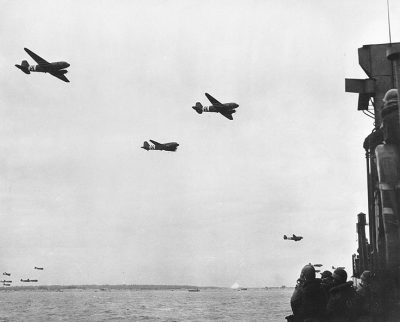
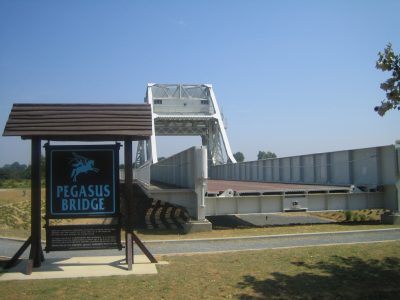
The first troops to land came by glider. Three of them put down beside the Caen canal at sixteen minutes past midnight, and the bridge now called Pegasus Bridge was taken in about ten minutes. The house at the far end, Café Gondrée, is reputed to be the first building in France liberated, and Ranville beyond it is usually called the first village freed. By dawn the British 6th Airborne held the crossings over the Orne, and a battalion that had lost most of its equipment on the drop had silenced the Merville battery casemates with a fraction of the men it planned to use.
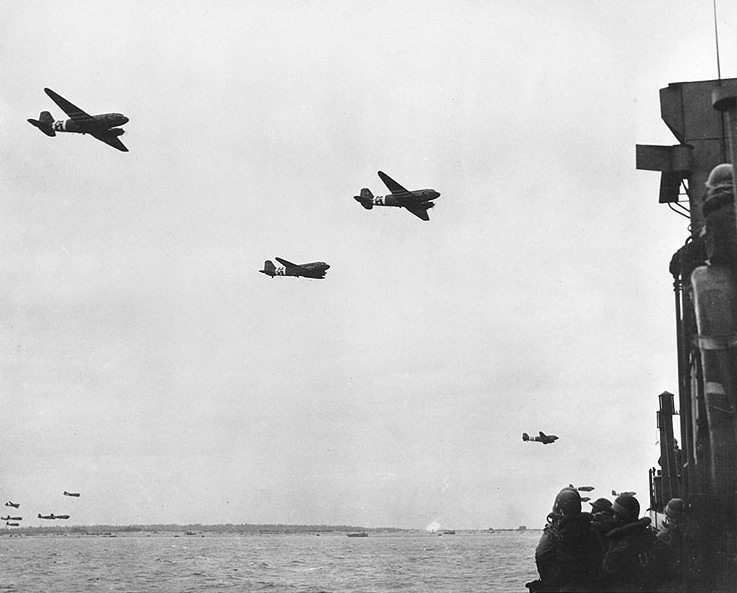
At the western end, the American 82nd and 101st Airborne came down across the Cotentin in the dark, into hedgerows and ground the Germans had deliberately flooded. Few units landed where they were meant to, some men drowned in the marshes under the weight of their equipment, and by dawn the two divisions were mixed together across the peninsula. That wrecked the drop plan and confused the defence just as badly: the Germans never worked out how big the landing was.
Sainte-Mère-Église was in American hands before the seaborne landings began, the first town in France to be liberated. The causeway at La Fière took three days of fighting to hold. A handful of men from the 101st knocked out a German artillery position at Brécourt Manor that was firing onto Utah, and two medics turned the church at Angoville-au-Plain into an aid post for both sides, where the pews are still stained.
Further south at Graignes, a battalion of the 507th came down nearly thirty kilometres from its drop zone, the worst mis-drop of the night. The village kept them fed and hidden for five days. When the 17th SS took the place on 11 June they shot the wounded, the surgeon and medics who stayed with them, the two priests who had sheltered them and villagers accused of helping, then burned the church and most of the houses.
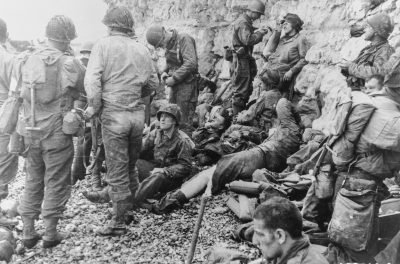
The seaborne assault began at half past six, on five beaches across eighty kilometres of coast. Utah came ashore off course and got away with it, at a cost of around 200 casualties, the lightest of the five. Omaha nearly failed: the bluffs behind the sand were undamaged by the bombardment, the swimming tanks sank, and strongpoints like Widerstandsnest 62 fired down the beach for most of the morning. Roughly 2,000 Americans were killed or wounded there. West of it, Rangers climbed the cliffs at Pointe du Hoc to find the guns gone, and then found and destroyed them in an orchard inland. The battery at Maisy was missed by the bombardment altogether and was not cleared until 9 June.
On the British and Canadian beaches the day went closer to plan. Gold opened the road to Bayeux. The first assault companies at Juno lost heavily in the opening minutes on an obstructed beach, and the Canadians still finished the day further inland than anyone else. At Sword the landing itself was quick, and then a single fortified position, the Hillman fortress above Colleville-Montgomery, held out for most of the day and took the momentum out of the drive on Caen.
Nearly 160,000 men crossed the Channel that day in more than 5,000 vessels, and by nightfall not one of the five beachheads had reached the line drawn for it. Caen, a first-day objective, would not fall for six weeks. Bayeux was taken intact on 7 June and became the Allied administrative capital, which is why it still has its cathedral and its medieval streets. The five beachheads were not one continuous front until 12 June, when Carentan fell and joined Utah to Omaha.
Supplying the beachhead
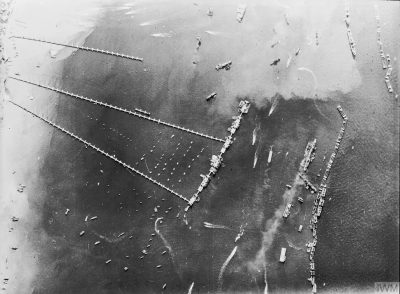
The Allies had no harbour on 6 June and no expectation of capturing one intact, and an army of that size could not be kept going for long across open beaches. So two artificial harbours were built in England and towed across in sections: Mulberry A off Omaha and Mulberry B at Arromanches.
Each was built the same way. Hollow reinforced concrete boxes as big as a block of flats, called Phoenix caissons, were towed across the Channel and sunk in an arc offshore to make a breakwater, with old merchant ships scuttled inside the line to thicken it. Behind that, floating roadways on pontoons ran to the beach from pier heads that stood on legs on the sea bed and rode up and down a six-metre tide, so a ship could unload onto a lorry at any hour.
A storm from 19 June, the worst on that coast in forty years, destroyed 21 of the 28 caissons at Omaha and the harbour there was written off. The one at Arromanches survived, was strengthened with what could be salvaged, and worked for ten months, landing close to three million men, half a million vehicles and four million tons of stores. The line of concrete boxes still sitting out in the bay at Arromanches is that breakwater.
Cherbourg, the real port and the reason the Americans landed at the base of a peninsula at all, fell on 26 June after the fortress at Fort du Roule was taken out of the rock above the town. The garrison had spent the siege demolishing the harbour so thoroughly that it did not work at full capacity until late September. Until then the campaign was supplied over open beaches and through Arromanches.
The fight for Caen
Caen was a road hub, and the open country south of it was the only ground in the sector suited to airfields and to a fast armoured advance. Both sides could read that off a map, which is why the German armour arriving in Normandy was fed in against the British and Canadians in the east while the Americans fought in the west. Historians still argue over whether Montgomery planned it that way or claimed so afterwards; either way, most of the panzer divisions in Normandy spent the summer facing Second Army.
The first attempt on Caen, in the second week of June, tried to outflank the city from the west. It ended at Villers-Bocage on 13 June, where a few Tigers wrecked the head of a British armoured column in minutes and the flanking move stopped for good. Operation Epsom followed from 26 to 30 June, west of the city, aimed at the high ground around Hill 112. The hill was taken, lost, and fought over into August. Tilly-sur-Seulles, a few kilometres away, changed hands more than twenty times.
The 12th SS Panzer Division, which held the ground north-west of Caen, murdered Canadian prisoners at Authie and at Ardenne Abbey, where the garden the executions took place in is now the memorial. The Canadians attacked the airfield at Carpiquet on 4 July, took the village, and could not clear the airfield itself until Caen fell five days later.
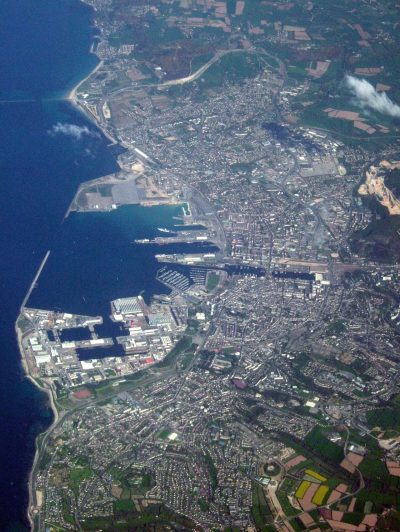
Northern Caen finally fell on 9 July, after some 450 heavy bombers hit the edge of the city the evening before. About three quarters of Caen was destroyed in the campaign, and thousands of civilians who had nowhere to go sheltered for weeks inside the Abbaye aux Hommes, which the Allies were told not to shell. Operation Goodwood, from 18 to 20 July, sent three armoured divisions south-east through Cagny toward the Bourguébus ridge; it took ground, did not take the ridge, and cost more than three hundred tanks. The city was completely in Allied hands on 21 July, six weeks late and largely rubble.
The Mémorial de Caen covers this half of the campaign better than anywhere else, and needs half a day.
The bocage and the breakout
The Americans were fighting through the bocage: banked earth topped with trees, dividing the country into small fields, each one a walled box with the defender in the far hedge and nothing visible beyond it. Tanks were blind in it, advances were measured in fields, and the infantry loss rates in June and July were among the worst American units suffered anywhere in the war.
Saint-Lô, a road junction that had to be taken before anything could move south, fell on 18 July with almost nothing left standing in it. Its nickname afterwards was the capital of ruins.
Operation Cobra opened a week later, on 25 July, with nearly 3,000 aircraft bombing a box of countryside west of Saint-Lô roughly 6,000 yards by 2,200. Some of it fell short onto American positions, twice, killing more than a hundred men including a lieutenant general. What it did to the German defenders was worse, and for the first time in seven weeks there was open road ahead. Avranches fell on 31 July, Brittany was open, and Patton's Third Army was activated on 1 August into a campaign that had suddenly become a war of movement. A British attack, Operation Bluecoat, held the German armour in the east while it happened.
Hitler's response on 7 August was to counter-attack west from Mortain to cut the corridor at Avranches. It was broken up from the air within days, and it pushed the German army in Normandy deeper into a sack whose mouth the Allies were already closing.
The Falaise pocket
Two Canadian and Polish attacks came south down the Caen to Falaise road, Operation Totalize on 8 August and Operation Tractable on 14 August. Falaise itself was taken on 17 August. By then there were two Allied armies swinging round behind the German position, one from the south and one from the north, and a gap between them near Trun and Chambois that everything still in Normandy was trying to get through.
American, French, Polish and Canadian units met at Chambois on 19 August. The Polish 1st Armoured Division held Hill 262 above Montormel across the last escape road, cut off for two days and shelled from both sides, and the ridge is still called the Maczuga after the club-shaped position they held. The gap was shut on 21 August.
Roughly 50,000 Germans were taken prisoner inside the pocket and thousands more killed, in ground so choked with wrecked transport and dead horses that Eisenhower wrote afterwards it was literally possible to walk for hundreds of yards stepping on nothing but dead and decaying flesh. Somewhere between 20,000 and 50,000 got out eastwards, mostly without their equipment. Paris was liberated on 25 August, and the last German units crossed the Seine on 30 August, which is where Overlord is usually said to end.
What it cost
Allied casualties in Normandy came to around 210,000, of whom some 37,000 ground troops were killed, alongside close to 17,000 Allied airmen lost over the campaign. German losses were heavier: more than 200,000 killed or wounded, and roughly the same number taken prisoner. Between 13,600 and 19,900 French civilians were killed during the invasion itself, and counting the bombing campaign that preceded it the figure for 1944 in Normandy runs from 25,000 to nearly 40,000. Normandy was liberated and largely wrecked in the process, and Caen, Saint-Lô, Falaise and Villers-Bocage were rebuilt from very little.
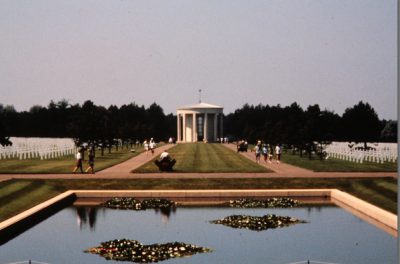
Ten war cemeteries lie across the sector. The Normandy American Cemetery holds nearly 9,400 graves on the bluff above Omaha. Bayeux War Cemetery is the largest Commonwealth burial ground in France, Bény-sur-Mer is Canadian and the ages on the stones are what visitors remember, and La Cambe holds more than 21,000 German dead under flat dark markers. The British Normandy Memorial above Gold names 22,442 people who died under British command in the campaign, cut into stone columns in a field above the beach.
Where to see it
The standard Normandy visit runs west to east along the coast, Utah to Sword, about eighty kilometres of driving. It is a good day, and it covers the first sixteen hours of the campaign.
A second day inland covers the rest. The Mémorial de Caen in the morning sets the whole war around the campaign. Hill 112 afterwards takes twenty minutes and shows you the kind of ground six weeks of fighting was actually spent on: a rise in a field, with a view worth holding. If you can face the drive east, the Montormel Memorial looks straight down into the valley where the campaign ended, with the last escape road below it. Few visitors get this far.
The whole campaign is on the interactive map, coast and inland together. Filter by sector to follow it west to east, or by category to see how the batteries, the airborne ground and the cemeteries fall across the same eighty kilometres.