Sainte-Mère-Église
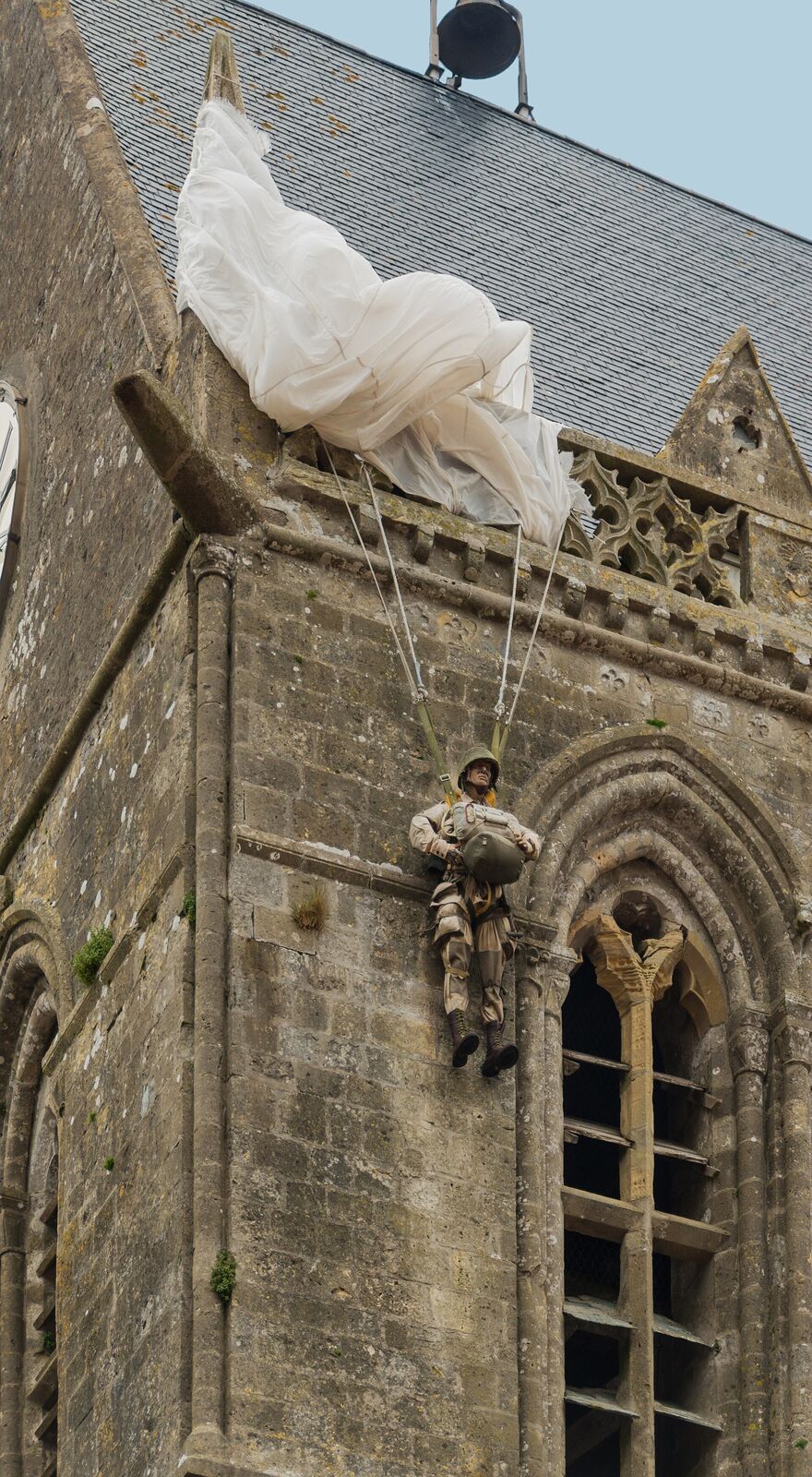
One of the first French towns liberated, in the early hours of 6 June 1944 by American paratroopers of the 82nd and 101st Airborne. Paratrooper John Steele's parachute snagged on the church tower - an episode immortalised in the film The Longest Day and recalled by an effigy still hanging there today.
Most visitors arrive knowing the parachute-on-the-steeple story before they know anything else about this small market town at the base of the Cotentin peninsula. That single image has almost eclipsed a harder, more chaotic night - and a village that spent 6 June 1944 caught between a burning building, descending paratroopers, and a German garrison it had lived alongside for four years. It repays slowing down and looking past the effigy on the tower.
What happened here
In the early hours of 6 June, transport aircraft carrying men of the U.S. 82nd and 101st Airborne Divisions crossed the Cotentin under anti-aircraft fire and scattered their sticks across the fields and marshes around the town. Sainte-Mère-Église sat astride the road the Germans needed to reinforce Utah Beach, which made it a priority objective.
The drop went badly wrong here. A building near the square was already ablaze, and townspeople had been roused to fight the fire under the eyes of their German guards. The flames turned the sky above the square into a lit stage. Paratroopers who drifted into that light were dangerously exposed; some came down into the fire itself, and others were shot as they hung helpless from trees and telegraph poles. It was into this chaos that Private John Steele of the 505th Parachute Infantry Regiment fell, his canopy snagging on a pinnacle of the church tower. He hung against the stonework for roughly two hours, playing dead, wounded in the foot, before he was cut down and taken prisoner. He escaped soon afterwards and rejoined his division.
By around five that morning, a force under Lieutenant Colonel Edward Krause had taken the town against light initial resistance, and the American flag went up over the square. The fight was far from over: German counterattacks pressed the paratroopers hard through the day, and the position was only secured when armour pushed inland from Utah Beach the following day. Sainte-Mère-Église became widely described as one of the first French towns liberated.
The church and the effigy
The parish church, Notre-Dame-de-l'Assomption, dominates the square. The dummy paratrooper you see suspended from the tower is deliberately hung on the side most visible from the square rather than the exact spot where Steele came down - a piece of stagecraft, but a forgivable one.
Step inside for the detail most people miss. Two modern stained-glass windows commemorate the airborne. The earlier one shows the Virgin and Child above the burning town, ringed by parachutes and aircraft; it was designed by a local man who had been a teenager during the landings and executed by the celebrated Chartres glass workshop of Gabriel Loire. A second window, installed for the 25th anniversary, honours Saint Michael, patron saint of paratroopers, and carries the insignia of the 82nd Airborne.
Practical notes
The square is now Place du 6 Juin 1944, and it is the natural starting point. Look on the pavement for the Borne 0 - Kilometre Zero of the Voie de la Liberté, the "Liberty Road" whose milestones trace the Allied advance all the way to Bastogne. A signed heritage trail of information panels loops around the town, marking the church tower, the site of the fire, and the location of a temporary wartime cemetery.
The town sits just off the main road running up the Cotentin and is signed from every approach; traffic funnels naturally toward the church. Leave the car in one of the free car parks a short walk off the square rather than on the square itself, which fills quickly, and everything described here is then within a few minutes on foot.
Directly across from the church stands the Airborne Museum, built as a cluster of pavilions - one sheltering a Waco glider, another a genuine Douglas C-47 Skytrain of the type that carried the paratroopers, alongside weapons, kit and personal effects. Afterwards, the Auberge John Steele on the square keeps his memory in photographs and letters on its walls.
Allow an hour for the square, the church and the heritage trail, and most of a day if you take the museum properly. The square and the streets around it are paved and level, so a wheelchair or a pushchair manages the walk without difficulty; the church has a shallow step at the door, and the two airborne windows are best read from the nave. The square, the church and the trail panels are open access and free, while the museum opposite is ticketed. The town is busiest and most moving around the anniversary each June, when veterans' descendants and re-enactors fill the streets.
If you have the afternoon, the causeway at La Fière is a couple of minutes west and shows the other half of the 82nd Airborne's fight over ground that has barely changed. Sainte-Marie-du-Mont makes the obvious next stop if you are working your way toward the coast.