Airborne Museum
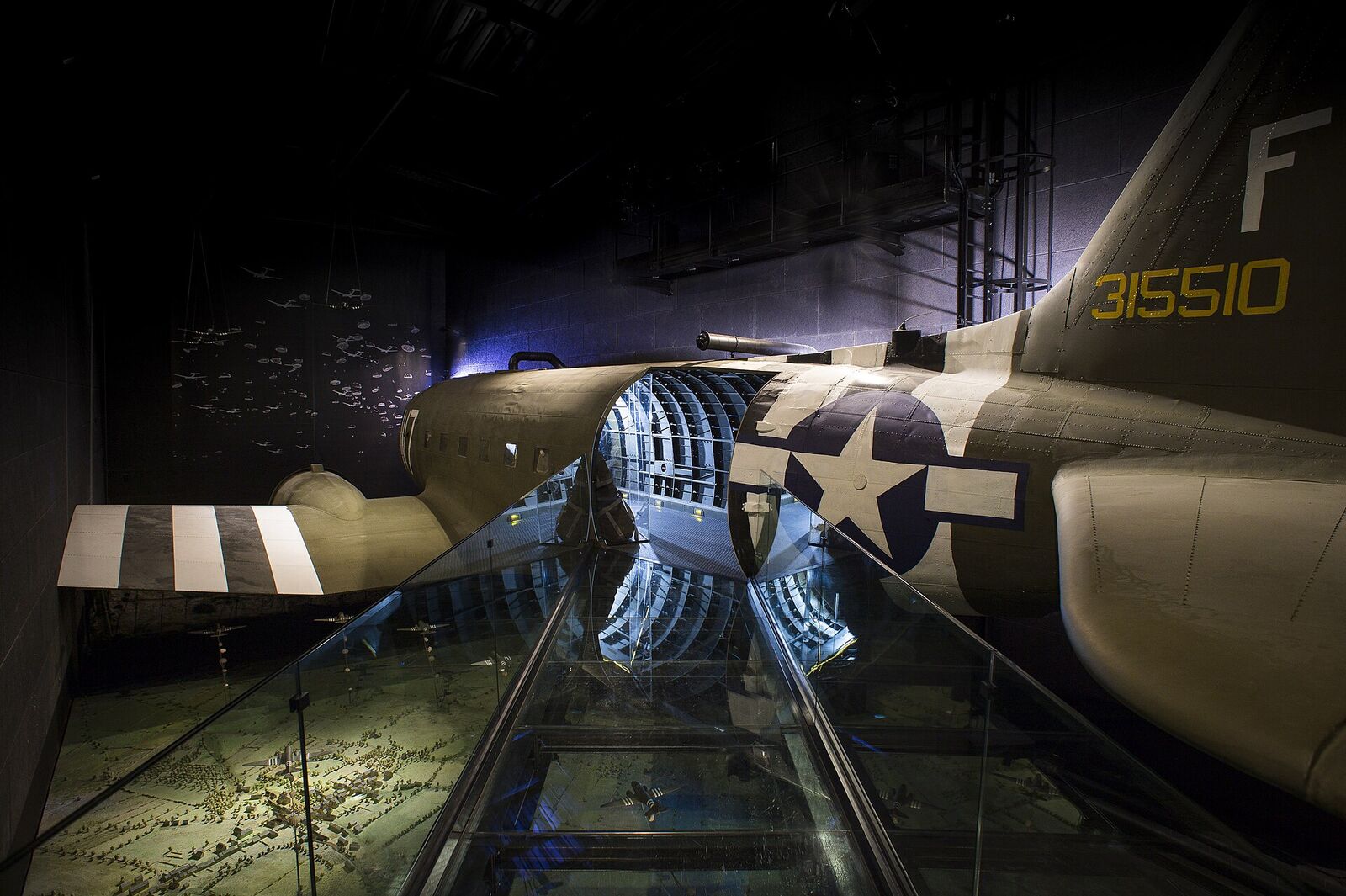
A major museum on the square at Sainte-Mère-Église devoted to the US 82nd and 101st Airborne Divisions. Its pavilions house an original C-47 transport and a Waco glider, alongside immersive recreations of the chaotic night drops of 6 June 1944.
Stand in the square at Sainte-Mère-Église and you are standing at the hinge of the American airborne assault. This was the first French town liberated on D-Day, taken in the small hours by paratroopers of the 82nd Airborne who came down among burning houses and church bells. The Airborne Museum grew directly out of that night, and unlike many collections assembled decades later, it sits on the very ground where the story happened.
What happened here
In the hours before the seaborne landings, thousands of American paratroopers and glider troops of the 82nd and 101st Airborne Divisions dropped inland to seize causeways, crossroads and bridges behind Utah Beach, among them the Merderet crossings at La Fière and Chef-du-Pont. The drop was chaotic: transport aircraft scattered by flak and cloud spilled men far from their zones, and around Sainte-Mère-Église some descended straight into a town already awake and lit by a house fire on the square. In the confusion several paratroopers were killed as they hung in the air. One, Private John Steele of the 505th Parachute Infantry Regiment, snagged his canopy on the church tower and hung there feigning death for hours before being taken prisoner and later escaping. His story, dramatised in the film The Longest Day, made the town famous.
The museum itself is built on the plot of a house that burned that night, the same fire that drew paratroopers and German defenders into a firefight on the square. It opened in 1964, on the twentieth anniversary of the landings, driven by the town's wartime mayor and pharmacist, Alexandre Renaud, who had lived through the occupation and later wrote about it, and by American veterans who returned to help.
What to see today
The museum has grown into a park of five pavilions, and part of its appeal is architectural: the two oldest buildings are low domes shaped like open parachute canopies, a detail worth pausing over before you go in. Each pavilion has a distinct job.
The centrepiece of one dome is a genuine Douglas C-47 Skytrain, the workhorse that carried the paratroopers, displayed among suspended figures and open canopies so you grasp how cramped and precarious the jump really was. The newest pavilion, opened in 2024 and devoted entirely to glider troops, houses a Waco CG-4A assault glider - a fragile lattice of steel tube and doped fabric, and reportedly the only surviving example in France. It repays close inspection: these unpowered craft landed men and jeeps into hedgerow fields at speed, and their flimsiness tells you a great deal about the courage of the men aboard.
The Operation Neptune pavilion trades artefacts for immersion, walking you from a darkened English airfield through the flight and into the fighting in the marshes and hedgerows, and it displays a small Piper Cub observation aircraft. A further building serves as cinema and temporary exhibition space, while the renovated original pavilion now tells the quieter story of the four years of German occupation and local resistance that preceded liberation. Across the collection are thousands of objects, including equipment associated with senior airborne commanders such as Ridgway and Gavin.
Before or after your visit, walk the few steps to the church on the square. A parachute and a dummy paratrooper hang permanently from the steeple, marking Steele's ordeal, and the stained-glass windows inside honour the airborne troops. The square itself, Place du 6 Juin, and the milestone marking the start of the Liberty Road nearby, put the museum in its landscape - this was a crossroads worth dying for, which is precisely why it was taken first.
Practical notes
The museum stands on the square in the middle of the town, signposted from the N13 between Carentan and Cherbourg; leave the dual carriageway at the Sainte-Mère-Église exit and the centre is a few hundred metres on. There is parking around the town, though the streets nearest the square fill quickly in summer and on anniversary weekends, so be ready to walk a couple of blocks. Admission is ticketed.
Allow around two hours, and longer with children, who tend to stall in front of the aircraft. The pavilions sit in a landscaped park joined by surfaced paths and the galleries are on the level, so the visit manages well with a wheelchair or a pushchair; parts of the Operation Neptune building are deliberately dark and enclosed, which is worth knowing in advance. The square and the church outside are flat and paved.
The obvious pairings are close at hand. Angoville-au-Plain Church, where two American medics treated the wounded of both sides in the pews, is a few minutes south, and Azeville Battery lies a similar distance north-east if you want the German side of the same few days.