Angoville-au-Plain Church
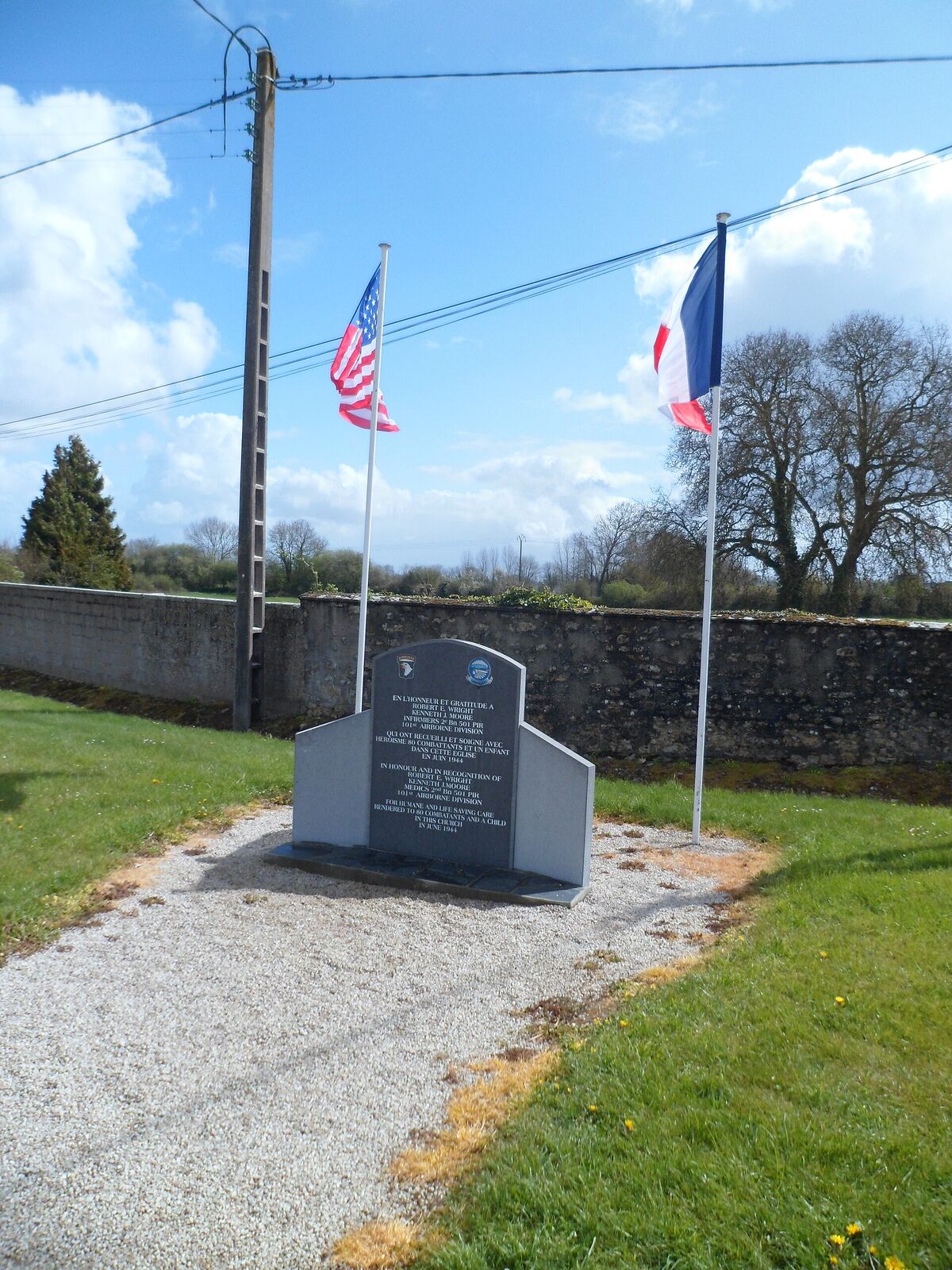
In this tiny Romanesque church two American medics, Robert Wright and Kenneth Moore, treated dozens of wounded from both sides as the battle raged around them, refusing to turn anyone away. Bloodstains remain on the pews and modern stained glass commemorates their humanity.
Most visitors racing between Utah Beach and Carentan drive straight past Angoville-au-Plain without slowing down. That is a mistake. This hamlet is barely more than a crossroads, a farm or two, and a squat Romanesque church dedicated to Saints Cosmas and Damian - fittingly, the patron saints of physicians. Inside those thick stone walls unfolded one of the most humane episodes of the entire Normandy campaign, and the evidence is still there in the wood you can reach out and touch.
Two medics, seventy-two hours
On the morning of 6 June 1944, two young medics of the 2nd Battalion, 501st Parachute Infantry Regiment - Robert Wright of Columbus, Ohio, and Kenneth Moore of Los Angeles - found themselves in the church as fighting closed in around the village. They turned it into an aid station, hung out a Red Cross flag, and laid the wounded on the pews and the stone floor. Their one rule was absolute: no weapons inside. Over roughly seventy-two hours they treated some eighty casualties - Americans, Germans, and at least one local child - refusing to distinguish between friend and enemy.
What makes the story extraordinary is that the village changed hands more than once, and the two medics simply kept working through it. When American paratroopers pulled back and the Germans moved in, Wright and Moore stayed with their wounded. The account most often repeated has a German soldier shouldering through the door with a machine gun, seeing his own countrymen being treated alongside Americans, and lowering the weapon. From then on both sides respected the church's neutrality; Germans even brought their own wounded to the door. At one point a mortar round is said to have punched through the roof and struck the floor among the wounded without exploding - the cracked flagstone is part of local memory here. Both men were later awarded the Silver Star. Their conduct is the kind of thing that sounds embellished until you stand in the small, plain space and realize how little room there was to hide from any of it.
What to see today
The church is tiny, and its power comes precisely from how ordinary it looks. Go straight to the wooden pews: the dark stains soaked into the grain are the blood of the men treated here, deliberately left uncleaned as a memorial. It is a genuinely sobering thing to see up close, and it asks for the quiet respect you would give a grave - this is still a working parish church.
Look up to the stained-glass windows, installed in 2004 for the sixtieth anniversary of D-Day. They are modern and unmistakably about this place rather than generic piety: one honours Wright and Moore and their medical work; the other, set with a descending parachutist and the screaming eagle of the 101st Airborne, honours the paratroopers who fought for the village. You will also find commemorative plaques recording the events of June 1944 and the eighty combatants and the child cared for here.
Step back outside and take in the setting. The flat, hedge-lined fields around you are the bocage the airborne divisions dropped into in the dark, scattered and disoriented, in the hours before the seaborne landings. Angoville-au-Plain sits inland from Utah Beach, just north of Saint-Côme-du-Mont and the approaches to Carentan, on ground the 101st fought hard to secure.
Practical notes
The hamlet is reached by narrow lanes off the D913 between Sainte-Marie-du-Mont and Carentan, and it is small enough to miss if you are not watching for the sign. There is no ticket office, no museum and usually no crowd; parking is on the gravel and grass beside the churchyard, which takes a handful of cars and no more. The church is generally open to visitors during daylight hours, and there is no charge, but it remains a consecrated parish church, so keep voices low and photography discreet.
Fifteen or twenty unhurried minutes is enough, longer if you sit for a while. The ground is level all round: a short path from the parking area to the door, grass and gravel underfoot, and a plain flagged floor inside, so a wheelchair or pushchair manages it apart from the low step at the doorway. The interior is dim, and the pews are best read close up.
It fits neatly into any Utah Beach itinerary. Saint-Côme-du-Mont and its Dead Man's Corner museum are minutes down the road, and Sainte-Marie-du-Mont, with its own church tower and village square, makes the natural next stop heading back toward the coast.