Azeville Battery
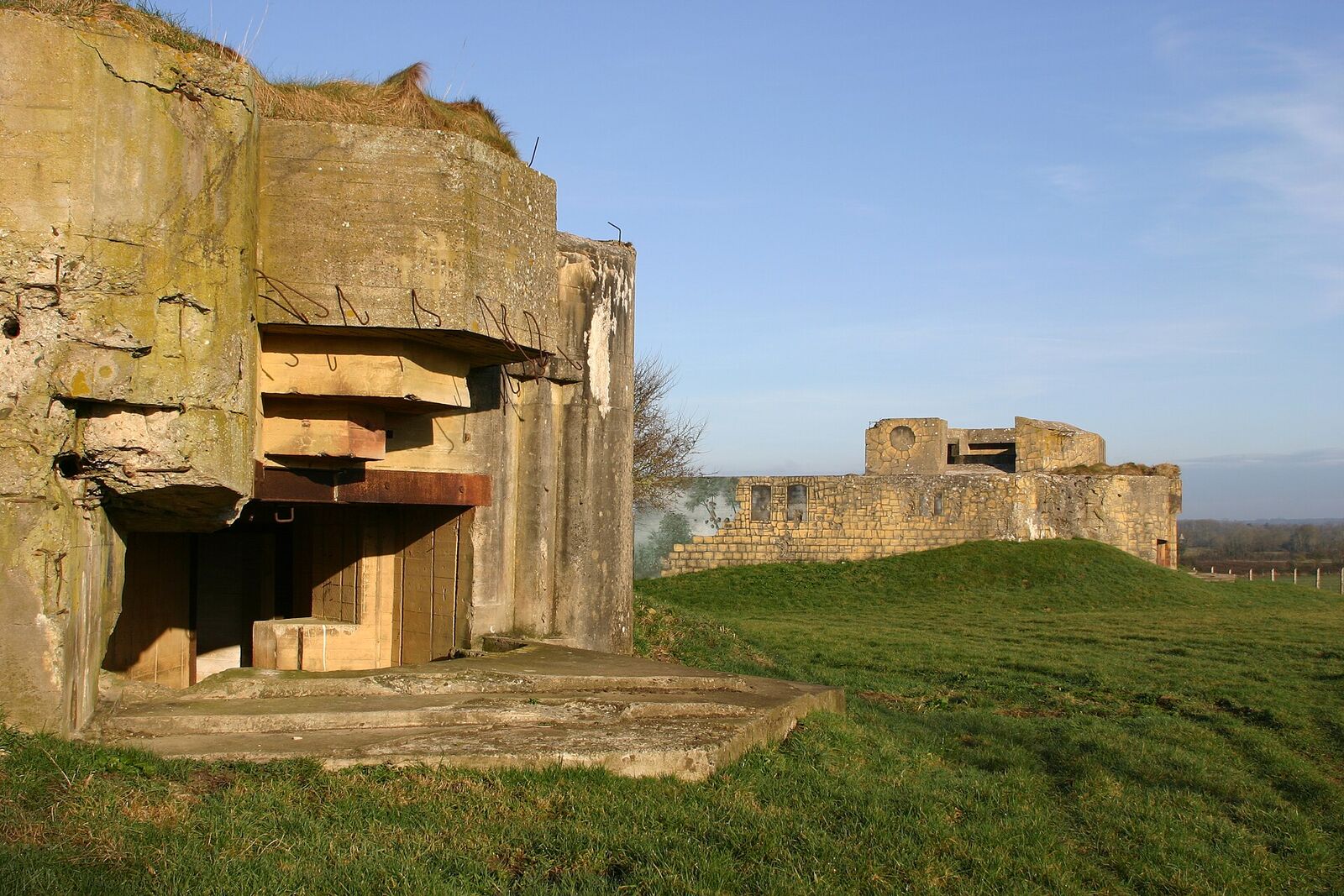
A German coastal battery of four 105 mm guns set in camouflaged casemates, linked by 350 metres of underground tunnels. It duelled with the invasion fleet off Utah Beach before falling to American troops on 9 June 1944. The bunkers, painted to resemble houses, are open to visitors.
Set among hedgerows a few kilometres inland from the coast, Azeville is one of the most complete German artillery positions still standing in the Cotentin. It was built to be unseen: no gun here ever pointed at the sea, and from the fields around it the site reads as farmland. That concealment, and the tangle of tunnels beneath it, are what make a visit here different from the more famous clifftop batteries.
Why it was built here
Azeville belonged to the Atlantic Wall, the belt of fortifications Germany strung along the coast of occupied Europe. Work began in 1941, when four elderly French 105 mm Schneider guns were installed in open pits. Between 1943 and 1944 the Todt Organisation encased them in four heavy concrete casemates, roughly forty metres apart and linked to ammunition stores, shelters and machine-gun posts by several hundred metres of underground galleries. Sited well back from the beaches, the guns could reach the shoreline near what the Allies would code-name Utah, while the battery itself stayed invisible to ships offshore.
The garrison of around 170 men was commanded by Hauptmann Hugo Treiber, in a village whose peacetime population was little more than a hundred. To hide the casemates from the air, their outer walls were painted in trompe-l'œil to look like ordinary Norman houses, complete with fake windows, doorways and a false balcony. Allied aerial photographs saw through the trick, but it remains one of the most striking survivals on the whole Wall.
Three and a half days of fighting
From the morning of 6 June, Azeville and its neighbour at Crisbecq shelled the American landings and the ground behind Utah Beach, helping to slow the push inland. The battery held out for three and a half days against infantry, tanks, artillery and naval gunfire. A shell from an American warship offshore punched into one casemate and killed around fifteen men sheltering inside.
The end came on 9 June, when the 22nd Infantry Regiment of the US 4th Infantry Division attacked after a heavy bombardment. The decisive moment belonged to a single soldier, Private Ralph Riley, sent forward with a flamethrower. He crossed open ground under fire, and when the weapon failed to light he improvised, igniting it by hand with a cigarette lighter and playing the flame against a casemate door. Ammunition inside began to explode, and shortly afterwards the garrison raised a white flag and surrendered. Around 169 men were taken prisoner.
What to see today
The battery is preserved almost intact and explored with an audioguide that follows the German soldiers' own routine. You walk down into the tunnel system - several hundred metres of it are open - passing the cramped dormitories, ventilation gear, ammunition rooms and firing chambers, emerging at the great casemates themselves.
Look closely at the concrete as you approach. On the northern casemates you can still make out the painted brickwork, window frames and shutters of the fake houses; the southern ones were instead hidden under banks of earth. Inside one casemate is the object that ends the story: the huge naval shell that pierced the position in 1944, recovered when the site was prepared for visitors in the 1990s and displayed where it struck.
Take a moment above ground too. The fields around the bunkers still carry the shallow scars of the trench lines that once connected them, and from here you get a sense of how ordinary this landscape looks - exactly the point of the place. Azeville pairs naturally with the neighbouring Crisbecq battery a short drive away, and the two together tell the story of the guns that contested Utah Beach.
Practical notes
Azeville is reached by narrow lanes off the main roads through the eastern Cotentin, signed once you are close, though the last stretch is single-track with passing places. There is a free car park at the reception building, which is where the visit starts and where the audioguide is issued; the site is ticketed. Allow an hour and a half, which covers the tunnels, the four casemates and the walk around the field above them.
Underfoot the galleries are the limiting factor. You go down by steps into narrow concrete corridors with low headroom, raised thresholds and floors that stay damp year round, so the tunnel route does not suit a wheelchair and is awkward with a pushchair. The surface path between the casemates is grass and gravel and much easier going, and the fake-house paintwork can be seen without going underground at all. Take a jacket even in warm weather, because the tunnels hold the cold, and wear shoes you do not mind muddying.
Crisbecq is barely ten minutes up the road and the two batteries are best done in the same morning. Afterwards Sainte-Mère-Église lies a short drive south and Montebourg about the same distance north.