Crisbecq Battery
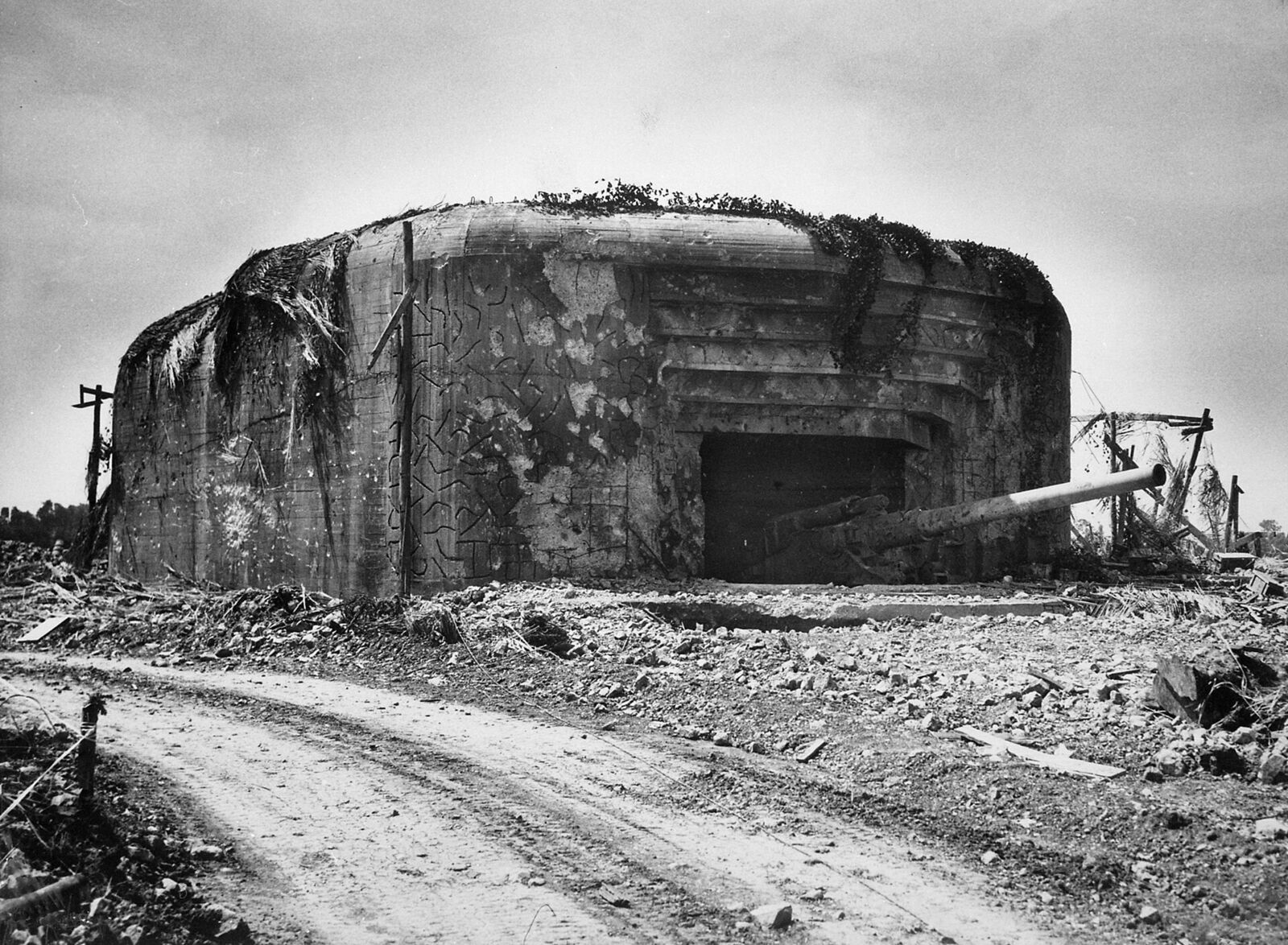
Armed with long-range 210 mm naval guns, this powerful battery overlooking Utah Beach sank the destroyer USS Corry on D-Day and held out against repeated assaults until 12 June. Its massive casemates and a reconstructed garrison make it one of the most complete Atlantic Wall sites in the Cotentin.
Set back roughly three kilometres from the sea on the rising ground behind Utah Beach, Crisbecq was the most powerful German battery on the eastern Cotentin - and among the most stubborn. From here the guns could reach almost the entire invasion coast, from Saint-Vaast-la-Hougue in the north to the cliffs of Pointe du Hoc. What survives today is not a single ruin but a whole fortified settlement, dug in, tunnelled, and slowly restored by hand.
The guns and the men
The battery was laid out by the Organisation Todt from 1941, built with forced labour drawn from occupied Europe, and armed with three Czech-made 21 cm Škoda guns. Two sat inside colossal casemates with concrete walls several metres thick; a third stood in the open. Their range - better than thirty kilometres - is the whole point of the place: Crisbecq was never meant to fight the men on the sand, but the ships offshore.
The garrison numbered around 400, a mix of Kriegsmarine gun crews and army infantry from a grenadier regiment providing close defence. In command was a naval officer, Oberleutnant zur See Walter Ohmsen. It was his lookouts who, in the grey light before dawn on 6 June 1944, saw the invasion fleet materialise out of the Channel - and Crisbecq that opened fire, among the first shots against the Allied armada.
What happened here
The battery duelled directly with the American warships covering Utah, among them the battleships Nevada, Texas and Arkansas. Around half past six that morning the destroyer USS Corry went down - the only US destroyer lost on D-Day. Whether she was killed by a mine or by Crisbecq's shells has been argued ever since; the US Navy recorded a mine, but Corry's own captain and Ohmsen both believed the battery had done it. The truth is probably tangled up in both.
Naval gunfire smashed one casemate and knocked out the exposed gun, but the position held. From 7 June the infantry came for it, attacking uphill against wire, trenches and interlocking fire, and taking heavy losses. At one desperate moment, with American troops inside the perimeter, Ohmsen radioed the neighbouring Azeville battery and called artillery fire down onto his own position, driving the attackers back out. Crisbecq fought on, encircled and running dry, until around 11-12 June, when the last ammunition was gone and the guns wrecked. Ohmsen slipped out by night with a few dozen survivors, leaving his wounded and a number of American prisoners behind, and reached German lines. He was given the Knight's Cross days later.
Practical notes
The battery lay abandoned for decades until private owners bought it in 2004 and began clearing and restoring the bunkers; it is now a well-kept open-air museum, with a numbered route of roughly twenty stops threading through about a kilometre of trenches and tunnels.
Take the time to go underground. The rooms have been re-equipped as they would have been in 1944 - the infirmary, the kitchen, the ammunition stores, the cramped sleeping quarters - with period fittings and uniformed figures that make the scale of the place register. Look for the six-room anti-aircraft command post, the small Tobruk emplacements built for a single machine-gunner, and above all the two great gun casemates: stand beside the raw, blast-torn concrete of the one broken open by naval fire and the story of that morning becomes physical. From the top of the works, orient yourself seaward and you understand instantly why the Germans chose this hill, and why it took the better part of a week to take it.
The battery stands above the hamlet of Crisbecq in the commune of Saint-Marcouf, and the lanes to it are narrow and deeply hedged; follow the brown signs rather than the map once you leave the main road. There is a gravel car park at the entrance and the visit is ticketed. Allow at least an hour and a half, because the numbered route is longer than it looks on the plan and the underground rooms are the part people wish they had given more time to.
This is an outdoor site on rough ground, and it shows. The circuit runs on grass, gravel and bare earth, with trench sections that dip and climb, steps in and out of the bunkers and low doorways to duck through. It is not a route for a wheelchair, and a pushchair would be more trouble than it is worth. Wear boots after rain, and expect wind on the exposed top of the works even on a still day inland.
Pair it with the sister battery at Azeville ten minutes away, which was fought over in the same days and is gentler underfoot. Sainte-Mère-Église and Montebourg are both within a quarter of an hour if you want a village and a meal afterwards.