Merville Gun Battery
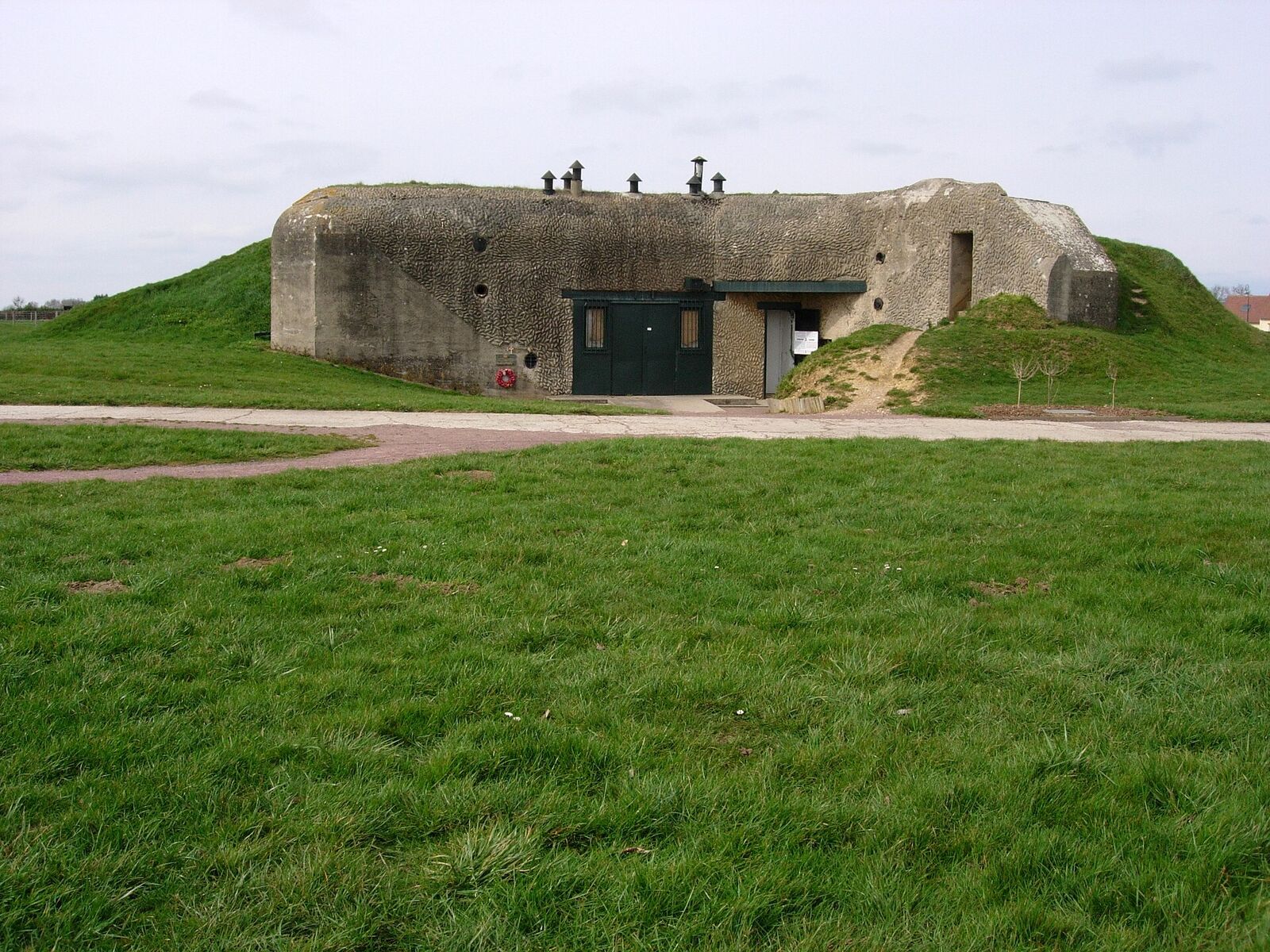
A casemated German battery thought to threaten Sword Beach, stormed in darkness on D-Day by a depleted British 9th Parachute Battalion under Lieutenant-Colonel Otway in a celebrated feat of arms. The bunkers now house a museum, complete with a Douglas C-47 Dakota.
Of all the objectives handed to the British 6th Airborne Division in the darkness before the seaborne landings, few were as feared as this one. Allied planners believed the four concrete casemates here held heavy guns capable of raking Sword Beach as the first men waded ashore. Silencing Merville before dawn was judged so vital that the task was rehearsed for weeks on a full-scale replica built in the English countryside. What unfolded on the night became one of the most celebrated small-unit actions of the entire campaign - and one of the most nearly disastrous.
The battle in the dark
The plan was elaborate: roughly 600 paratroopers and sappers of the 9th Parachute Battalion, under Lieutenant-Colonel Terence Otway, would land, breach the wire and minefield, and storm the position, while a handful of gliders crash-landed directly onto the guns in a coup de main. Almost nothing went as intended. Anti-aircraft fire and cloud scattered the drop across miles of unfamiliar countryside; much of the heavy equipment - mortars, mine detectors, the anti-tank gun, the medical section - vanished into the marshes. By the assembly point Otway had gathered only around 150 men, twenty Bangalore torpedoes and a single machine gun. The gliders meant to land on the battery missed it entirely.
With a naval bombardment from HMS Arethusa scheduled to fall on the position at a fixed hour, Otway could not wait. A reconnaissance party had already cut gaps in the wire and taped routes through the minefield by hand. The paratroopers blew the perimeter, charged across open ground swept by fire, and fought through the trenches in vicious close-quarters combat. Lacking demolition gear, the men improvised, destroying the guns with Gammon bombs and, in one case, by firing two shells through a barrel at once. The armament proved to be older, lighter Czech-made 100mm howitzers rather than the heavy coastal guns intelligence had feared - but the paras could not have known that going in.
To call off the naval guns, the signals officer released a carrier pigeon he had carried inside his battledress; it reached England with word of the victory. Of the 150 who attacked, only around 80 were still standing afterwards. The battalion, too weak to hold the ground, pressed on to its next task, and the Germans later reoccupied parts of the wrecked position.
What to see today
The battery survives largely intact, its four camouflaged casemates squatting low in the grass exactly where they stood in 1944. Casemate 1, a massive H611 type, is the heart of the museum: inside sits a 100mm howitzer identical to the originals, and every twenty minutes a sound-and-light presentation plunges the darkened bunker into the noise, flashes and smell of the night assault. Walk the linking trenches and open emplacements to grasp how compact and how heavily protected the objective really was - six-foot concrete walls, and the minefield and wire the paratroopers had to cross on foot.
Outside stands the museum's Douglas C-47 Dakota, "SNAFU Special," a genuine D-Day transport aircraft you can step inside to sense the cramped final minutes before a jump. Look for the bust of Colonel Otway, the memorial to the 9th Parachute Battalion, and - easy to miss but worth seeking out - the small monument to the carrier pigeons, a nod to the bird that carried the news home.
Allow two to three hours. The battery sits behind the coast at Merville-Franceville, at the eastern end of the Sword Beach sector and only a short drive from Pegasus Bridge, with which it pairs naturally into a day tracing the airborne battle for the invasion's left flank.
Practical notes
The site is signposted from the centre of Merville-Franceville-Plage, set back behind the dunes on the landward side of the village, and it has its own car park at the gate. Coming from the west you cross the Orne at Ouistreham and follow the coast road round the estuary, which is slower than the distance suggests in summer traffic. It is a ticketed museum rather than an open field, with a shop and toilets at the entrance.
The two to three hours above are best spent unhurried, and it is worth checking the presentation cycle when you arrive: if Casemate 1 is mid-show, walk the outer emplacements and the Dakota first and come back to it.
Underfoot the battery is grass and gravel paths between the bunkers, broadly level but rutted in places and heavy after rain. The open ground, the aircraft and the approaches to the casemates are manageable with a wheelchair or a pushchair, but the bunker interiors have thresholds, dark low-ceilinged rooms and some steps, and the linking trenches are narrow. Afterwards, Ranville War Cemetery is a few minutes away and holds many of the 6th Airborne dead, while Ouistreham makes the obvious stop for lunch on the way back along the coast.