Pegasus Bridge
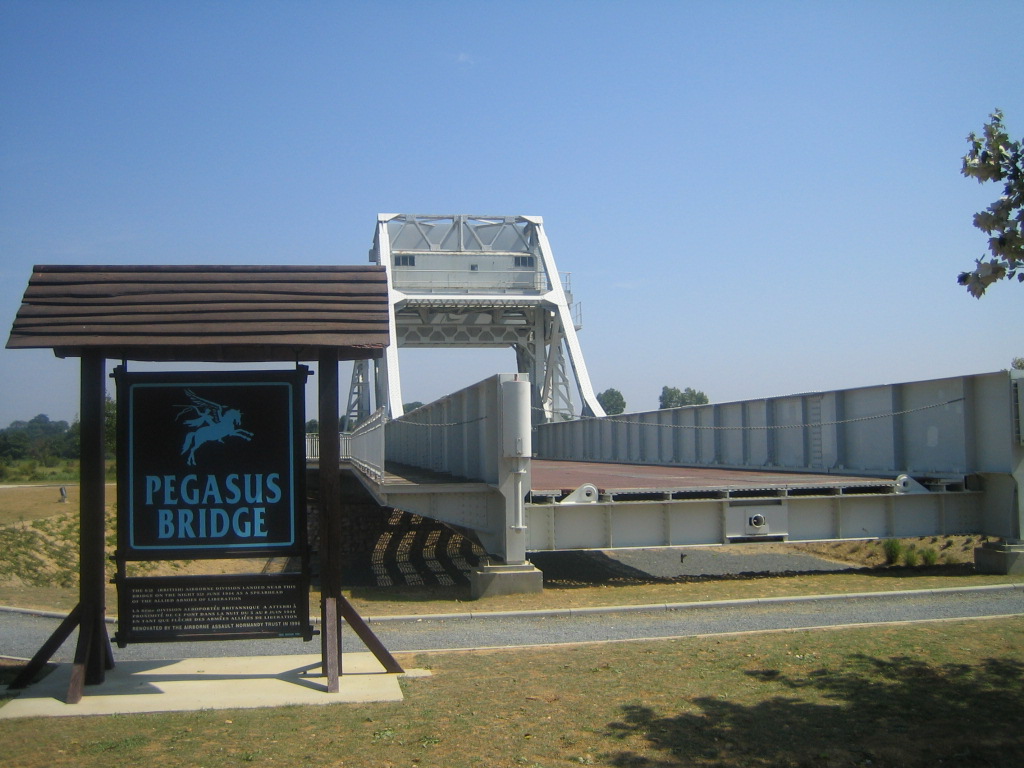
In the first action of D-Day, British glider-borne troops of the 6th Airborne Division seized this bridge over the Caen Canal in a daring coup-de-main shortly after midnight on 6 June 1944, securing the eastern flank of the invasion. The original bridge now stands at the adjacent Mémorial Pegasus museum.
Pilots flying at night, in gliders with no engines, were asked to land three flimsy plywood aircraft in a field the size of a couple of tennis courts, right beside their target, having cast off from their tugs miles away. That they did it - the first glider stopping barely fifty yards from the bridge, its nose crumpled into the wire - is why this quiet crossing over the Caen Canal became one of the most studied feats of arms of the whole invasion.
What happened here
The raiding party was drawn largely from D Company of the Oxfordshire and Buckinghamshire Light Infantry, reinforced by Royal Engineers and flown by the Glider Pilot Regiment - roughly 180 men in six Horsa gliders, towed across the Channel from Dorset and released to glide silently down onto their objectives. Their task was to seize two bridges intact: this one over the canal at Bénouville, and a second a few hundred yards east over the River Orne, before the Germans could destroy them and seal off the invasion's eastern flank.
Three gliders came down by the canal bridge. The men were out and storming the span within moments, and the fighting for it lasted only minutes. It was here that the platoon commander leading the charge across the bridge was cut down - remembered as the first Allied soldier to be killed by enemy fire on D-Day. One of the party had already died before a shot was fired, drowned in a nearby pond when his glider broke apart on landing. With both bridges taken, the codeword signalling success - "Ham and Jam" - went back over the radio, and the small force held on through the night against counter-attacks until relieved by commandos marching inland from Sword Beach.
The Café Gondrée
On the western bank, at the corner of the bridge, stands a modest café that has a fair claim to being the first house in France liberated on D-Day. It was run by Georges and Thérèse Gondrée, and it was no ordinary café: Thérèse, who understood German, had been quietly passing details of the bridge's defences to the Resistance and on to British intelligence. In the hours after the assault the house served as a first-aid post, and - according to a story the family has never discouraged - Georges dug up bottles of champagne he had hidden from the occupiers to toast the men who had freed him. It is still a café, still run by the Gondrée family, and a working memorial in its own right.
What to see today
The bridge you cross now is a slightly wider 1994 replica, built to the original's design. The real bridge - scarred, weathered, unmistakably the one in the wartime photographs - lies a short walk away in the grounds of the Mémorial Pegasus, the airborne museum on the eastern bank. It is worth going specifically to see it up close.
Before you leave the roadside, look for the markers set in the ground on the canal's eastern side: they show exactly where each of the first gliders came to rest, and pacing out the distance to the bridge is the single most eloquent thing you can do here. Nearby stands a bust of the operation's commander, and the museum park holds a full-size Horsa glider replica that lets you grasp just how cramped and fragile these aircraft were. The name itself comes from the winged-horse badge of the British airborne, formally adopted for the bridge weeks after the battle.
A few minutes away, the Commonwealth war cemetery at Ranville holds many of the 6th Airborne Division's dead, including men who fell here in the first hours. It is a fitting, quiet counterpoint to the museum, and well worth the short detour.
Practical notes
The bridge stands on the D514 between Ouistreham and Caen, at the northern edge of Bénouville, and it is signposted from every direction. There is parking on the eastern bank beside the Mémorial Pegasus and more along the road by the café on the western side; in high summer the roadside spaces fill early. The bridge, the glider markers and the memorials beside the water are open access and free. The museum is ticketed.
Allow an hour if you only want the bridge, the markers and a look at the canal, and closer to two and a half hours with the museum and its glider replica. Underfoot it is easy: level tarmac and firm gravel paths on both banks, with no climbing and no rough ground, so the whole roadside circuit suits a wheelchair or a pushchair. Only the grassy verge along the canal towpath gets soft after rain.
Nothing pairs better than the Café Gondrée on the west bank, which is a two-minute walk and still a working café rather than an exhibit. Beyond that, the war cemetery at Ranville is a few minutes east, and the Mémorial de Caen is a straightforward drive south if you want the wider campaign in one afternoon.