Café Gondrée
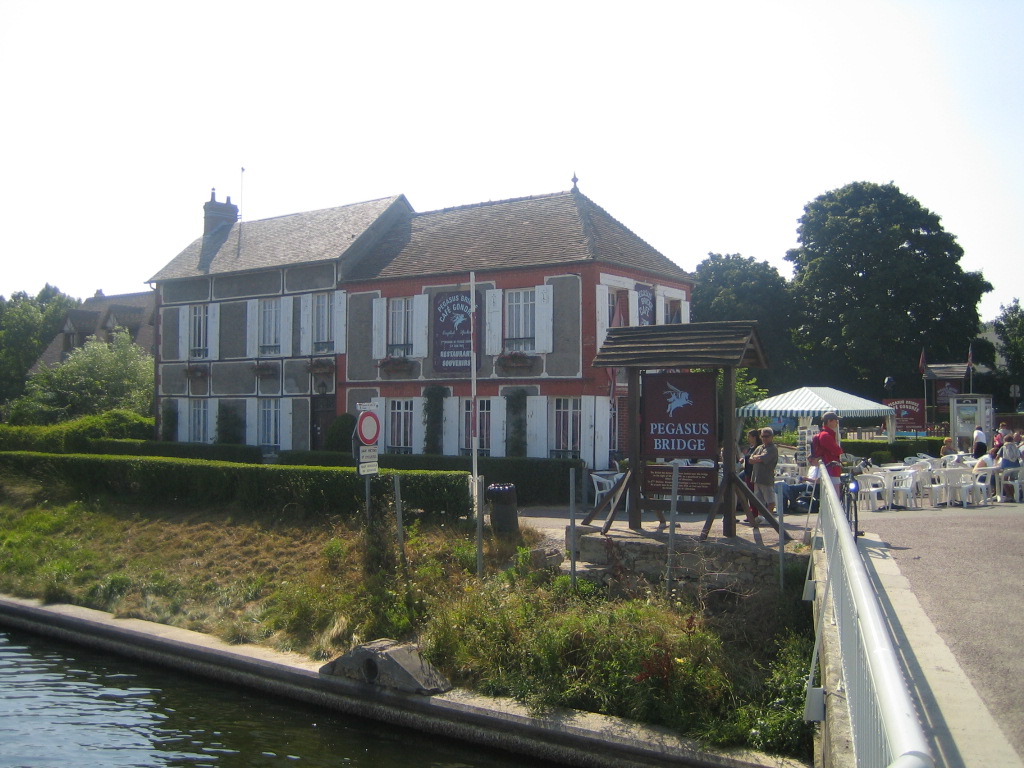
The café beside Pegasus Bridge, reputed to be the first house in France liberated on D-Day. Still run by the Gondrée family, who passed food and intelligence to the airborne troops who seized the bridge, it remains a place of pilgrimage for veterans.
A small red-brick house stands at the western end of Pegasus Bridge, its shutters painted, its terrace facing the still water of the Caen Canal. It looks like any village café, and that is precisely the point: for four years of occupation it was exactly that, an ordinary place where German soldiers stopped for a drink and talked freely, never suspecting that the woman behind the counter understood every word.
The house that watched the bridge
The café was run by Georges Gondrée, a former bank clerk who spoke fluent English, and his wife Thérèse, a trained nurse from Alsace. Thérèse's Alsatian upbringing meant she spoke German, a fact she was careful to hide from the garrison that used the bridge. While the occupiers relaxed at her tables, she listened, and what she overheard travelled back to British intelligence through the French Resistance.
The couple's reports were unusually precise. When a new anti-tank gun was installed near the bridge, Georges noted its exact position. More valuable still, Thérèse learned where the Germans had placed the firing mechanism for the charges meant to demolish the bridge, information that helped the men who came to seize it intact. The Gondrées were not soldiers, but they had quietly made themselves part of the plan.
The night of the gliders
A few minutes after midnight on 6 June 1944, in a village of Bénouville that had no idea what was coming, the family was jolted awake by an extraordinary sound: gliders scraping to a halt in the fields beside the house. This was the coup de main led by Major John Howard, roughly 180 glider-borne troops of the 6th Airborne Division sent to capture the canal and river bridges before the seaborne landings began. The pilots set their Horsa gliders down almost on top of the objective, and the canal bridge was taken in minutes.
The fighting swept right past the café's door. Georges, peering from an upstairs window, was very nearly shot by a nervous young officer who mistook his silhouette for a German. The family sheltered in the cellar until the shooting died away and English voices reached them. Soon afterwards, paratroopers of the 7th Parachute Battalion took over the house as a battalion headquarters and regimental aid post; the wounded were carried inside and tended where customers had once sat.
Then came the moment that became legend. Georges went into the garden and dug up ninety-eight bottles of champagne he had buried in June 1940 to keep them from German hands, and handed them out, free, to his liberators. The café has claimed to be the first house in France liberated on D-Day; historians dispute the honour, and other buildings have equally good cases. What is beyond dispute is the welcome, and the family's promise, kept ever since, that no veteran of the 6th Airborne need pay for a drink.
What to see today
The Gondrée family still runs the café, and Arlette Gondrée, a small child on the night of the assault, often greets visitors in person. The building has been a listed historic monument since 1987 and is thick with regimental plaques, photographs, cap badges and mementoes left by returning veterans over eight decades.
Step outside and orient yourself. The bridge you see is a wider modern replacement; the original Pegasus Bridge now stands in the grounds of the Mémorial Pegasus museum a short walk away. In the field on the far bank, look for the markers set into the ground showing where Howard's three gliders came to rest, astonishingly close to their target. Then take a coffee on the terrace, look back at the shuttered windows, and remember that this quiet frontage was a listening post, a battlefield, a field hospital and a place of celebration, all within a few hours of one long night.
Practical notes
The café sits on the western bank of the canal at the bridge, on the coast road between Ouistreham and Caen, and everything you have come for is within a couple of hundred metres of it. There is parking beside the bridge and more at the museum on the far bank; leave the car once and do the whole thing on foot. It is a working café rather than a museum, so there is nothing to pay to look at the walls, though the terrace is there to be used.
Half an hour covers the house and the glider markers. Allow a couple of hours if you take in the bridge, the museum and the fields behind it as one visit, which is how most people do it.
The ground here is level tarmac and paved terrace throughout, so a wheelchair or a pushchair manages the bridge, the frontage and the walk between them easily; the café interior is small, low-ceilinged and can be very crowded in summer. From the bridge it is a short drive or a decent walk to Ranville War Cemetery, where many of the airborne dead of that night are buried, and a little further to Ouistreham and the sea the seaborne troops came in on later that morning.