Ranville War Cemetery
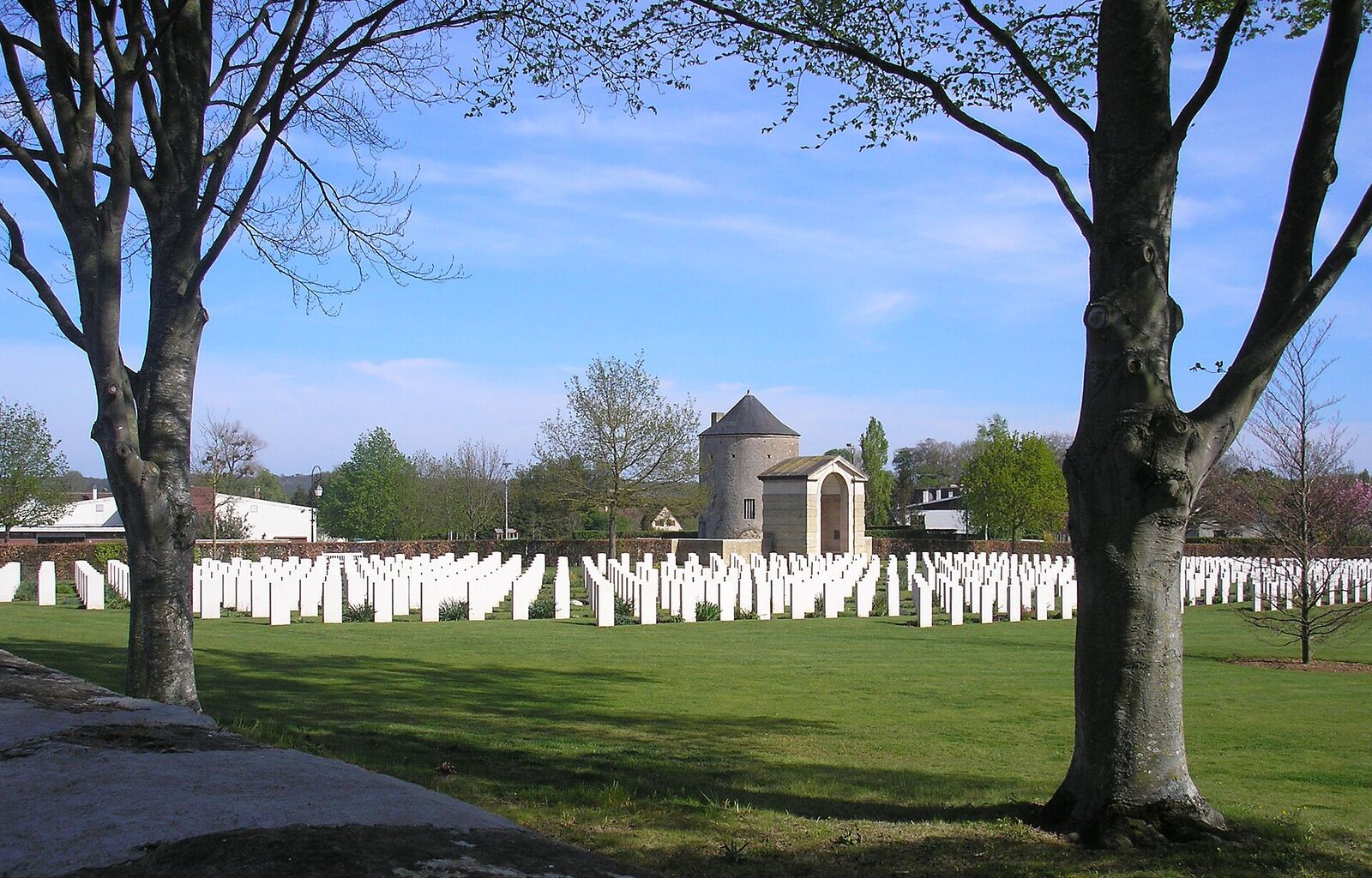
Beside the village church lie more than 2,200 graves, most of them airborne soldiers who fell securing the eastern flank around the Orne bridges. Ranville was among the first villages in France to be liberated, in the opening hours of D-Day.
Ranville sits just east of the Caen Canal and the River Orne, on the ground the British 6th Airborne Division dropped onto in the darkness before dawn on 6 June 1944. The village was among the first in France to be freed, and the men who secured this eastern flank of the invasion did not have far to travel to their graves. Many lie a few hundred metres from where they fell, in a cemetery beside the village church that has changed little since the war.
What happened here
The eastern flank was the airborne army's job. Gliders came down in the fields around the Orne bridges; parachute battalions scattered across the countryside to take crossings, silence the guns at Merville, and hold the line against the counter-attacks everyone knew would come. Ranville, overlooked by its detached stone church tower, sat at the centre of this and was captured in the opening hours of D-Day.
The dead were buried where the fighting left them. A plot beside the church became a battlefield cemetery in June 1944, and the larger war cemetery grew alongside it as graves were brought in from the surrounding fields and villages over the following months. Today the two are joined: the older churchyard graves and the formal war cemetery, designed by the architect Philip Hepworth, share one enclosure. More than 2,200 Commonwealth servicemen are buried here, the great majority of them airborne soldiers, alongside a smaller number of Allied dead of other nationalities and several hundred Germans. Roughly ninety of the Commonwealth graves hold men who could not be identified.
What to see today
The cemetery is open every day, with a lay-by at the entrance and a larger car park across the road behind an old stone windmill. It takes only a few minutes to walk, but reward the visit by looking closer.
Start in the churchyard, the smaller, older plot beside the church itself. Here lies Lieutenant Den Brotheridge of the Oxfordshire and Buckinghamshire Light Infantry, who led the glider-borne charge across the Caen Canal bridge and is widely remembered as the first Allied soldier killed by enemy fire on D-Day. He died of his wound in the first hours of the invasion, aged twenty-eight. The Gondrée family, who owned the café by the bridge and were among the first French civilians liberated, placed a plaque at his grave.
In the main cemetery, the headstones stand in the airborne dead's own company. Look for the grave of Private Emile Corteil of the parachute battalion tasked with the Merville Battery. A nineteen-year-old dog handler, he jumped with his patrol dog, Glen; the two were killed together on D-Day, by fire from Allied aircraft that mistook them for the enemy, and they are buried in the same grave. The inscription his parents chose reads, in part: "Had you known our boy you would have loved him too. Glen his parachute dog was killed with him." It is thought to be the only Commonwealth war grave shared by a soldier and his dog.
Walk the rows and read the ages and the family inscriptions carved beneath the regimental badges: they run overwhelmingly young. Towards one side stand the German graves, set apart but tended with the same care, a quiet reminder that this ground holds men from both armies. The Cross of Sacrifice anchors the cemetery, and the church tower rises just beyond the wall, the same landmark the paratroopers used to orient themselves in the dark.
Ranville is easily paired with a visit to Pegasus Bridge and its museum, a short drive away, which tells the story of the men whose graves you have just walked among.
Practical notes
The approach is through the village itself, with the green Commonwealth War Graves signs picking the cemetery up from the centre of Ranville and leading you to the church. The lane is narrow and still used by farm traffic, so leave the verges clear. Half an hour is enough to walk both plots, an hour if you stop to read the private inscriptions, which are the whole point of the place. There is a register and a visitors' book at the entrance.
The ground is easy. Gravel paths lead in from the gate and the grass between the rows is mown flat, so a wheelchair or a pushchair copes well in dry conditions, though the turf softens after rain. The older churchyard plot is the awkward part, with a step at the gate, uneven older stones and narrow gaps between them. Entry is free and unrestricted, as at every Commonwealth cemetery.
Almost everyone comes on from here to Bénouville and the crossing over the Caen Canal, ten minutes away, which is the story most of these headstones belong to. Going in that order, graves first and then the bridge, is the harder way round but the more honest one.