Mémorial de Caen
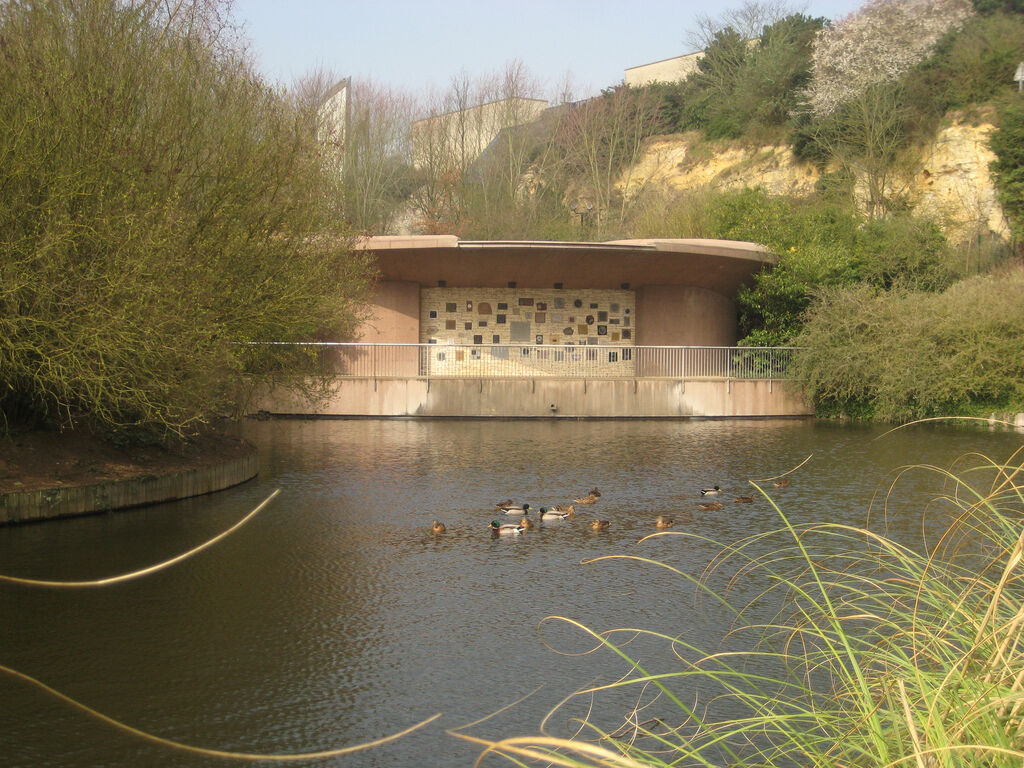
Normandy's largest and most ambitious museum, setting the D-Day landings within the wider story of the Second World War, the Battle of Normandy and the Cold War that followed. Immersive exhibits and original footage make it the natural starting point for understanding the campaign.
Most visitors come to the Mémorial de Caen for the big picture, and they get it: a museum that treats the D-Day landings not as an isolated event but as one hinge in a century of violence, from the humiliations of 1918 through the rise of Nazism to the Cold War and the fragile peace that followed. What far fewer realise is that they are standing on top of the very command post from which the German coastal defences were run on the morning of 6 June 1944. The story of this place begins underground.
The bunker beneath the museum
The ridge on Caen's northern edge was a limestone quarry long before it was a battlefield. In 1943 workers of the Organisation Todt tunnelled a gallery roughly seventy metres long and three metres high into the rock face, reached by dog-legged passages designed to blunt any blast. This became the headquarters of the 716th Infantry Division under General Wilhelm Richter, who from here oversaw the coastal sector stretching across the beaches that the Allies would code-name Sword, Juno, Gold and Omaha.
On the night of 5 to 6 June, Richter's staff began receiving reports of aircraft and parachute drops to the east of the Orne and beyond the Dives. As dawn broke, the underground rooms filled with the traffic of a battle already lost: telephonists, cartographers and signals officers trying to piece together what was happening on beaches they could not see. During the long fight for Caen the gallery served as shelter and, at times, as a dressing station, before the position was finally given up and Canadian troops moved in weeks later.
The museum was built directly above it and opened on 6 June 1988, the forty-fourth anniversary of the landings, inaugurated by President François Mitterrand. The bunker itself was opened to the public in 1991. It is the single most atmospheric thing here, and the most easily missed.
The descent into war
The main exhibition is arranged as a deliberate journey downward. You enter along a spiralling ramp lined with photographs and documents charting the rise of Nazi power through the 1930s, the architecture itself pulling you down into the hell that followed. The route carries you through the outbreak of war, occupation, the Holocaust and the global conflict, before arriving at the Normandy campaign.
The set-piece is a split-screen film of the landings that runs Allied and German footage side by side, refusing to let the day become a simple story of triumph. Beyond it, the museum follows the brutal three-month grind of the Battle of Normandy, the hedgerow fighting of the bocage and the near-destruction of Caen itself.
What to see today
Give yourself at least half a day. Outside the entrance, look for the knotted-barrel revolver sculpture, Carl Fredrik Reuterswärd's "Non-Violence", and read the inscription cut into the long stone façade, which frames the whole museum as a passage from suffering to freedom. Later additions widen the frame considerably: a gallery devoted to the Nobel Peace Prize and a Cold War wing, opened in 2002, that includes fragments of the Berlin Wall and hardware from the nuclear standoff.
Do not leave without walking the memorial gardens dedicated to the American, British and Canadian forces who fought here, quieter spaces that reward a slow pace. And make time to go down into Richter's bunker. After the polished galleries above, its raw rock walls and cramped passages are a bracing reminder that the history on display was directed, briefly and unsuccessfully, from the ground beneath your feet. As an orientation to everything else in Normandy, there is no better first stop.
Practical notes
The museum sits on the northern edge of the city, well signposted from the Caen ring road and reached in a few minutes from the exits on the north side. There is a large car park at the entrance, which matters here, because parking in central Caen is a good deal more trouble. This is a ticketed museum, and one of the larger ones in the region.
Allow half a day at minimum, and a full day if you intend to see the Cold War wing and the gardens as well as the main route down through the 1930s. Most visitors underestimate it and end up walking the last galleries too quickly.
The main building is modern, level and generously wide, with lifts between floors, so the exhibition route suits a wheelchair or a pushchair throughout. The underground gallery is the exception: it is reached by steps, the rock floor is uneven and the passages are narrow and cold, so plan for that part separately. Afterwards, the Abbaye aux Hommes in the old centre makes an obvious continuation, and Pegasus Bridge is a short drive north-east if you want to put the museum's account of the airborne landings onto real ground.