Abbaye aux Hommes
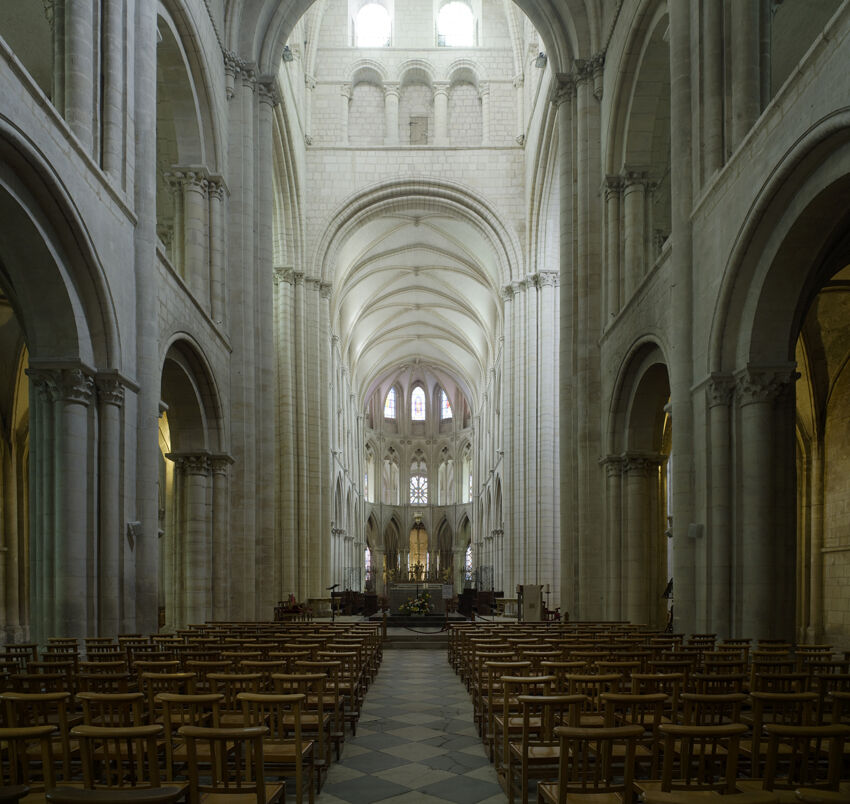
William the Conqueror's great Romanesque abbey in Caen, which sheltered thousands of civilians during the bombardment and battle for the city in 1944. Marked with Red Cross flags, it survived largely intact while much of Caen burned around it.
Nearly nine centuries separate the two events that define this place: the burial of a king who reshaped Europe, and the summer when his abbey became a lifeboat for a drowning city. Both stories are told inside the same pale Caen stone, and a thoughtful visitor can read one against the other. The Abbaye aux Hommes is not a battlefield in the usual sense. It is where Caen came to survive.
The abbey William built
William, Duke of Normandy, founded the abbey of Saint-Étienne in 1063, a few years before he crossed the Channel and became the Conqueror. Reputedly it was an act of penance, part of a bargain with the Church over his marriage to Matilda of Flanders, who endowed the sister house, the Abbaye aux Dames, at the other end of town. The church is one of the great Romanesque buildings of Normandy, its west front rising in three severe stages between two spired towers. Look up inside the nave and you can trace the moment architecture changed: some of the earliest ribbed vaulting in France was raised here in the decades around 1120, a technical leap that pointed the way to the Gothic.
William was buried in the choir in 1087, and few graves have been treated so roughly. His tomb was opened on papal order in the sixteenth century, scattered by Protestant iconoclasts during the Wars of Religion, and disturbed again at the Revolution. Of the man who won England, only a single thigh bone is said to survive beneath the plain marble slab that marks the spot today.
A sanctuary in the summer of 1944
By June 1944 the abbey was no longer a monastery but the Lycée Malherbe, a school. Planners had earmarked it before the invasion as a reception centre for perhaps six hundred displaced people. What arrived was something else entirely. As Allied bombing and the long battle for Caen ground the city to rubble, as many as ten thousand civilians crowded into the abbey, its cloister and the school buildings around it, roughly a sixth of Caen's population sheltering under one set of roofs.
It worked as an improvised town. Red Cross and civil-defence teams ran dormitories, a clinic for the lightly wounded that took pressure off the overwhelmed hospitals, and a nursery where a hundred and fifty or more children were kept for weeks. Feeding the crowd became a daily battle of its own: from around fifteen hundred meals a day in early June, the kitchens were turning out many times that number by mid-July, with volunteers scavenging flour, cheese and butter from the ruins outside.
The building's survival was not luck alone. Huge white sheets marked with red crosses were spread on the roofs and the ground to tell the aircrews overhead that this was a hospital and a refuge, not a target. The abbey came through the destruction of Caen largely intact. When Anglo-Canadian troops finally entered the shattered left bank in the second week of July, the celebration was held here, at the gates of the place that had kept so many alive.
What to see today
The abbey now serves as Caen's town hall, so you move through working municipal corridors as well as historic rooms. Step into the church of Saint-Étienne for the nave and the modest ledger stone in the choir marking William's grave, then find the serene enclosed cloister and the grand stone staircase. The permanent exhibition "Caen, été 44 : la vie continue" is the reason to come with the 1944 story in mind, using photographs and recorded testimony to reconstruct daily life among the refugees. Guided tours reach rooms otherwise closed to individual visitors. As you walk the calm courtyards, picture them packed shoulder to shoulder, and the roofs above draped in bloodied sheets, and the abbey earns its place on any Caen itinerary.
Practical notes
This is a city-centre visit rather than a country one. The abbey stands on the Esplanade Jean-Marie Louvel on the western side of central Caen, and the approach is on foot: there is a little parking on the surrounding streets, but the underground car parks in the centre are the safer bet, and the tram and bus network drops you within a few minutes' walk. The church is free to enter. The guided tour of the town hall rooms is ticketed and booked at the desk.
Half an hour is enough for the church alone. Allow an hour and a half to two hours if you want the exhibition on the summer of 1944 and a guided tour of the interiors, which is the version of the visit worth planning for.
The ground is easy: paved squares, a level gravel forecourt and a flat, generously wide church floor, all fine for a wheelchair or a pushchair, though the historic upper rooms are reached by the great stone staircase and the cloister has a lip or two. Pair it with the Mémorial de Caen across town for the campaign in full, or with Ardenne Abbey on the northern outskirts for a much darker chapter of the same battle.