Tilly-sur-Seulles
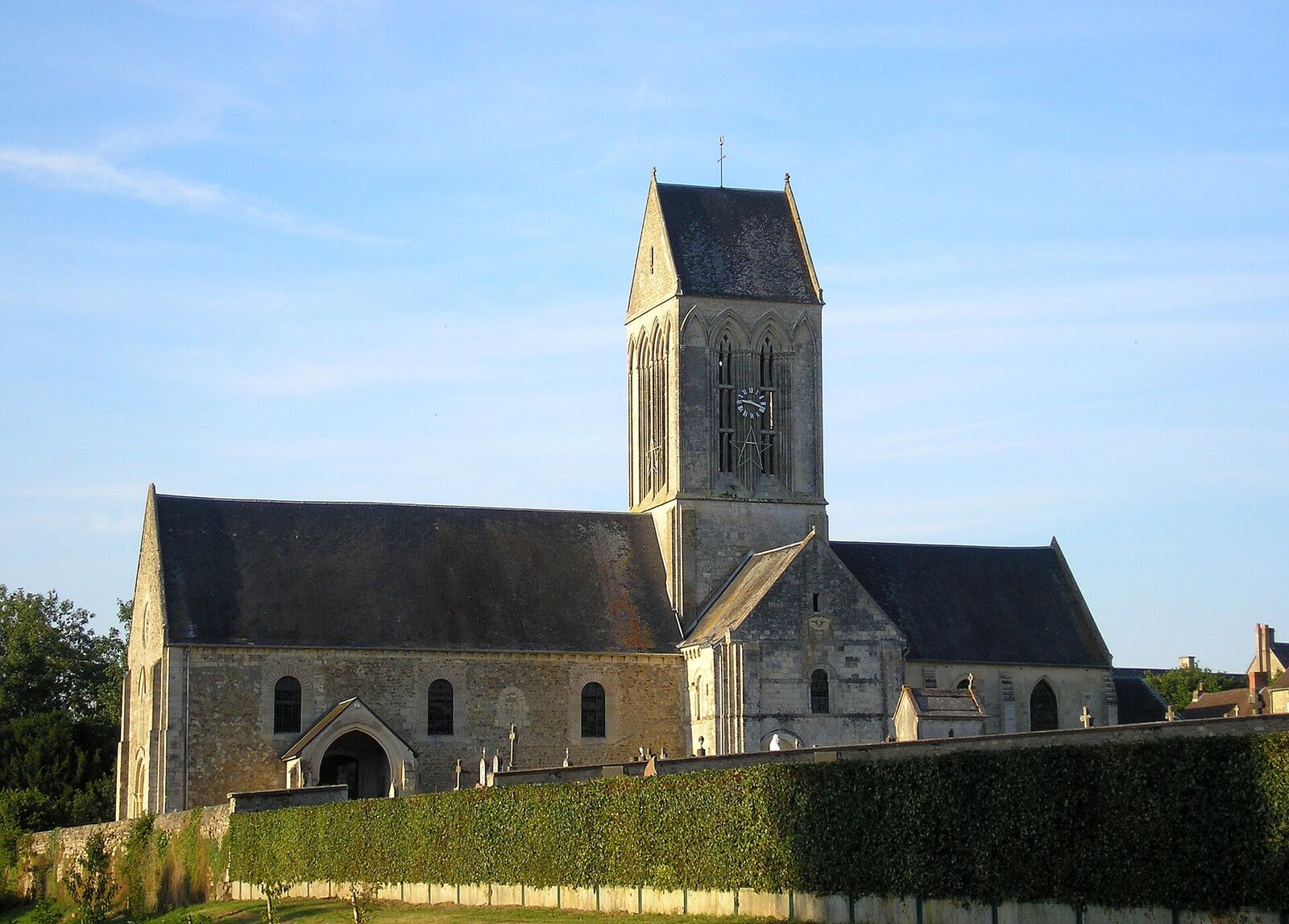
A village south of Bayeux that changed hands more than twenty times in June 1944 during ferocious fighting between the British 50th Division and the elite Panzer-Lehr Division. A small museum in a former chapel tells the story of the battle.
Drive twelve kilometres south-east of Bayeux and the open farmland begins to close in. Hedgerows thicken into walls of earth and thorn, lanes sink between them, and the horizon shrinks to the next field. This is the Norman bocage, and in June 1944 it turned a modest crossroads village into one of the most stubborn deadlocks of the campaign. Tilly-sur-Seulles was not a D-Day objective, but the road through it led towards Caen, and holding that road cost both sides dearly.
The crossroads that would not fall
Once the Allies were ashore, British XXX Corps pushed inland from the Bayeux sector, feeling for a way south around the western flank of Caen. In their path stood the Panzer-Lehr Division, one of the best-equipped armoured formations the Germans could field, built around veteran instructors and hundreds of tanks. Its commander, Fritz Bayerlein, dug his men into the hedge-lines around Tilly, where the sunken lanes cancelled out much of the Allied advantage in the air and in numbers.
What followed, through the middle weeks of June, was less a battle than a grinding series of them. The British 50th (Northumbrian) Division and neighbouring formations fought hedgerow by hedgerow, attacking and being counter-attacked across the same few fields. The village itself changed hands again and again, roughly two dozen times by most accounts, until there was little left to hold. When the front finally moved on, Tilly and the hamlets around it had been almost completely destroyed.
The cost was not only military. Around one in ten of the village's civilians were killed in the fighting and the bombardment that came with it, a figure that puts the polite phrase "changed hands" into grim perspective. This was a community caught inside the battle, not beside it.
A museum in a medieval chapel
The village's memory of all this is kept in an unlikely building: the Chapelle Notre-Dame du Val, a partly ruined medieval chapel on the edge of the village, listed as a historic monument and restored in the 1970s. Since the end of that decade it has housed the Musée de la Bataille de Tilly-sur-Seulles, run largely by local volunteers.
It is a small, intense place rather than a slick visitor centre, and that is its strength. The displays are built around objects lifted from the surrounding fields, alongside photographs, documents, uniforms and models that trace the fighting from the occupation and the Allied bombing through to the ground battle and its effect on ordinary people. Give it three-quarters of an hour and read the panels carefully; the story here is specific to these fields, not a general D-Day overview you could get anywhere on the coast.
What to see today
Stand outside the chapel and the first thing to grasp is the terrain itself. The rebuilt village looks unremarkable, but walk or drive the narrow lanes just outside it and you are moving through the exact obstacle that defeated timetables here: high banks, blind corners, fields the size of a tennis court, each one a small fortress.
A little over a kilometre west of the centre, on the D13, lies Tilly-sur-Seulles War Cemetery. It holds around 1,200 graves, the great majority of them British, with smaller numbers of other Commonwealth servicemen and more than two hundred Germans buried among them. That mix, enemies at rest in the same ground, is worth pausing over; so are the headstones marked only "A Soldier of the 1939-1945 War, Known Unto God," the men the bocage swallowed and never gave back by name.
If you are combining sites, Tilly pairs naturally with a wider loop through the bocage battlefields toward Villers-Bocage. But allow time simply to stand in one of these sunken lanes and listen. The quiet here was very hard won.
Practical notes
Tilly sits on the D6 between Bayeux and Villers-Bocage, an easy twenty minutes from either, and the village is small enough that you can park on the street near the centre or in the space by the chapel itself. The war cemetery a little over a kilometre west on the D13 has its own roadside parking. The museum is volunteer-run, so it is worth checking that it is open before you make a special trip of it; the cemetery is open access and free at any time.
Allow an hour and a half for both together, or three-quarters of an hour if you are only doing the museum. Add half an hour again if you want to drive some of the surrounding lanes, which is really the best part of a visit here.
The chapel housing the museum is a medieval building, with a step at the door and an uneven floor inside, so it is not straightforward for a wheelchair. The cemetery, by contrast, is level mown grass with a firm entrance path and presents no difficulty. The lanes around the village have no pavements and high blind banks, so if you walk them, walk facing the traffic. Jerusalem War Cemetery, the smallest of its kind in Normandy, is a few minutes up the road toward Bayeux, and Bayeux War Cemetery rounds out the day.