Jerusalem War Cemetery
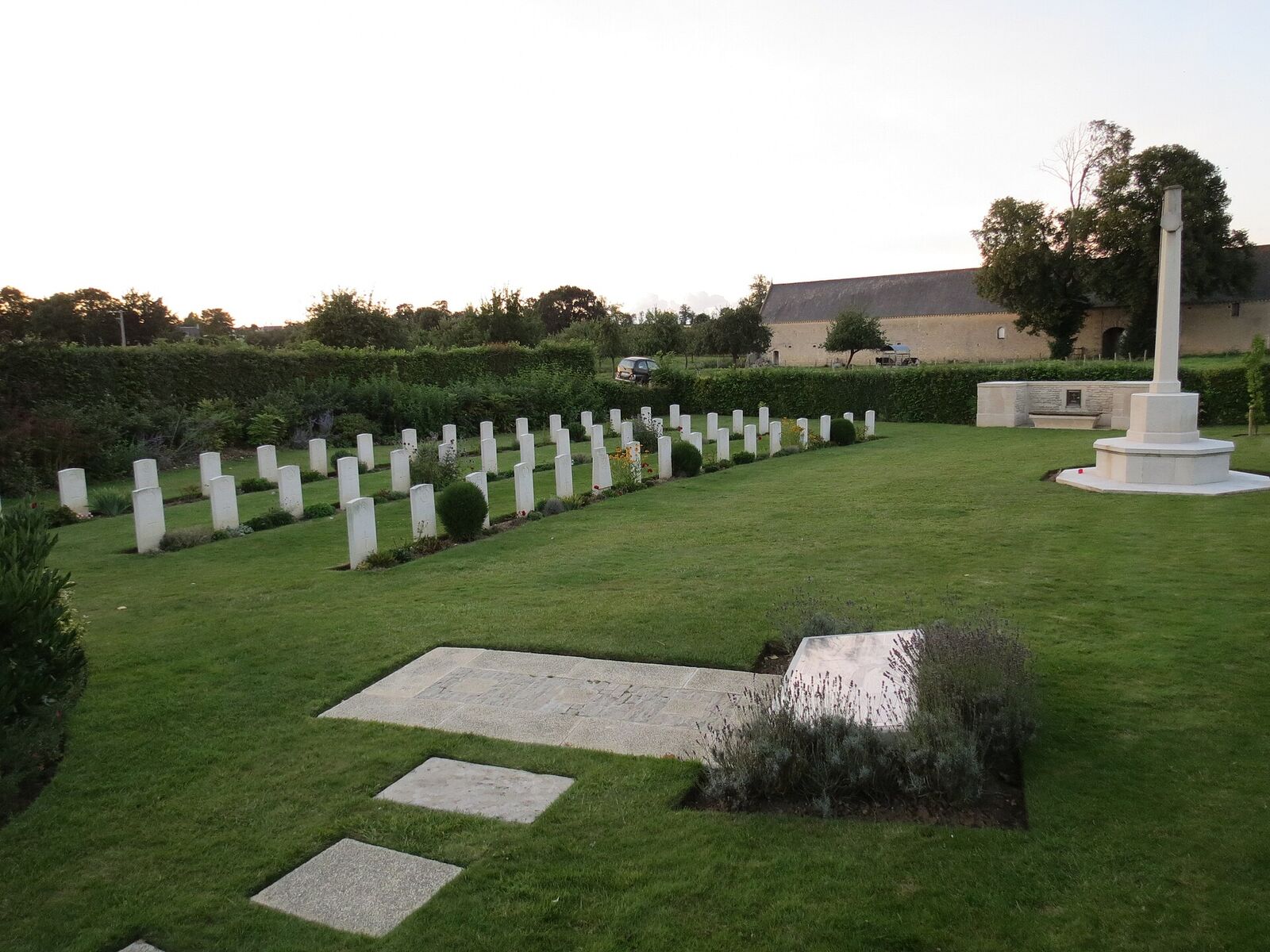
The smallest Commonwealth war cemetery in Normandy, with just forty-eight graves set among farmland south of Bayeux. Named after the hamlet beside it, it holds men of the British 49th and 50th Divisions killed in the June 1944 fighting.
Most visitors to the Normandy war cemeteries come away with an impression of scale: the long, receding ranks of headstones at Bayeux or Ranville, the sheer arithmetic of loss. Jerusalem War Cemetery offers the opposite. Set back from the D6 between Bayeux and Tilly-sur-Seulles, on a gentle slope of open farmland beside the hamlet that gives it its name, it holds fewer than fifty graves. It is the smallest Commonwealth war cemetery in Normandy, and its smallness is precisely what makes it worth the short detour.
What happened here
The cemetery was begun on 10 June 1944, only four days after the landings, as fighting surged across the fields south of the newly liberated Bayeux. This was not the beach, but it was no quiet backwater either: the ground between Bayeux and Tilly-sur-Seulles was bitterly contested through June and July as Commonwealth divisions pushed inland and German counter-attacks tried to claw the town back. The men buried here were drawn largely from British infantry divisions fighting in that sector, and many fell in the grinding struggle around Tilly-sur-Seulles, a village that changed hands repeatedly and was all but destroyed.
Because it was opened so early in the campaign, Jerusalem holds a small distinction in the history of the Commonwealth War Graves Commission: it is said to have been the first CWGC cemetery in France to have its Cross of Sacrifice erected. For a plot this modest, that is a striking claim, and it speaks to how quickly the burial parties and, later, the Commission's architects set about their work even as the front line moved only a few miles away.
The people beneath the stones
The intimacy of the site is reinforced by who lies here. Among the graves is that of Private Jack Banks of the Durham Light Infantry, who was sixteen years old when he was killed in July 1944, and is remembered as the youngest British soldier to die in the Normandy campaign. His headstone carries a family inscription of raw grief, the kind of private line that repays reading slowly.
Nearby lie two army chaplains, including the Reverend Gerard Nesbitt, attached to the same Durham Light Infantry battalion, who died in early July aged thirty-three and had been decorated with the French Croix de Guerre. That two padres should rest in so tiny a cemetery is a reminder that the men who buried the dead and comforted the dying were not spared the shellfire either. Of the burials, all but a couple are identified British soldiers; there is also a Czech grave and one unknown.
Practical notes
Jerusalem is easy to miss and easy to reach. From Bayeux, take the D6 south-east toward Tilly-sur-Seulles, an ordinary two-lane road through farmland with nowhere obvious to slow down; after roughly eight kilometres the cemetery appears on the left, at the foot of a slope, marked by a modest blue metal gate. The lay-by at the gate holds two or three cars at most and there is no turning circle, which is worth knowing if you overshoot. That suits the place: you are unlikely to share it with a coach party. It is open access and free, as all Commonwealth war cemeteries are, and there is no attendant.
The plot, designed by the architect Philip Hepworth, is roughly triangular and set on a gentle incline, with grass paths between the rows and the Cross of Sacrifice standing over the whole. The register box by the entrance lets you find individual graves, and in a cemetery this size you can genuinely stand before each one. Look for Jack Banks and the chaplains, and take a moment to read the personal inscriptions chosen by the families; with so few stones, they are legible as a set rather than a blur.
Twenty minutes is genuinely enough to stand before every grave, and most people stay a little longer than they meant to. From the gate a short path leads up the grass slope to the plot, and the rows are separated by mown grass rather than paving. That makes it soft going after rain and awkward for a wheelchair, though the incline itself is slight and a pushchair copes; the headstones nearest the entrance can be read without going far in. There is no shelter, no water and no bin, so take everything away with you.
Come here after the crowds of Omaha or the Bayeux War Cemetery and the contrast lands hard: the war reduced to a single field, a handful of names, and the quiet of the Bessin countryside closing back in around them. Tilly-sur-Seulles and its small museum, a few minutes further down the same road, explain the fighting that filled these graves, and Ryes War Cemetery north of Bayeux is another modest plot of the same early weeks.