Ryes War Cemetery
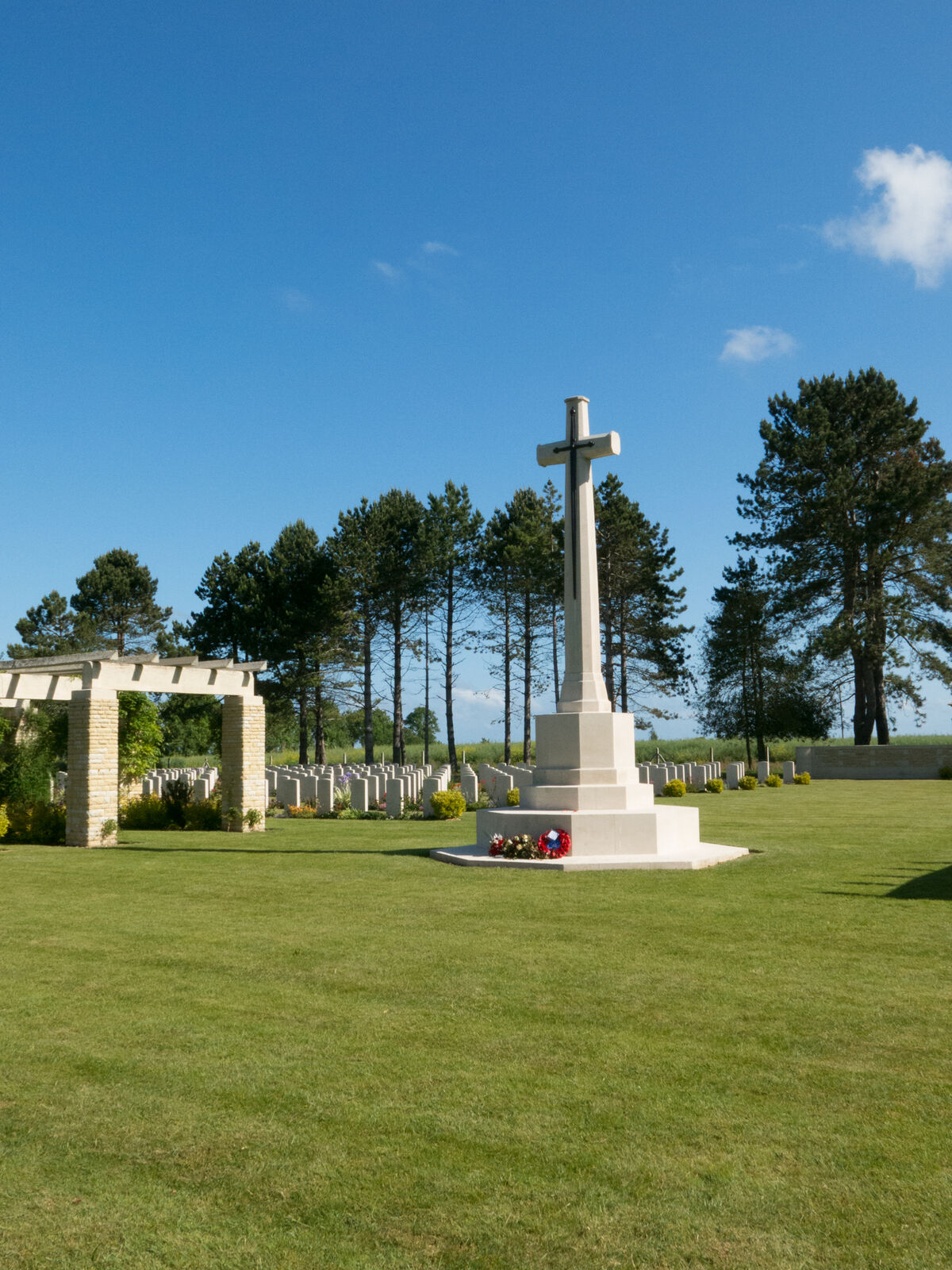
A Commonwealth War Graves cemetery near Bazenville holding around 980 burials, including many men who fell on Gold Beach and in the first days of the bridgehead. As at several Normandy cemeteries, German war dead lie here beside the Allied graves.
Down a farm lane between Bazenville and Ryes, a few kilometres inland from Gold Beach, the ground rises gently to a wall of pale stone and a single tall cross. There is rarely anyone here. Runners and cyclists pass on the road below without slowing, and the cemetery keeps its quiet almost entirely to itself. Yet the men buried on this slope were among the very first to fall on the road inland, and Ryes has a claim that none of the larger, better-known cemeteries can match: its earliest graves were dug while the battle for the beaches was still being fought.
The first graves after D-Day
The 50th (Northumbrian) Division came ashore on Gold Beach on the morning of 6 June 1944 and pushed inland toward Bayeux. Behind the fighting troops came the burial parties, and within two days of the landings the first men were being laid to rest in a field near Bazenville. That makes Ryes one of the earliest permanent Commonwealth cemeteries of the Normandy campaign, begun not as a planned memorial but as a battlefield necessity while the bridgehead was barely established.
The cemetery holds around 980 burials. Roughly 650 are Commonwealth dead, the great majority British, with a smaller number of Canadians and a single Australian, alongside one Polish grave. Among them lie a number of Royal Navy and merchant navy men, a reminder that the fighting offshore was as lethal as the fighting inland. And, as at several Normandy cemeteries, more than three hundred German war dead rest here too, gathered from the surrounding country and buried within the same walls as the men they had faced.
Two brothers, side by side
Walk the rows and the individual stories surface from the identical headstones. In one plot lie the brothers Casson, from a family in the north-east of England. Robert, a Royal Marine Commando, was killed on 6 June, D-Day itself; his younger brother Joseph, barely eighteen and serving with the Durham Light Infantry, was wounded weeks later and died of his wounds toward the end of June. Joseph was first buried elsewhere in the Normandy fields. It was his mother who asked that her sons not be parted, and in November 1944 his body was moved to Ryes so that the two brothers could lie beside one another. Their graves stand together today.
Not far off is the grave of Leonard "Les" Milner, a professional footballer who had played as an inside forward for York City before the war. He was killed near Bayeux in late June 1944 while serving as a sergeant with the Seaforth Highlanders. Ages on the headstones run from men in their thirties down to teenagers; reading the inscriptions their families chose is the surest way to feel the scale of what a single week of fighting cost.
Practical notes
Ryes is easily reached by car from Bayeux, roughly eight kilometres to the east, or as a short detour from Arromanches and the coast. The cemetery is signed off the lane between Bazenville and Ryes, and the turning is easy to overshoot. A gravel area at the gate takes a few cars. It is open at all hours, free to enter, and there is no visitor building of any kind.
Designed by Philip Hepworth, one of the Commission's principal architects for North-West Europe, it follows the familiar pattern of Portland stone headstones in level ranks, with a Cross of Sacrifice and a Stone of Remembrance among the plantings. Look for the German graves, set apart in their own rows and marked by darker stone, and note how early the dates on the Commonwealth headstones run: many fell in the first days after the landings. The register and visitors' book are kept in a recess by the entrance; signing it, and pausing at the Casson brothers' shared plot, turns a brief roadside stop into something worth the detour.
Allow half an hour, or an hour if you want to walk every plot and read the inscriptions properly.
The site sits on a gentle slope, and there is a short rise and a few steps between the entrance and the plots above, which will defeat some wheelchairs; the mown grass paths beyond are level and firm in dry weather but soften considerably after rain, and a pushchair is easier carried over the first stretch than pushed. There is no shade and no shelter, so it is exposed in wind or sun.
Ryes works best as the quiet half of a pairing. Bayeux War Cemetery, the largest Commonwealth burial ground in Normandy, is a short drive west and makes the contrast in scale plain, and the coastal batteries at Longues-sur-Mer are about the same distance north if you want the ground the 50th Division crossed.