Longues-sur-Mer Battery
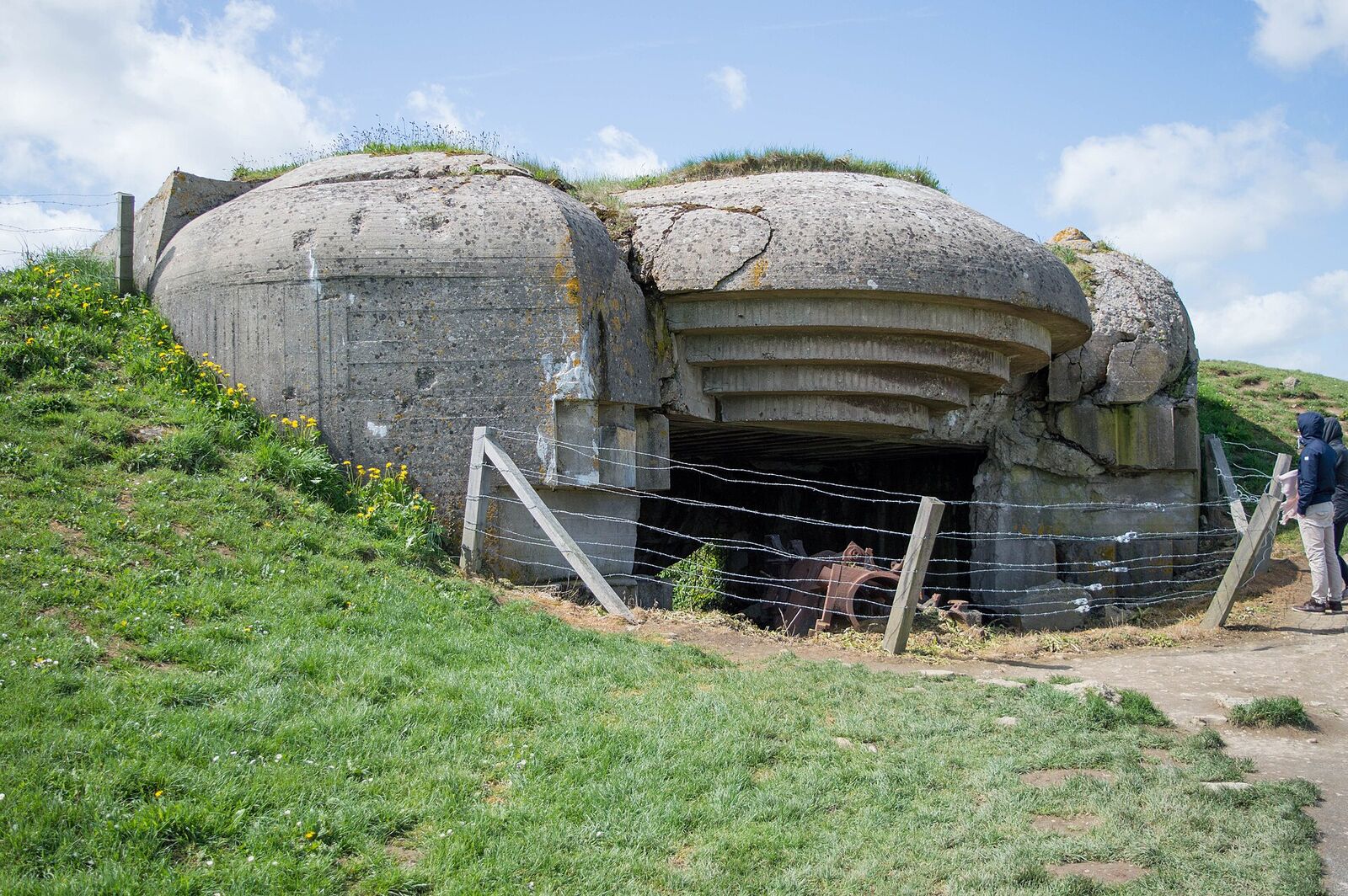
The best-preserved German battery in Normandy, still housing its original 150 mm naval guns in four concrete casemates between Gold and Omaha. It exchanged fire with Allied warships on D-Day before being silenced, and its intact emplacements make it a highlight of the Atlantic Wall.
Perched on a sixty-metre chalk cliff roughly a kilometre north of its namesake village, the Longues-sur-Mer battery occupies one of the most commanding positions on the whole invasion coast. It sits almost exactly between the British landings at Gold and the American sector at Omaha, and its four naval guns could reach either. What makes it exceptional today is simple: it is the only German coastal battery in Normandy that still holds its original guns, sitting in the casemates where their crews loaded them in June 1944.
The battery and its guns
Built by the Organisation Todt between the autumn of 1943 and the spring of 1944, the position was armed with four 15 cm naval guns of the type normally mounted on warships, manufactured by the Škoda works and capable of throwing a shell some twenty kilometres out to sea. Each sits inside a heavily reinforced casemate with walls and roof more than two metres thick.
Fire direction was handled from a separate command and observation bunker set apart from the guns, right on the lip of the cliff. This was one of the more advanced fire-control installations on this stretch of the Atlantic Wall, but on D-Day it was still unfinished, and the sophisticated links between the observers on the cliff and the gunners behind never fully came into their own.
What happened here
In the hours before the landings the site absorbed a heavy Allied air bombardment, yet the thick concrete largely shrugged it off. Soon after dawn on 6 June the battery opened fire, ranging first toward the American ships off Omaha and then switching to a headquarters vessel lying off Gold. The response was overwhelming. British cruisers duelled with the guns through the morning, and French cruisers and an older American battleship joined the counter-battery fire, silencing the position for a time. One of the eastern casemates was knocked out; others were damaged. The gunners managed to resume intermittent fire later in the day, but the battery had loosed only a little over a hundred rounds before it fell quiet.
It was not stormed on the beaches but taken from behind. On 7 June British infantry advancing inland from Gold Beach - men of the Devonshire Regiment - reached the position and took the surrender of the garrison, roughly a hundred and twenty men, without a serious fight. The battery played no further part in the campaign.
What to see today
The four casemates stand in a line along the fields above the cliff, and three of them still hold their guns - dark, weathered, unmistakably purposeful. Walk to the easternmost casemate and you can see the difference: this one took the worst of the naval gunfire, its structure torn and its barrel wrecked, a vivid record of a direct hit. Step inside the others and look for the roughness of the concrete, the recesses for shells, and the scars of splinters on the walls.
Do not stop at the guns. Follow the path out toward the sea to the observation and command bunker perched on the cliff edge, a squat two-level block with a horizontal viewing slit. Film enthusiasts may recognise it: it appears in the 1962 epic The Longest Day. From here the strategic logic of the place becomes obvious - on a clear day you can see east along the coast toward Arromanches, where the remains of the Mulberry harbour still lie in the water.
The site is open, free, and unusually atmospheric because it is so complete. Note that the ammunition chambers behind the casemates have been closed off in recent years, and coastal erosion has forced the sealing of parts of the cliff-edge bunker, so keep to marked ground. Allow a good hour, and take the coast path for the view the German observers once used for very different purposes.
Practical notes
The battery is signed off the coast road at the village of Longues-sur-Mer, and a lane runs north from there to a free car park beside the visitor kiosk. From the car park the guns are a level walk of a few hundred metres across open fields. Allow an hour for the four casemates, and closer to ninety minutes if you walk out to the observation bunker on the cliff and back.
The track from the car park to the guns is firm, wide and almost flat, which makes the main part of the site workable with a wheelchair or a pushchair in dry weather. Beyond that it gets harder. The casemate floors are rough concrete with raised sills to step over, and the path along the cliff to the command bunker is grass and packed earth, uneven in places and close to an eroding edge, so stay behind the fencing and keep children and dogs in hand. There is no shelter at all on the clifftop when the wind comes off the Channel.
Bayeux is a quarter of an hour inland and makes the natural base for this stretch of coast. Nearer still, the fishing harbour at Port-en-Bessin lies just west along the same road and is the easiest place hereabouts to find lunch.