Bayeux War Cemetery
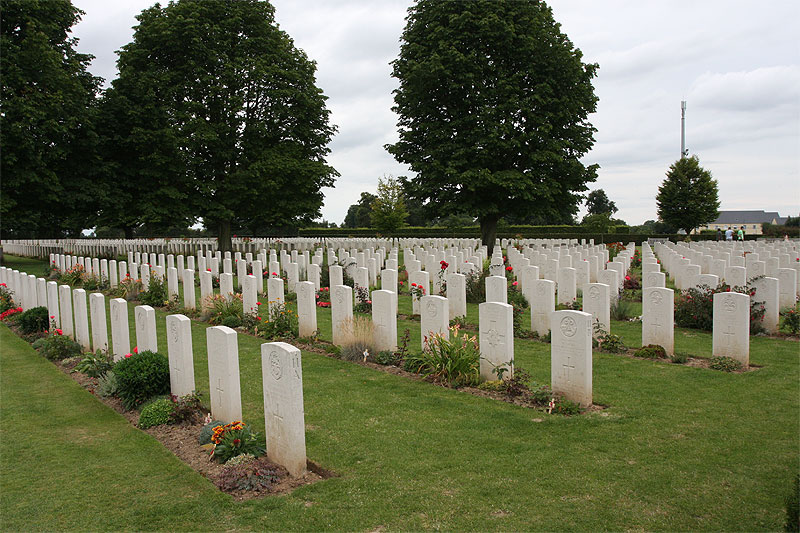
The largest Commonwealth cemetery of the Second World War in France, with 4,648 graves of many nationalities. Across the road the Bayeux Memorial records over 1,800 missing of the Normandy campaign who have no known grave.
Bayeux was the first town of any size in France to be liberated, freed on 7 June 1944 and spared the shelling that flattened so much of Normandy that summer. Because it survived intact, it quickly became a hospital town, and the wounded came in their thousands from the beaches and the bocage. The cemetery on the town's western edge grew directly out of that role: a field where those who could not be saved were laid to rest, close to where they died.
What happened here
In the first days after the landings, British field hospitals were set up around Bayeux to receive casualties from the fighting inland. A graves registration unit marked out the burial ground in an open field at the beginning of July 1944, and the first burials followed within days. The men who lie here did not all fall in one action. Some were killed on the beaches on 6 June; a great many died in the grinding weeks that followed, in the hedgerow country south of the coast where every field and sunken lane had to be taken at close quarters. More than seven hundred of those buried or commemorated at Bayeux died on D-Day itself, and hundreds more within the week that followed.
Today the cemetery holds 4,648 burials, the largest Commonwealth cemetery of the Second World War in France. The great majority are British, alongside Canadians, Poles, Australians, New Zealanders and a handful of others. Several hundred graves are unidentified, marked simply as soldiers "Known unto God." What surprises many visitors is that the dead also include more than four hundred and sixty Germans, buried among their former enemies without distinction of ground or care.
The Bayeux Memorial
Directly across the road stands the Bayeux Memorial, a long colonnade of pale stone that records more than 1,800 men of the Commonwealth forces who fell in the Normandy campaign and have no known grave. Run your eye along the frieze beneath the roofline and you will find a line of Latin: Nos a Gulielmo victi victoris patriam liberavimus - "We, once conquered by William, have liberated the Conqueror's native land." It is a deliberate and rather magnificent reversal: nine centuries after William of Normandy sailed from these shores to conquer England, an army from England and its Commonwealth returned to free Normandy. In the town whose famous tapestry tells the story of 1066, and whose cathedral was the building it first hung in, the parallel is anything but accidental.
What to see today
The cemetery was designed by the architect Philip Hepworth, and it repays slow walking rather than a quick circuit. The two standard features of every Commonwealth cemetery are here: the tall Cross of Sacrifice and the low altar-like Stone of Remembrance, its inscription reading "Their Name Liveth For Evermore." The headstones stand in long, exact rows above deep flower borders, so that in summer the ground reads almost as a garden.
The detail worth slowing for is at the foot of the stones. Families were allowed to choose a personal epitaph, and it is these few lines - a mother writing of an only child, a wife of a young husband, some defiant, some simply broken - that carry the real weight of the place. Look, too, for the age carved on many stones: eighteen, nineteen, twenty. Among those buried here is a Victoria Cross winner of the Royal Norfolk Regiment, killed in August 1944 during the fighting south of the beachhead.
The cemetery lies a short walk from the town centre, on the ring road near the museum of the Battle of Normandy, and is open at all hours without charge. Come early or late if you can; the low light suits it, and you will likely have the rows to yourself.
Practical notes
The entrance is on the ring road on the south-western side of town, signposted and directly opposite the museum of the Battle of Normandy, which shares the same stretch of road and has a car park. On foot it is a level fifteen minutes or so from the cathedral quarter. The memorial colonnade stands across the road from the cemetery gate, so allow for one crossing.
Most visitors give it forty-five minutes to an hour, and longer if you are looking for a particular grave; take the register from the shelter inside the entrance first, since it gives plot and row references. The ground is flat throughout, with a paved approach and wide mown paths between the plots, so the main axes suit a wheelchair or a pushchair without difficulty. Reaching an individual headstone in the middle of a plot means crossing grass and flower borders, which can be soft after rain.
It pairs naturally with a half day in the town itself, and with the tiny Jerusalem War Cemetery a short drive out of town, which holds fewer than fifty graves and makes an instructive contrast in scale. Drivers heading for the coast afterwards can reach Longues-sur-Mer Battery in about twenty minutes.