Bayeux Cathedral
A soaring Norman-Gothic cathedral consecrated in 1077, the original home of the Bayeux Tapestry. Towering over the spared town, it became a landmark of the first days of the liberation and remains the centrepiece of historic Bayeux.
Long before it became a fixed point on Allied maps, the cathedral of Notre-Dame de Bayeux was a landmark. Its twin western spires and its later central tower rise clear above the rooftops, visible for miles across the flat Bessin farmland. That silhouette, consecrated in 1077 by Bishop Odo, half-brother of William the Conqueror, was the reason the tapestry that bears the town's name was first displayed here - and, nine centuries later, one of the reasons the town below it survived the war almost untouched.
The town that was spared
On the morning of 7 June 1944, the day after the landings, patrols of the British 50th (Northumbrian) Infantry Division moved into Bayeux and found the German garrison gone. It became the first town of any size in France to be liberated, and it was taken without a fight. That accident of geography and timing mattered enormously. Because the German command was drawn eastward into the grinding battle for Caen, Bayeux was never bombed or shelled into rubble like so many of its neighbours. Its medieval streets, its half-timbered houses and its cathedral came through intact.
The cathedral itself played a quiet part in the invasion. Its towers were prominent enough to serve as a navigation and orientation point for Allied aircrews and troops pushing inland - a recognisable marker in a landscape where whole villages were being erased. A week after the liberation, on 14 June, General de Gaulle came ashore and spoke to the townspeople in the streets nearby, re-establishing Free French authority on liberated soil. Bayeux spent the rest of the campaign as a hospital and headquarters town, and today it lies beside the largest British war cemetery in France.
A sanctuary in the summer of 1944
In June 1944 the interior was not the polished space visitors see now. Much of its furniture - the altar, pulpit and pews - had been removed, leaving a bare stone shell lit by candles at a makeshift altar. Into that space came soldiers, sailors and displaced civilians, worshipping side by side and mourning the men they had already lost on the beaches and in the hedgerows. One Royal Navy man recalled that "once through that door, it seemed like another world." The link endures: remembrance services are held here during the D-Day commemorations each June, and a memorial bell was dedicated within the cathedral to mark the seventieth anniversary in 2014.
What to see today
Give the building more than a passing glance, because its best features reward a slow visit. The lower walls of the nave are the oldest survivors, and they are extraordinary: the great Romanesque arcades are covered in a dense, restless carpet of carving - interlacing bands, net-like patterns and rows of small four-petalled flowers - an almost obsessive decoration you will not find in this profusion elsewhere in Normandy. Above them, the lighter Gothic upper storey and its tall windows belong to the following century.
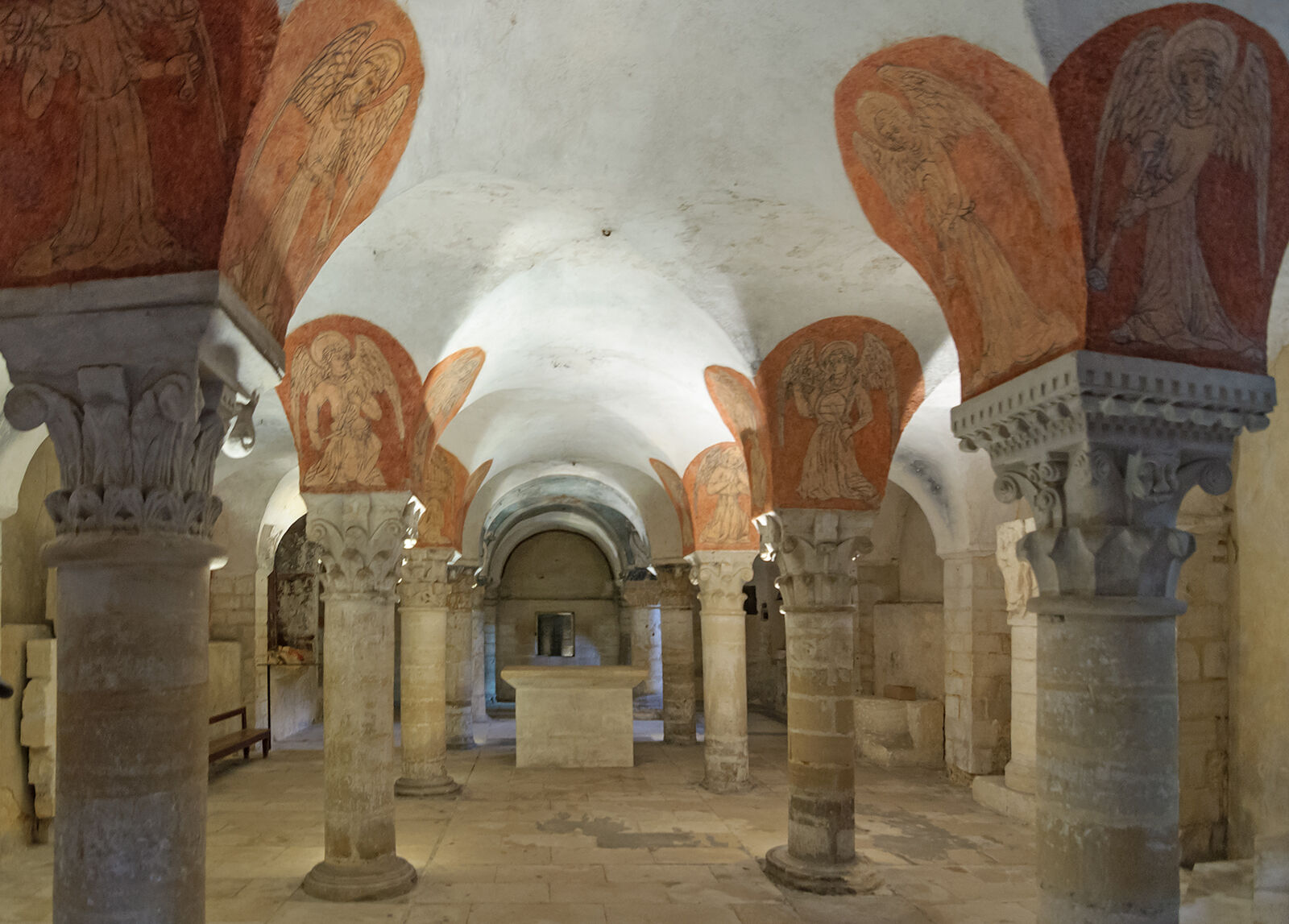
Do not miss the crypt beneath the choir, the oldest part of the church. On its vaults, painted in 1412, are frescoes of angels playing medieval instruments - harps, lutes and flutes rendered in faded red and gold, a rare and intimate survival. Nearby, the chapter house preserves a small tiled labyrinth set into its thirteenth-century floor, a cousin of the famous mazes at Chartres and Amiens.
Outside, walk the surrounding square to appreciate why the town grew around this church, then follow the short route to the Musée de la Tapisserie, where the embroidery that once hung in the nave is now displayed. For the war story, the Battle of Normandy Memorial Museum and the British cemetery, with its plaque to the Northumbrian division that arrived first, lie a few minutes' walk to the south-west.
Practical notes
The cathedral stands in the middle of the old town, and the streets immediately around it are narrow and largely given over to pedestrians, so do not try to drive to the door. Use one of the signed town car parks on the ring of boulevards and walk in; it takes only a few minutes from any of them, and the spires make navigation simple. It is a working church, free to enter, and you should expect services and rehearsals to interrupt a visit now and then.
Allow around an hour. That is enough to walk the nave slowly, take in the carved Romanesque arcades, go down to the crypt and find the labyrinth, without feeling hurried. Add a further hour or two if you are continuing to the tapestry museum a short walk away.
The nave is flagged, broad and level, and the ground floor of the building is manageable with a wheelchair or a pushchair, though the flagstones are worn and uneven in patches. The crypt is the exception: it is reached by a flight of stone steps with no alternative route, and it is dimly lit, so anyone unsteady on stairs should take it slowly. Out of town, the guns at Longues-sur-Mer and the harbour remains at Arromanches are each about twenty minutes north and make the obvious afternoon after a morning in the town.