Montormel Memorial
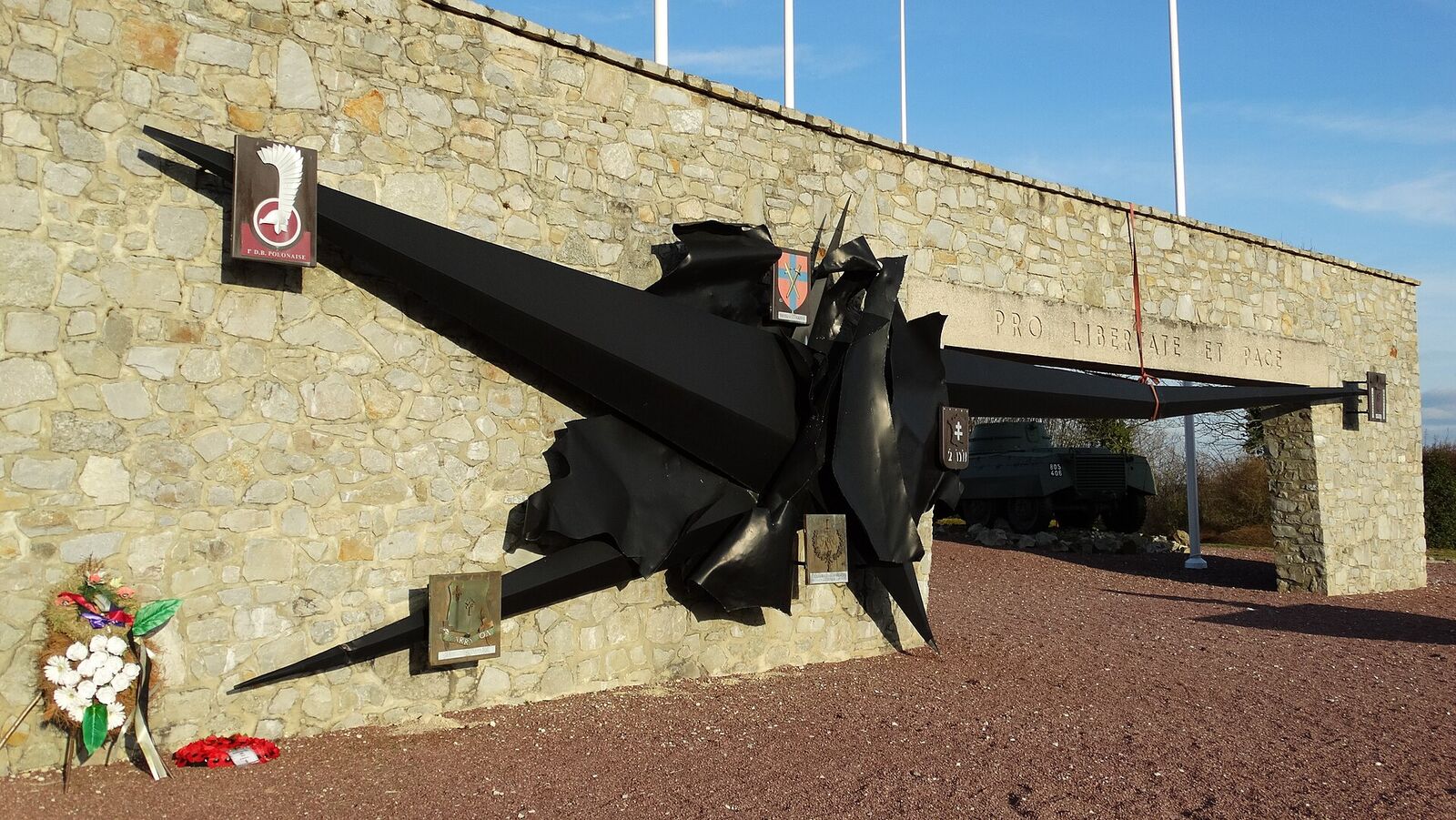
On the ridge where Polish and Canadian troops sealed the Falaise Pocket in August 1944, trapping the German armies in Normandy, this hilltop memorial and museum overlook the killing ground of the Corridor of Death below.
Few places in Normandy ask you to look down rather than up. From the terrace at Montormel, the ground falls away toward the plain of the Dives, and it was into that shallow valley below that the German armies in Normandy poured in August 1944, trying to escape an encirclement that was closing behind them. The men who held this ridge and slammed the gate shut were not British, American or Canadian, but Polish - and the story of how they did it is one of the most desperate small-unit stands of the entire campaign.
The battle for the Maczuga
By mid-August 1944 the German forces in Normandy were being squeezed into a shrinking pocket around Falaise. The only way out led east, past the high ground of Mont Ormel, marked on Allied maps as Hill 262. General Stanisław Maczek, commander of the 1st Polish Armoured Division, looked at the twin-humped feature and thought it resembled a caveman's club. His men called it the Maczuga - Polish for "mace" - and the name stuck.
On 19 August the Poles fought their way onto the northern hilltop, cutting straight across the German escape route. Roughly two battlegroups - some 1,500 infantry and around eighty tanks - dug in on a position barely two kilometres across, with the enemy on every side. Panther tanks trapped in the valley below could not raise their guns high enough to hit the Shermans on the crest, and the Poles wrecked the head of a fleeing column, littering one field with so many burning vehicles they nicknamed it "Psie Pole" - Dog's Field.
Then the position was surrounded. For two days German units still inside the pocket, and SS panzer divisions attacking from outside to reopen the corridor, threw themselves at the hill from front and rear. By the evening of 20 August the defenders were nearly out of ammunition; one wounded battlegroup commander told his surviving officers plainly that all was lost, that barely a hundred able men remained, and that they would fight on rather than surrender to the SS. They held. At midday on 21 August the Canadian Grenadier Guards fought through to the ridge, and the Falaise Pocket was sealed. A Canadian engineer later planted a sign that read simply: "A Polish Battlefield."
What to see today
The museum is dug into the hillside so as barely to disturb it, and the visit is built around a single dramatic gesture. After a film with animated maps and archive footage, a wall slides back to reveal a wide panoramic window looking out over the actual battlefield - the "Corridor of Death" through which the Germans fled, now quiet farmland. A second room gives over the account to the veterans themselves, Polish and local, in their own voices.
Outside, take time on the terrace with the orientation table before you go in; it repays the effort of matching the labelled ridgelines and villages to the real horizon, and it is the only way to understand how completely the Poles overlooked the escape route. Two vehicles flank the memorial wall: an M8 armoured car in Free French markings and a Sherman tank carrying General Maczek's name. In the trees a short walk away stands a quiet bust of Maczek himself, easy to miss.
Practical notes
Montormel rewards visitors who arrive already knowing a little of the story, and its value is less in the display cases than in the view from them: this is one of the few Normandy sites where the ground itself still explains the battle. Allow time simply to stand on the ridge.
The memorial stands on the ridge above Coudehard, reached by a narrow lane climbing off the valley road. It is signposted, but the last stretch is single-track with passing places, so take it gently. There is a car park at the top beside the terrace. Coming from Caen it is about an hour by road, most of it on ordinary D-roads rather than dual carriageway.
An hour and a half is about right for the film, the exhibition and the orientation table outside. The museum and the terrace are on one level with surfaced approaches and are manageable with a wheelchair or a pushchair; the grass around the memorial wall and the short path through the trees to the Maczek bust are uneven and can be muddy. It is exposed up here, and the wind off the ridge is a real consideration on a rough day.
Entry to the museum is ticketed, while the terrace, the vehicles and the memorial wall outside are open ground.
The visit sits naturally within a wider Falaise Pocket itinerary, since the villages of Coudehard, Chambois and Mont-Ormel below all featured in the fighting. The obvious companion is Trun, a few minutes down the valley at the other end of the gap the Poles were sent to close.