Authie
A village north-west of Caen where captured Canadian soldiers were murdered by men of the 12th SS Panzer Division on 7 June 1944. A roadside memorial marks one of the most notorious war crimes of the Normandy campaign.
Barely six kilometres separate Authie from the northern edge of Caen, and on the second day of the invasion that short distance was as far as the Canadians got. What happened in this ordinary farming village on 7 June 1944 is remembered less for the ground taken or lost than for what was done to men who had already put down their weapons.
The advance that stalled here
On the morning of 7 June, the North Nova Scotia Highlanders of the 9th Canadian Infantry Brigade pushed inland from the Juno beachhead, riding on and alongside the Sherman tanks of the Sherbrooke Fusiliers. Their objective lay beyond Authie: the airfield at Carpiquet and the high ground north-west of Caen. It was the regiment's first day in action, and they were walking into the assembly area of the 12th SS Panzer Division "Hitlerjugend", a formation largely made up of teenagers led by hardened veterans. From his command post at the nearby Abbaye d'Ardenne, Kurt Meyer watched the Canadian columns cross open wheatfields and launched the 25th SS Panzergrenadier Regiment against their exposed flank.
The counterattack fell hardest on the leading company in Authie itself. Fighting went house to house until the Canadians, surrounded and out of ammunition, surrendered. By the day's end eighty-four North Novas were dead, the Sherbrookes had lost around fifteen tanks, and the survivors had been pushed back through Buron. The village would stay in German hands for a full month, until the Canadians finally cleared it during Operation Charnwood in early July.
A war crime, not a battle
What set Authie apart was what came after the surrender. Prisoners were shot where they stood, others bayoneted or beaten to death. In one of the campaign's most infamous images, the bodies of dead Canadians were deliberately run over by a tank and dragged along the village street, left in full view of the French inhabitants. Among those murdered were men killed together in the kitchen of a village house, and a medical orderly wearing a red-cross armband, shot alongside the wounded man he was tending.
The killings at Authie were the opening of a pattern. Prisoners taken here and nearby were sent back to the Abbaye d'Ardenne, where over the following days some eighteen Canadians were executed in the abbey garden. It was chiefly the testimony of Authie's own residents - ordinary villagers who had seen the bodies in their street - that later helped convict Meyer at his 1945 war-crimes trial, where his death sentence was commuted to life imprisonment.
What to see today
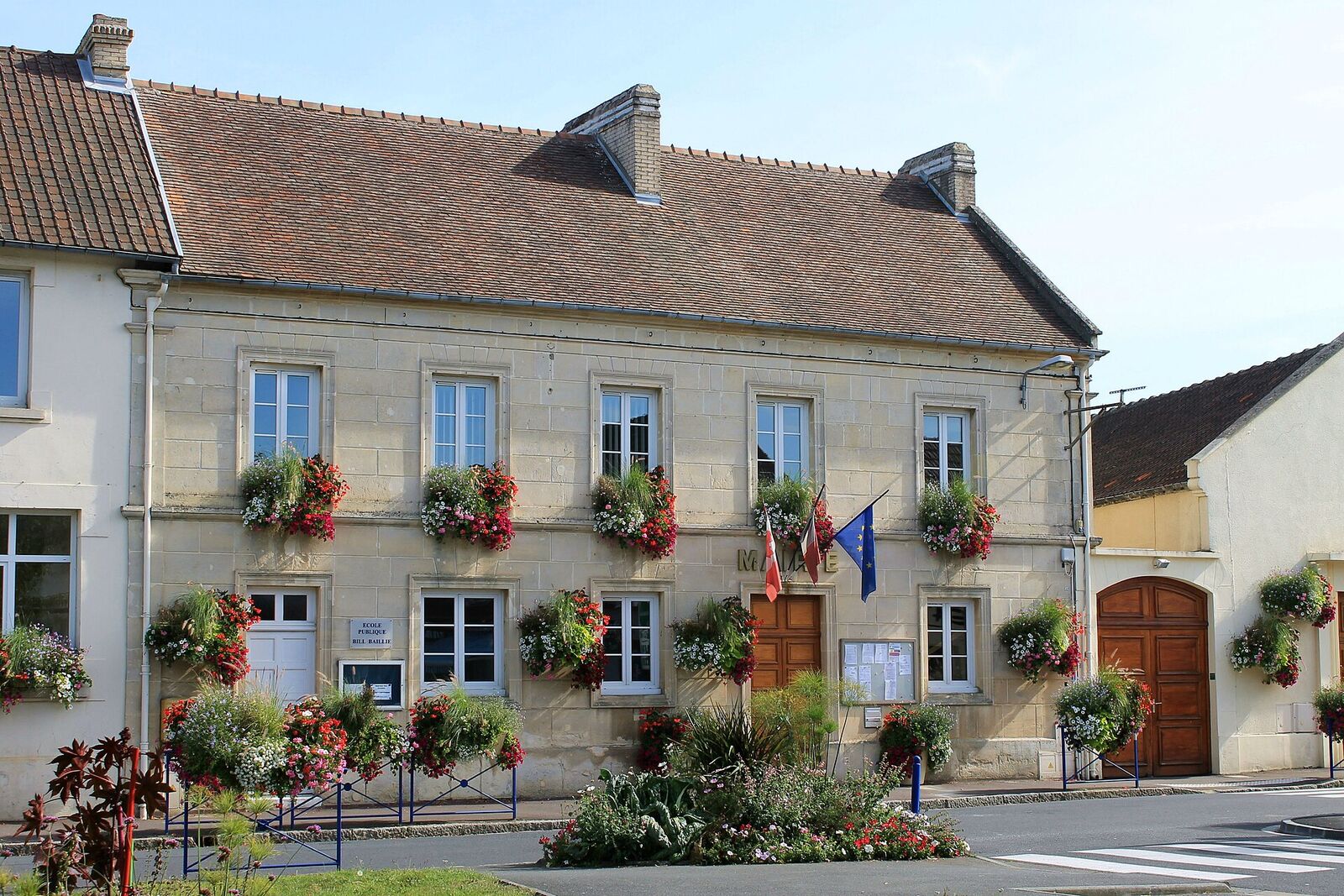
The rebuilt village gives little hint of 1944, but at its heart is the aptly named Place des Canadiens, where the principal memorial stands. Its inscription is plain and deliberate, recording that here and in the surrounding fields the North Nova Scotia Highlanders received their "baptism of fire", and naming the eighty-four soldiers and seven civilians of Authie who died that day. Look for the separate civilian plaque set nearby: the seven villagers are remembered in their own right, a reminder that the price of liberation was paid by residents as well as soldiers.
Authie rewards being read together with the sites around it. The Abbaye d'Ardenne, where the prisoners were taken and murdered, lies only a short drive south and can be visited; its garden memorial is often strewn with small maple-leaf flags left by Canadian pilgrims. Buron, just to the north, and the Sherbrooke Fusiliers' memorial complete a compact circuit that can be walked or driven in a morning. Stand at the Place des Canadiens and orient yourself north toward the beaches: the fields the Highlanders crossed, and could not hold, open out in front of you.
Practical notes
Authie has been swallowed by the north-western spread of the city and is easiest reached from the ring road, a few minutes out from the centre and signposted through the neighbouring suburbs. There is no visitor car park; the memorial stands on the Place des Canadiens in the middle of the village, and you park on the street beside it as you would anywhere residential. The site is open ground, free, and there at any hour.
Twenty minutes or half an hour is enough unless you walk out toward the fields. The square is paved and flat and the memorials are set at ground level, so it is straightforward with a wheelchair or a pushchair; follow the lanes north into the farmland and the surfaces get rougher, with stretches that have no pavement at all.
This is a short stop rather than a destination, and it reads best as part of a morning that takes in the abbey and the ground between here and the coast. The Mémorial de Caen is only a few minutes away and supplies the campaign context that a roadside memorial cannot.