Carpiquet
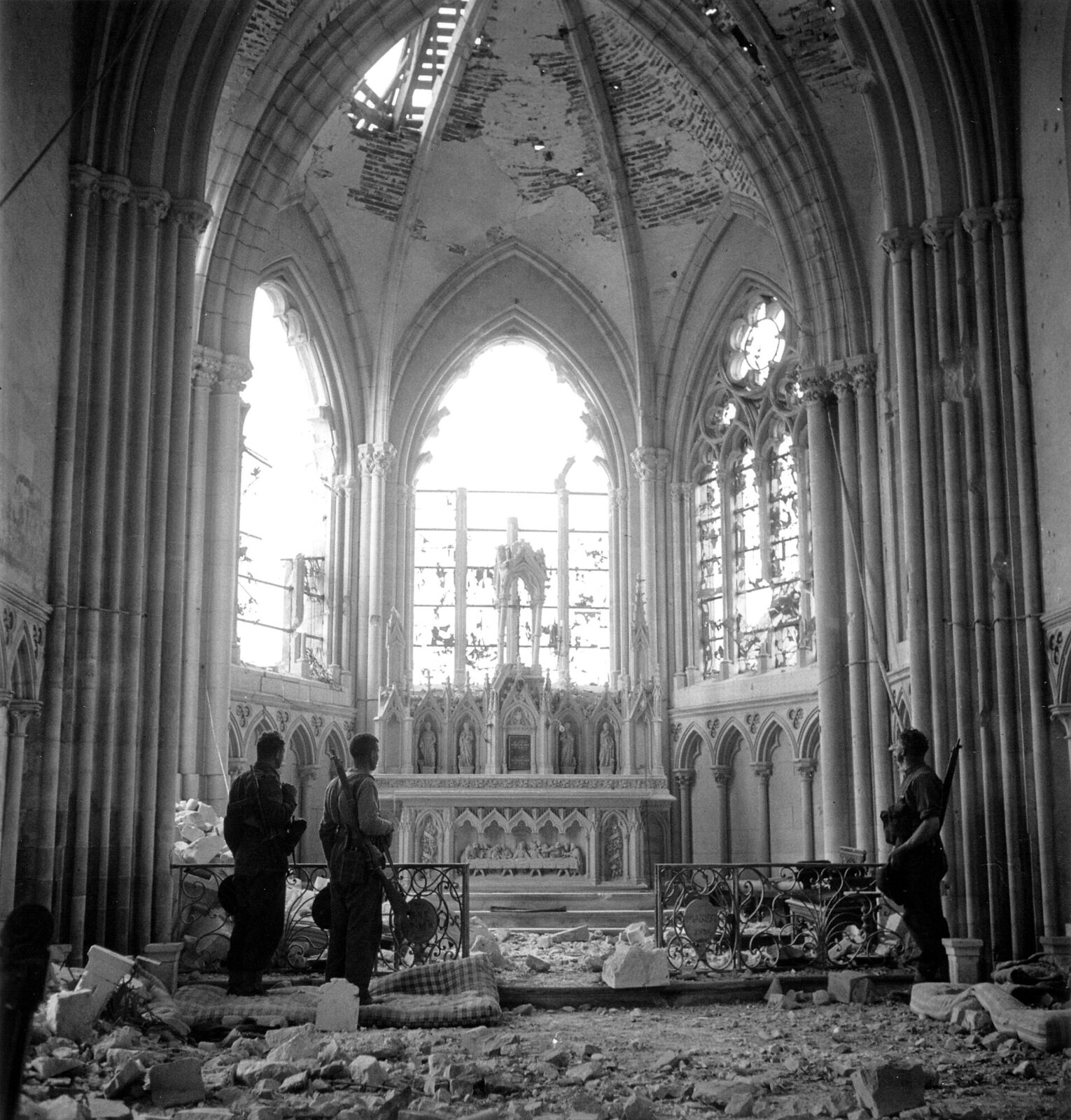
A village and airfield west of Caen, assaulted by Canadian troops in Operation Windsor on 4 July 1944 against fanatical resistance from the 12th SS Panzer Division "Hitlerjugend". The fight for its runways was among the hardest of the struggle for Caen.
West of Caen the land opens into a flat, treeless plateau, and it was this openness that made Carpiquet so costly. Today the plateau still carries an airport - Caen's small commercial airfield - but in July 1944 its runways and hangars formed one of the most heavily fortified positions the Canadians faced in the whole struggle for the city. The village and its aerodrome sat squarely across the western approaches to Caen, and neither side could afford to let the other hold them.
Operation Windsor
The attack, code-named Operation Windsor, opened at dawn on 4 July 1944. It fell to the 8th Canadian Infantry Brigade of the 3rd Canadian Infantry Division - the Queen's Own Rifles of Canada, Le Régiment de la Chaudière, and The North Shore (New Brunswick) Regiment - with the Royal Winnipeg Rifles borrowed from the neighbouring brigade to seize the hangars, and Fort Garry Horse tanks in support. One of the heaviest bombardments yet mounted in the campaign preceded them, the guns of some twenty-one field regiments joined by rocket-firing Typhoons overhead and naval gunfire from the coast.
The defenders were the 12th SS Panzer Division "Hitlerjugend", young, ideologically hardened, and dug in behind minefields, machine-gun nests, gun pits and buried tanks. The village itself was cleared by mid-afternoon in bitter house-to-house fighting. But the airfield was another matter. To reach the hangars on the southern side, the infantry had to cross more than a mile of open, level ground swept by fire, and here the attack broke down. The control buildings and southern hangars stayed in German hands, and over the following days Kurt Meyer's SS launched repeated counter-attacks that the Canadians beat off but could not overcome.
Windsor cost 377 Canadian casualties, 127 of them killed, most on the first day; the North Shore and the Winnipeg Rifles were hit hardest. The Chaudière had already suffered badly before the attack even began, shelled in their forming-up area. The airfield fell only on 9 July, during the larger Operation Charnwood, after a massive bombing of Caen. For men who fought it, "the hell of Carpiquet" needed no embellishment.
What to see today
Carpiquet is an easy detour from Caen, and the ground itself is the main exhibit - stand at the edge of the plateau and the lethal openness the infantry had to cross is immediately, physically obvious. The airport still functions, so the runways are not accessible, but the flatness that shaped the battle is unmissable from the surrounding roads.
In the village, look for the Canadian memorial on Avenue Charles de Gaulle, dedicated on the sixtieth anniversary in 2004. Its inscription names Major Gauvin and his comrades of the Chaudière alongside the Queen's Own Rifles, the North Shore Regiment and the Fort Garry Horse, and closes with the village's own words of "eternal recognition." A separate stele honours the North Shore (New Brunswick) Regiment, whose bond with the town endures in a twinning with Miramichi, marked by a planted maple.
Seek out the church of Saint-Martin, whose oldest fabric is medieval and whose surviving fourteenth-century doorway is a listed monument. The building was wrecked in the fighting; one of the best-known photographs of the battle shows Canadian infantry moving through its shattered nave. Carpiquet also remembers its own dead - a memorial recalls the civilians of the commune killed during the bombardments, many of them sheltering when the shells came.
For those with time, the surrounding fields hold the wider story. A short drive away lie Ardenne Abbey, where Canadian prisoners were murdered by the 12th SS in June 1944, and the village of Authie, both of which deepen the account of what the "Hitlerjugend" defence of this airfield truly meant.
Practical notes
The village lies just off the main road west out of Caen, on the far side of the airport from the city, and is signed from the ring road. Ignore the airport terminal turning and carry on into the village itself, where there is free parking on the street near the church and the mairie. The memorials on Avenue Charles de Gaulle are a short walk from there, and everything worth seeing is within a few hundred metres.
Three quarters of an hour covers the village comfortably. The ground is flat, the pavements are ordinary village pavements and the walk between the memorials and the church is level and easy, so this is one of the more straightforward stops on the Caen battlefields for a wheelchair or a pushchair. The one thing you cannot do is walk the battlefield proper: the airfield is operational and fenced, so the sense of that open, fire-swept mile has to be taken from the roads and field edges around it, which is enough.
Come here as part of a loop with the abbey at Ardenne and the outlying villages rather than on its own, or set the whole western fight for the city in context first at the Mémorial de Caen, a ten minute drive away.