Graignes
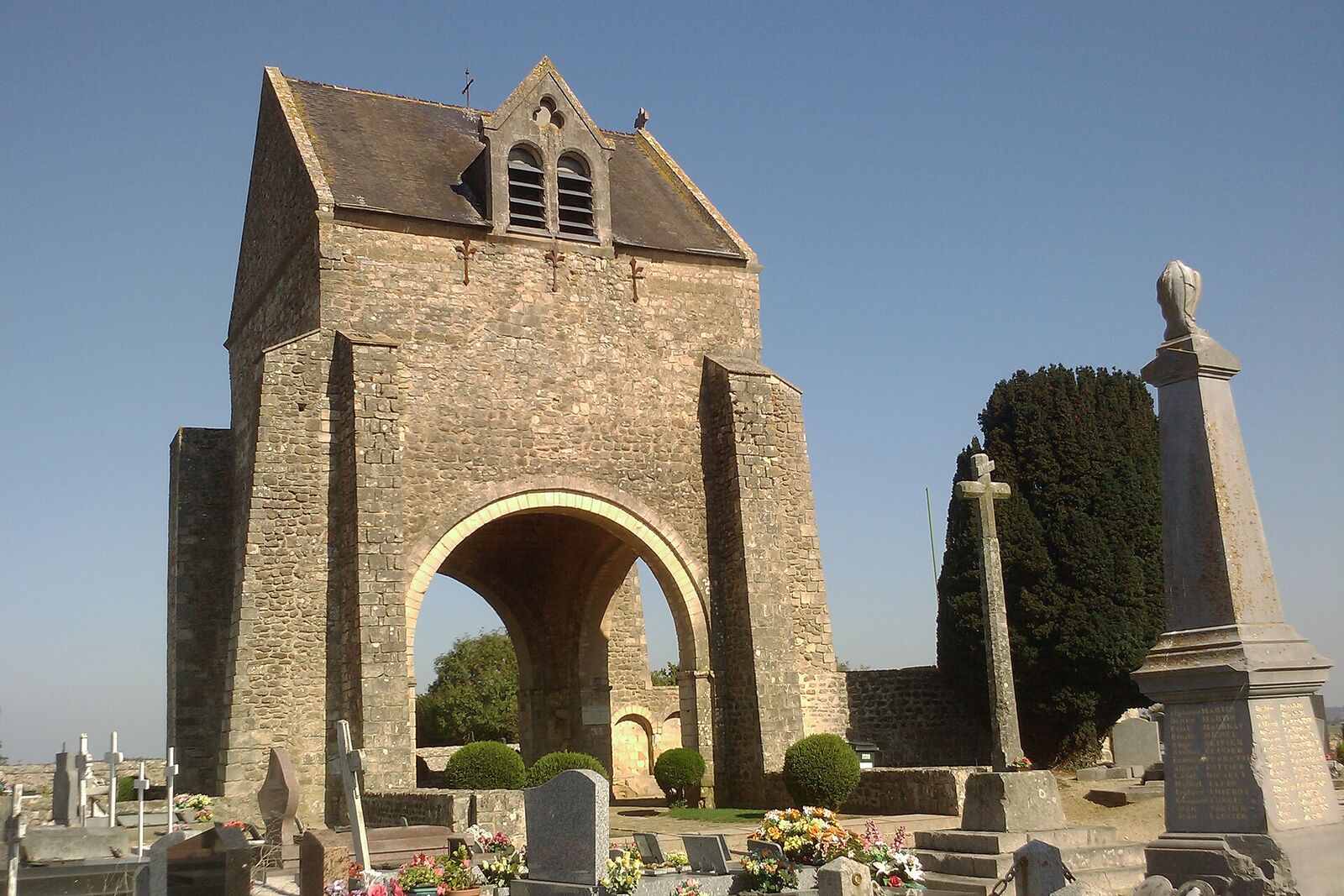
American paratroopers scattered here on D-Day, helped by the villagers, held out against the SS until overrun; reprisals followed against soldiers and civilians alike. The ruined church stands as a memorial to that sacrifice and Franco-American solidarity.
Few places in Normandy tell the story of civilian courage as starkly as Graignes. This quiet farming village, ringed by the marshes of the Cotentin, was never a planned objective. It became a battlefield by accident, and a place of reprisal by design. The roofless church on the rise above the village is the memorial, and standing inside its open nave is the most direct way to understand what happened here.
An accident of the night drop
In the small hours of D-Day, paratroopers of the 3rd Battalion, 507th Parachute Infantry Regiment were scattered far south of their drop zone near Amfreville, coming down instead in the flooded marshland around Graignes. It was among the most badly dispersed jumps of the entire American airborne operation. Over the following days a mixed force of roughly 180 men gathered in the village, well behind German lines and cut off from their divisions.
What made Graignes different was the response of its people. The mayor, Alphonse Voydie, gathered the villagers and they agreed, knowing the danger, to help the stranded Americans rather than turn them out. Villagers recovered supply bundles and weapons that had fallen into the marshes and carried them up to the defenders. At the café, Germaine Boursier organised the women to cook two meals a day for men who would otherwise have gone hungry. Children ran messages. For several days an ordinary community quietly became a garrison.
Bloody Sunday
The attack came on Sunday 11 June, during morning Mass, when troops of the 17th SS Panzergrenadier Division "Götz von Berlichingen" pushed against the village. The paratroopers held through repeated assaults, but they were vastly outnumbered and running short of ammunition. Artillery fire eventually knocked out the observation post in the church tower and killed the American commander. With the perimeter collapsing, the order was given for men to break out and slip away toward Carentan.
What followed was not battle but atrocity. The SS overran an aid station where a young American doctor, Captain Abraham Sophian, had stayed with the wounded. The medical staff and their patients were taken out and murdered. In the days after, the Germans turned on the village itself: the two parish priests, Father Leblastier and Father Lebarbanchon, were killed for having sheltered the Americans, elderly residents were shot, and dozens of civilians lost their lives. The Germans then burned Graignes to the ground. Of some two hundred houses, only a handful were left standing; the twelfth-century church was gutted.
Many of the paratroopers did get away, hidden and guided through the marshes by local families - the Rigaults among them - who risked everything to move them toward Allied lines. Most of the defenders survived because of them.
What to see today
The ruined church is the heart of the memorial and is freely accessible. Rebuilding a new church elsewhere in the village, the community deliberately left these walls open to the sky rather than restore them. Walk in through the old doorway and you stand in the nave where the wounded were sheltered. Where the choir and high altar once stood, a dark granite plaque lists the names of the fallen - American paratroopers and Graignes villagers set down together, which is the point of the place.
Look for the surviving bell tower, the vantage from which the defenders watched the marshes and which drew the fatal shellfire. Interpretive panels around the ruins map the fighting and name the people involved, and a separate memorial honours the villagers, several of whom were later decorated by the United States for their service. Take time in the adjoining space that recalls the civilian dead. Graignes sits off the main tour routes east of Carentan; the detour is short, and the emptiness of the roofless church says more than any museum could.
Practical notes
The village lies in the marsh country south-east of Carentan, reached by small roads off the main axis rather than by any signposted tour route, so set the memorial itself rather than the village centre as your destination. There is parking beside the ruins at the top of the village, and the site is open access and free, with no gate and no attendant.
Half an hour to forty-five minutes is right for most visitors: enough to read the panels, walk the nave and stand a while by the plaque. The approach from the village is uphill, and the ground inside the ruined church is old, uneven paving and grass, with a threshold at the doorway. Wheelchair and pushchair users can reach the terrace and see the shell of the building from outside without difficulty, but the interior is rougher going and there is no handrail.
Graignes works best paired with the marshland sites the same night drop scattered men across. Saint-Côme-du-Mont and the approaches to Carentan are twenty minutes north, and Saint-Lô, with its own story of a town destroyed in the campaign, is a similar drive south if you are continuing inland.