Maisy Battery
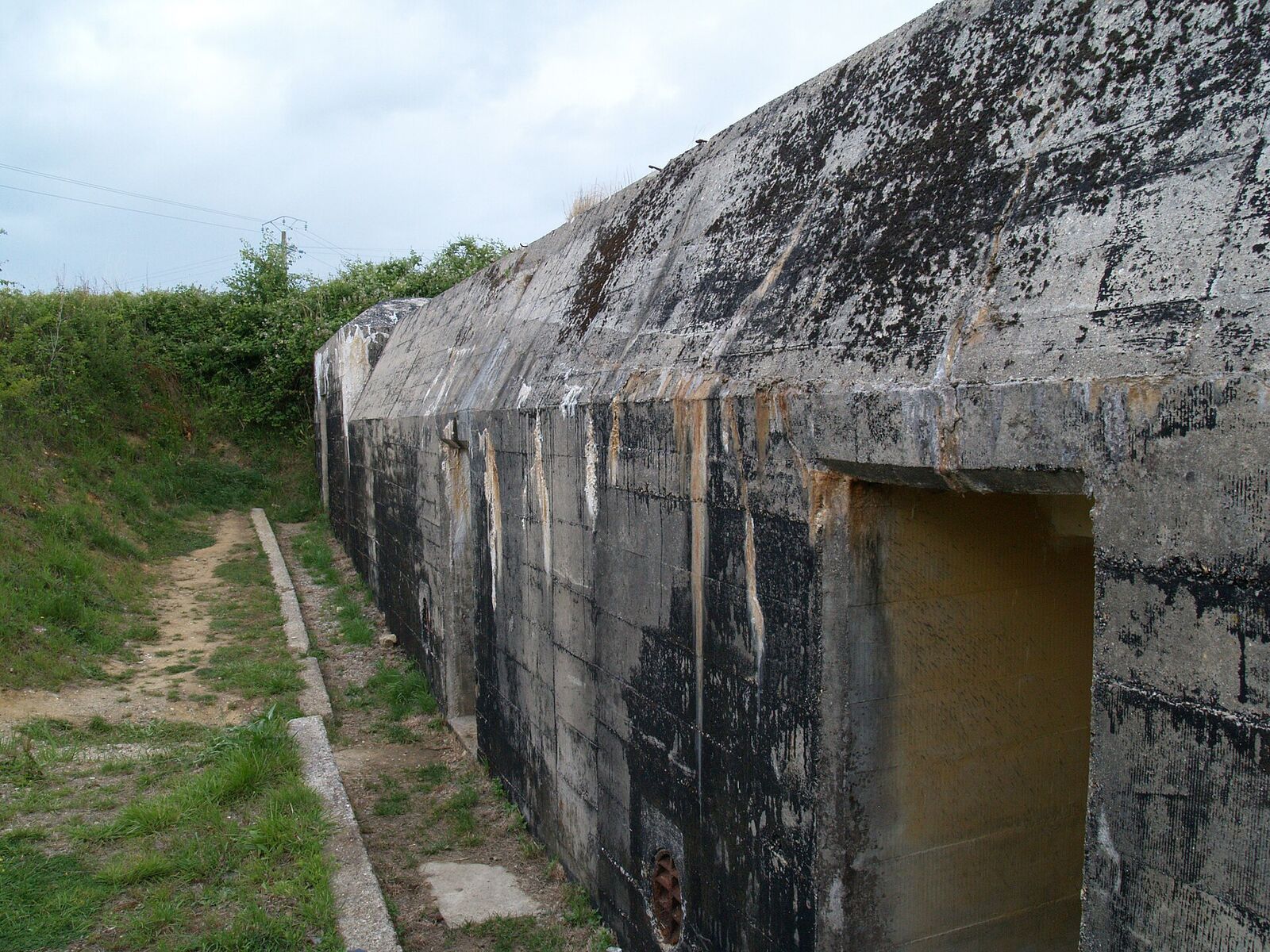
A large German artillery complex between Utah and Omaha that was buried after the war and only rediscovered and excavated in 2004. Visitors can walk hundreds of metres of original trenches and gun pits, giving an unusually raw sense of a wartime position.
Most Atlantic Wall sites announce themselves from the roadside: a grey slab of concrete, a rusting gun, a car park. Maisy does the opposite. It sits back from the lane between Grandcamp-Maisy's fields, largely underground and almost invisible until you are standing in it. For nearly sixty years it was invisible to everyone, buried and forgotten, and its rediscovery in 2004 remains one of the strangest footnotes of the Normandy campaign.
A hidden battery between the beaches
Maisy is not a single gun position but a cluster of them, built by the Organisation Todt using forced labour and sited to cover the mouth of the Vire, the low ground dividing the American landing sectors at Omaha and Utah. The main positions carry Atlantic Wall codes still used today: Les Perruques (WN 83), armed with French-made 155mm field howitzers, and La Martiniere (WN 84) a few hundred metres away, with lighter guns in casemates. Around them the Germans dug an unusually elaborate warren of trenches linking gun pits, ammunition stores, crew shelters, a command post and a first-aid bunker, all screened from the sea and from the air.
That concealment is central to Maisy's controversy. The site was known to Allied planners, yet in the confusion of the first days ashore it slipped through the cracks. The Rangers who scaled the cliffs at nearby Pointe du Hoc found their famous guns had been moved, while Maisy's batteries, further inland, were left largely intact and are reported to have kept firing on the beachhead. Only on 9 June did American Rangers, elements of the 2nd and 5th Battalions, mount a deliberate assault across the position. Veterans recalled a long, close-quarters fight through the trenches, confusing and hard, before the garrison was overwhelmed. How much Maisy actually mattered on D-Day is still argued over by historians; what is not in doubt is that the fight here was real and that it has been oddly absent from the standard accounts.
Lost, then found in a dead man's map
After the war the American army had the whole complex bulldozed and buried, and the fields simply grew back over it. It might have stayed that way but for the British collector Gary Sterne, who in 2004 bought a US veteran's uniform and found, tucked in a trouser pocket, a hand-drawn map marking an "area of high resistance" inland from the beaches. Following it, he traced the buried battery, bought the land piecemeal, and began excavating by hand. What emerged over the following years was extraordinary: kilometres of original trench, gun platforms, and bunkers preserved almost exactly as they had been sealed in. The site opened to visitors in the mid-2000s.
What to see today
Give yourself time and decent shoes, because Maisy is walked rather than viewed. A path leads you down into the trench system, and from there you follow well over two kilometres of original earthworks, deep enough in places to close out the modern world entirely. This is the site's real value: unlike the polished museums elsewhere, you experience the position as its crews did, moving between gun pits and shelters below ground level.
Look for the circular howitzer emplacements, some fitted with heavy field guns and ringed by reconstructed sandbag revetments to show how they worked. Step into the low personnel bunkers, built for ten or twelve men, and note the air vents and the stepped entrances up to daylight. Seek out the command and radio rooms and the underground aid post. Signage is deliberately plain, numbered panels in French and English, with no audio gimmickry. Guided tours run with the family who excavated the site, and are worth catching for the human detail behind the concrete.
Practical notes
Maisy is signed off the coast road at Grandcamp-Maisy and reached down a narrow lane inland, with parking on site at the entrance. It is privately owned and ticketed, which is worth knowing if you are used to the free open-access bunkers along this coast. Because it is a working excavation rather than a landscaped monument, there is no café and little shelter, so come prepared for the weather.
Allow at least an hour and a half, and closer to two if you walk the full trench circuit or catch one of the guided tours. This is not a site you can take in from the car park.
Terrain is the one real caveat. You spend the visit down inside earthworks with gravel and bare earth underfoot, uneven in places, with steps up to the gun platforms and shelters, and it turns muddy after rain - proper shoes rather than sandals, and not a realistic proposition for a wheelchair or a pushchair. Above ground the site sits among open fields with almost no shade. It pairs well with a look round Grandcamp-Maisy itself, a working fishing harbour a few minutes away, and with the very different atmosphere of La Cambe German War Cemetery a short drive inland.