La Cambe German War Cemetery
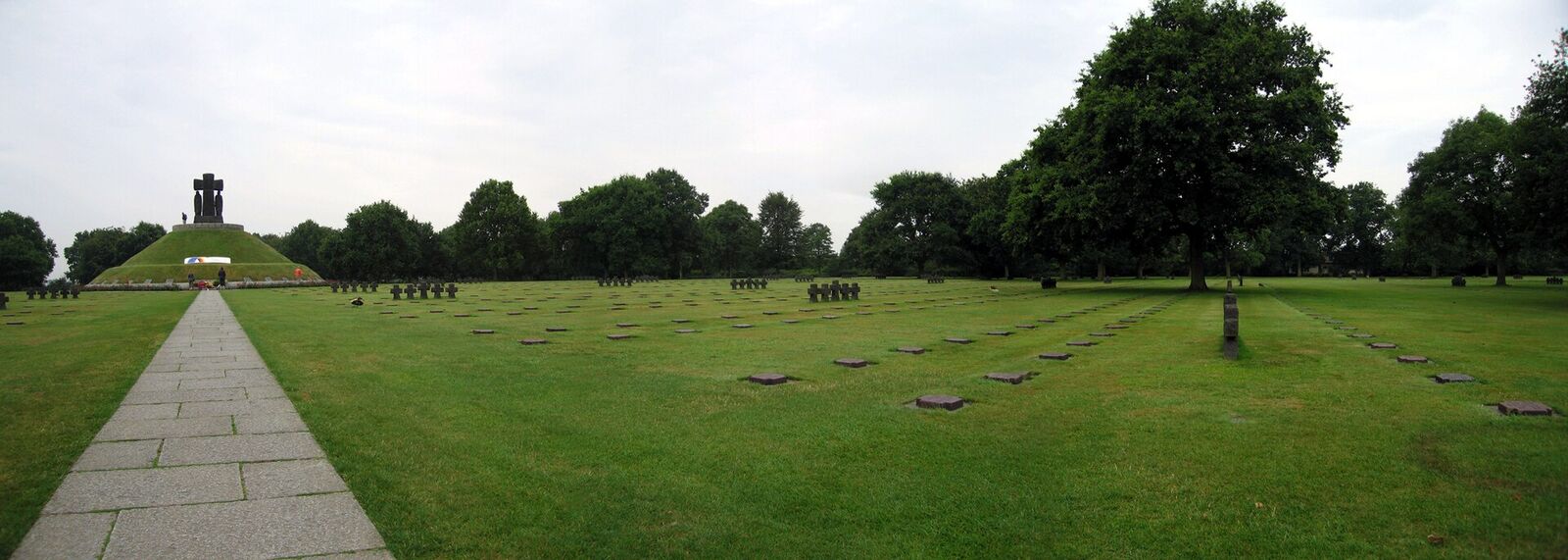
The largest German war cemetery in Normandy, holding over 21,000 dead beneath dark basalt markers and grassed mounds. A sombre counterpoint to the Allied cemeteries, it is centred on a tumulus topped by a cross and is tended as a place of reconciliation and peace.
Most visitors to the Omaha sector spend their day among the white marble of the Allied dead. La Cambe is the other half of that story, and it feels entirely different the moment you pass through the low, dark gatehouse. The grass is greener, the stone almost black, and the mood heavier. This is where the men who defended these beaches lie, more than 21,000 of them, and the cemetery makes no attempt to soften what that means.
What happened here
The ground was first opened as a battlefield burial site in June 1944, dug by an American graves registration unit that interred both American and German dead in adjacent fields. After the war the American remains were repatriated or moved to the clifftop cemetery above Omaha Beach, and La Cambe was given over entirely to the German fallen. The great expansion came after the 1954 Franco-German war graves agreement, when roughly twelve thousand soldiers scattered in field graves across Calvados, the Manche and the Orne were gathered here. The cemetery was formally inaugurated in 1961.
Most of the men buried at La Cambe died in the ten weeks between the landings and the closing of the Falaise pocket in August 1944. They range in age from teenagers of sixteen to men in their sixties and seventies. A plaque near the entrance sets the tone with unusual honesty, describing it as a resting place for soldiers "not all of whom had chosen either the cause or the fight." It is a cemetery that asks you to hold grief and moral discomfort at the same time.
What to see today
The design is the opposite of the Allied cemeteries. Instead of rows of upright headstones, the graves are marked by dark stone plaques laid flush with the turf, so that from a distance the fields read as bare, open lawn. The markers are grouped in blocks, and the density is startling: many plaques cover two men, so the modest sixteen acres hold a number that dwarfs cemeteries several times its size. Scattered across the grass in clusters of five stand squat, rough-hewn stone crosses, dark and Germanic, which serve to divide the burial sections.
Everything is drawn toward the tumulus at the centre, a broad grassed mound rising above the flat ground and crowned with a massive cross of near-black basalt lava, flanked by two brooding sculpted figures. Beneath the mound is a mass grave holding several hundred soldiers, most of them unknown. Climb the path around it for the best sense of the whole site and its deliberate, sombre geometry.
Two graves draw particular attention, and both are worth thinking about carefully. Around block 47, three blocks up on the right from the entrance, lies the Tiger tank commander Michael Wittmann, whose remains were not identified until 1983; you will often find his marker singled out by wreaths, a reminder of how uneasily military celebrity sits in a war cemetery. Elsewhere in the grounds lies an SS officer linked to the massacre at Oradour-sur-Glane. La Cambe does not curate its dead, and that unflinching honesty is part of what makes it powerful.
Outside the walls, follow the path to the Peace Garden, opened in the 1990s and planted with more than a thousand maple trees. Each can be sponsored in memory of one of the fallen, the donor's name and connection recorded at its base, so the garden grows slowly as an act of individual remembrance. The adjacent information centre holds a searchable database of the graves and an exhibition on the German War Graves Commission, which maintains La Cambe largely through volunteers and donations, often youth work camps who tend the graves in summer. Allow an hour, and come here after the Allied sites rather than before; the contrast is the point.
Practical notes
The cemetery lies just south of the village of La Cambe, immediately off the N13 between Bayeux and Isigny-sur-Mer, and brown signs bring you in from either direction. There is a free car park at the gatehouse with room for coaches, and entry to the cemetery, the Peace Garden and the information centre is free.
The hour suggested above covers the tumulus, the burial blocks and the two much-visited graves at an unhurried pace; add twenty minutes or so if you want to walk the maple avenues of the Peace Garden properly. Underfoot the site is flat, and the main approach from the gatehouse is a firm surfaced path, so the entrance area and the information centre are manageable with a wheelchair or a pushchair. The burial blocks themselves are mown grass that turns soft and heavy in wet weather, and the tumulus is reached by a sloping path, so the centrepiece of the site involves a modest climb.
The obvious pairing is Pointe du Hoc, a short drive north and a complete change of register, or the harbour at Grandcamp-Maisy if you want somewhere to eat between the two.