Normandy American Cemetery
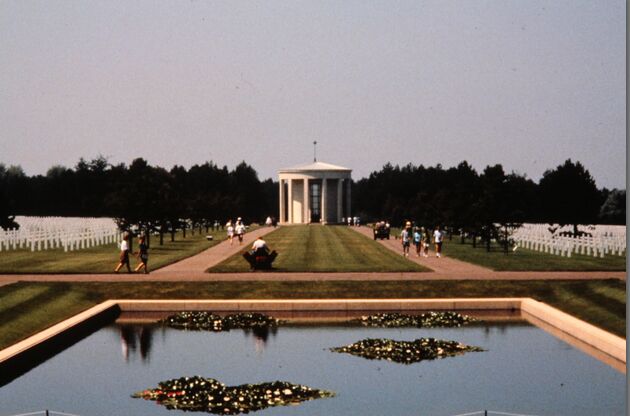
Set on the bluff above Omaha Beach, this 70-hectare cemetery holds the graves of 9,388 American war dead, their white marble crosses and Stars of David aligned across the lawns. A reflecting pool, memorial colonnade and visitor centre overlook the Channel. It is among the most visited sites of the Normandy landings.
Most visitors arrive knowing the numbers already. What the numbers do not prepare you for is the geometry: the way the headstones resolve into perfect rows from whichever angle you stand, and the way the whole cemetery is turned deliberately westward, toward the United States and home. Set on the bluff at Colleville-sur-Mer, directly above the eastern end of Omaha Beach, this is ground the American army fought up on the morning of 6 June 1944. The men buried here are, in a sense, still holding it.
What happened here
The first American burials on this stretch of coast were hasty field graves, dug within days of the landings as the fighting pushed inland. A temporary cemetery was established close to the beach almost immediately, and it was only after the war that the site was consolidated into the permanent memorial you see today, on land granted to the United States by France. Families were given a choice: repatriation home, or permanent burial overseas among the men their sons and husbands had served beside. The graves here represent the families who chose to leave them in Normandy.
Not everyone buried here died on the beach below. The cemetery gathers dead from across the wider Normandy campaign, and a smaller number from other operations, so the crosses and Stars of David span weeks of fighting far beyond D-Day itself.
Names to look for
Two graves in particular reward the walk. The first belongs to Brigadier General Theodore Roosevelt Jr., son of the president. At 56, walking with a cane and a heart condition he concealed, he came ashore with the first wave at Utah Beach and, finding the landing craft had drifted off course, made the decision to fight the war "from right here." He was awarded the Medal of Honor and died of a heart attack in Normandy a few weeks later. Beside him lies his brother Quentin, a fighter pilot killed in the First World War and brought here in 1955 so the two could rest together - two brothers, two wars, one row.
Nearby are the graves of two of the Niland brothers, whose family story - several sons at war, believed lost, one ordered home - became the seed of the film Saving Private Ryan. The film's own headstone was a prop, but these are real. When you find them, note how ordinary the stones look: nothing distinguishes them from the thousands around them, which is rather the point.
What to see today
Enter from the visitor center and walk toward the sea. The memorial rises first: a semicircular colonnade framing Donald De Lue's bronze figure, The Spirit of American Youth Rising from the Waves, and behind it two great stone maps that trace the landings and the campaign that followed - worth reading slowly to understand the ground under your feet. A long reflecting pool draws the eye down the central axis toward the graves.
Turn to the curved Walls of the Missing, inscribed with more than 1,500 names of men never recovered or identified. Look closely for the small bronze rosettes set beside a handful of names: each marks a man since found and accounted for, a quiet running correction to the record.
Step into the chapel at the center of the field and look up - the ceiling is a vast mosaic in which America blesses her departing sons and France receives their sacrifice. Outside, seek the overlook where a path descends toward Omaha Beach itself, so you can stand where the cemetery's whole meaning began.
Time your visit for the end of the day if you can. The lowering of the flags and the sounding of taps, carried out each afternoon before closing, is brief and without ceremony, and it is the moment most visitors remember longest.
Practical notes
The cemetery is signed off the D514 coast road just east of the village of Colleville-sur-Mer, and it has a large free car park beside the visitor centre. Entry is free. Security screening at the entrance means bags are checked, so travel light and expect a short queue at busy times.
Allow at least two hours, and half a day if you intend to take in the visitor centre properly as well as the graves, the memorial and the overlook. The centre alone absorbs an hour, and rushing it is a false economy.
Once past the entrance the whole site is level, hard-surfaced and generously wide, and it is one of the easiest places on this coast to visit with a wheelchair or a pushchair; the only demanding section is the path down from the overlook to the beach, which is stepped and steep. The Overlord Museum sits a few hundred metres away at the cemetery roundabout and makes a natural pairing, and the German cemetery at La Cambe, a quarter of an hour west, is the counterweight that most visitors find they want afterwards.