Overlord Museum
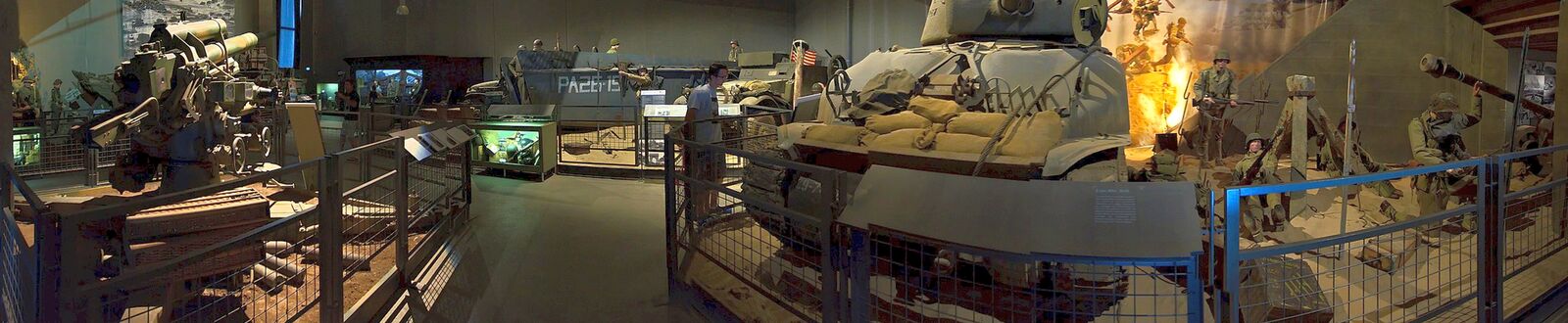
Near the American Cemetery, this museum displays a large collection of restored tanks, vehicles and artillery alongside detailed dioramas tracing the campaign from the landings to the liberation of Paris. Its open-air and indoor exhibits make the scale of the Allied build-up vivid.
Most visitors arrive here having just walked the rows of white crosses at the Normandy American Cemetery, a few hundred metres up the road. The Overlord Museum offers a different kind of encounter with the same history: not the human cost, but the sheer industrial machinery that made the liberation possible, gathered over a lifetime by one Norman man who refused to let the battlefield's iron be scrapped or forgotten.
One man's forty-year obsession
The collection is the life's work of Michel Leloup, a forestry operator and sawyer from the Norman countryside. In the aftermath of the war the fields and hedgerows around him were littered with the debris of the fighting, and where others saw scrap, Leloup saw history worth saving. The turning point came in 1971, when he pulled a German half-track out of a sawmill; from there a private hoard grew into something extraordinary. He first opened his collection to the public in a former cheese factory at Falaise in the 1980s, a location he chose deliberately because no museum then told the story of the closing of the Falaise pocket and the end of the Normandy campaign.
His son Nicolas carried the vision to its natural home. In June 2013, on the eve of the anniversary of the landings, the collection reopened here beside Omaha Beach, purpose-built to hold what had outgrown every earlier space.
What is on display
The museum traces the campaign in sequence, from the assault on the beaches through the hedgerow fighting and the breakout to the liberation of Paris. Around forty tanks, vehicles and artillery pieces representing the half-dozen armies that fought here are set into large, meticulous dioramas: full-size figures, period vehicles and reconstructed streets and fields, with soundtracks meant to place you inside the moment rather than behind a rope. Bilingual panels give each machine its own story, so the armour reads less as hardware than as witnesses that survived.
Several pieces reward a closer look. A Panther, one of the more formidable German tanks of the war, is displayed slung beneath a Strabokran gantry crane of the type used to lift tank engines in the field; intact examples of such cranes are vanishingly rare. Nearby stands a colossal FAMO half-track, the heaviest artillery tractor the German army built, of which only a handful survive worldwide; the museum's example absorbed something on the order of ten thousand hours of restoration across seven years. Most of these vehicles were recovered from Norman soil, and several carry their own local histories, including armour captured and turned against its former owners in the final weeks of the fighting.
Do not hurry past the smaller objects. Among them is a grappling hook of the kind the Rangers fired up the cliffs at Pointe du Hoc, retrieved after the battle and kept for decades by a local civilian, one of the very few to survive in anything like complete condition.
Practical notes
Begin outside, where a Sherman and other heavy equipment stand on the lawn and set the scale before you go in. Inside, follow the chronological route rather than wandering, so the story builds as its makers intended, and allow more time than you expect; the dioramas repay slow looking. The visit ends with a wall of portraits, faces of the men who lived this history, a quiet counterweight to the steel that fills the halls, and a fitting note on which to step back out toward the beach and the cemetery.
Coming off the D514 coast road, take the signed turning for the cemetery at Colleville-sur-Mer; the museum stands on the roundabout on the access road to the Normandy American Cemetery, roughly five hundred metres from both the cemetery gates and Omaha Beach, with its own large free car park and ample room for coaches. Admission is ticketed. Because the cemetery car park fills first on busy days, arriving at the museum end and walking on is often the easier way to do this stretch.
Allow an hour and a half, and rather longer if you read the panels properly. The halls are large, level and under cover, with wide aisles between the dioramas, so the interior suits a wheelchair or a pushchair well; the outdoor vehicles stand on grass and gravel, which is firm in dry weather and less so after rain. There is no shortage of seating, and the route is a single loop, so you can pace it.
The natural half day is museum, cemetery and beach in that order. If you want the German side of the same ground, Widerstandsnest 62 is barely a kilometre away above the sand, and the strongpoint makes far more sense once you have seen what came ashore against it.