Widerstandsnest 62
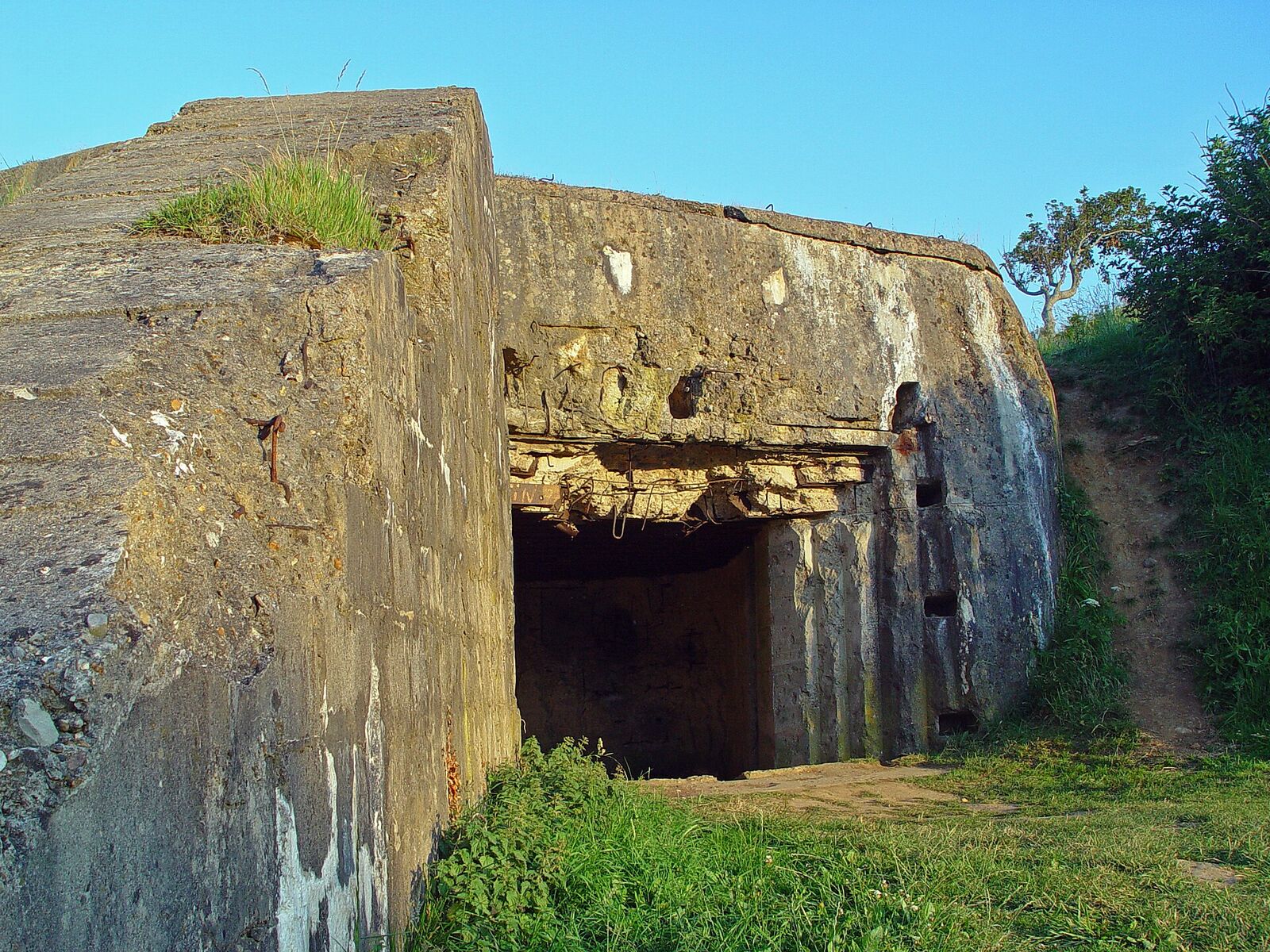
One of the German strongpoints that made Omaha Beach so deadly, overlooking the eastern draw. Its surviving bunkers and the position once manned by gunner Heinrich Severloh now sit beside memorials to the US 1st Infantry Division on the bluff above the sands.
Of the fifteen strongpoints the Germans strung along Omaha Beach, none did more damage than the one the defenders numbered 62. It sits on the bluff at the eastern end of the beach, just below what is now the American Cemetery, on high ground that looks straight down two natural exits from the sand. From here the field of fire was almost total. Men coming ashore on the Easy Red and Fox Green sectors had nowhere to hide, and the position kept firing for the better part of the day.
Why this ground mattered
A Widerstandsnest, literally a "resistance nest," was not a single bunker but a whole fortified pocket of trenches, gun pits and shelters knitted together to cover a stretch of coast. WN 62 was among the largest on Omaha, spread over two tiers of the slope roughly twelve to fifty metres above the tideline. Its concrete casemates were built for 7.5cm field guns, though only one of the two gun houses is thought to have been armed on 6 June. Around them ran zig-zag trenches linking machine-gun nests, an 8cm mortar set into a circular Tobruk pit, an underground personnel shelter and observation posts. The layout was deliberate: overlapping arcs of fire so that the whole beach in front could be swept without leaving a safe lane. American infantry, engineers and tank crews landing in the first waves were funnelled into exactly the killing ground the position had been designed to cover.
The man behind the gun
The strongpoint is inseparable from one soldier's name. Heinrich Severloh was twenty years old, an artilleryman of the 352nd Infantry Division serving as orderly to Lieutenant Bernhard Frerking, whose job was to direct artillery fire from an observation post here. By his own later account Severloh spent much of the day behind an MG 42, firing an enormous quantity of ammunition down onto the beach and switching to a rifle when his machine-gun belts ran low. Because he was reduced to using tracer rounds, the smoking line of his fire eventually gave his position away to the warships offshore. Resupplied until mid-afternoon, he finally slipped back to the village of Colleville as the position was overrun, and surrendered the following day. His postwar memoir, titled simply WN 62, made him briefly famous as the "Beast of Omaha," with claims of a thousand or more casualties inflicted. Historians treat those numbers with real caution, but the account still conveys something rare: the battle seen from the concrete looking out, rather than from the water looking in.
What to see today
The site is open, free and unstaffed, reached by the coastal path east of the American Cemetery car park. Start at the upper tier, where the ground is capped by the memorial to the 5th Engineer Special Brigade, mounted directly on top of a bunker. Nearby stands the granite memorial to the 1st Infantry Division, the "Big Red One," carved with the names of the men who fell in this sector and the division's motto, "No Mission Too Difficult, No Sacrifice Too Great, Duty First." From here walk down through the two surviving casemates. Look closely at the concrete: the deep scars and blown corners are the marks of naval shellfire and tank rounds aimed at silencing the guns. Between and below them, follow the shallow depressions running across the field, all that is left of the fighting trenches, and find the circular Tobruk pits that held mortars and machine guns.
An orientation panel maps the whole complex and is worth a minute before you explore. Then turn and face the sea. The single most useful thing at WN 62 is the view: stand where the guns stood, look down the long open slope to the water, and the reason Omaha cost what it did needs no explaining.
Practical notes
Most visitors park at the cemetery above Colleville, which has a large free car park, and walk out from there; the strongpoint lies just below and east of the cemetery grounds on the seaward side of the bluff, and can also be reached by climbing up from the beach car park at the foot of the Colleville draw. There is no gate and nothing to pay.
Three quarters of an hour covers the two casemates, the memorials and the trench ground, though most people stay longer once they have found the view. The going is rough: sloping grass, worn earth paths, uneven concrete and open drops around the Tobruk pits, with no handrails and no lighting inside the shelters. It is not suitable for a wheelchair, hard work with a pushchair, and better done in proper shoes than sandals. Children need watching near the pits and the bluff edge.
The cemetery immediately above is the natural companion. If you want vehicles and artefacts to set against the bare ground here, the Overlord Museum stands beside the same approach road, and Saint-Laurent-sur-Mer a little to the west puts you at the centre of the beach.