Saint-Laurent-sur-Mer
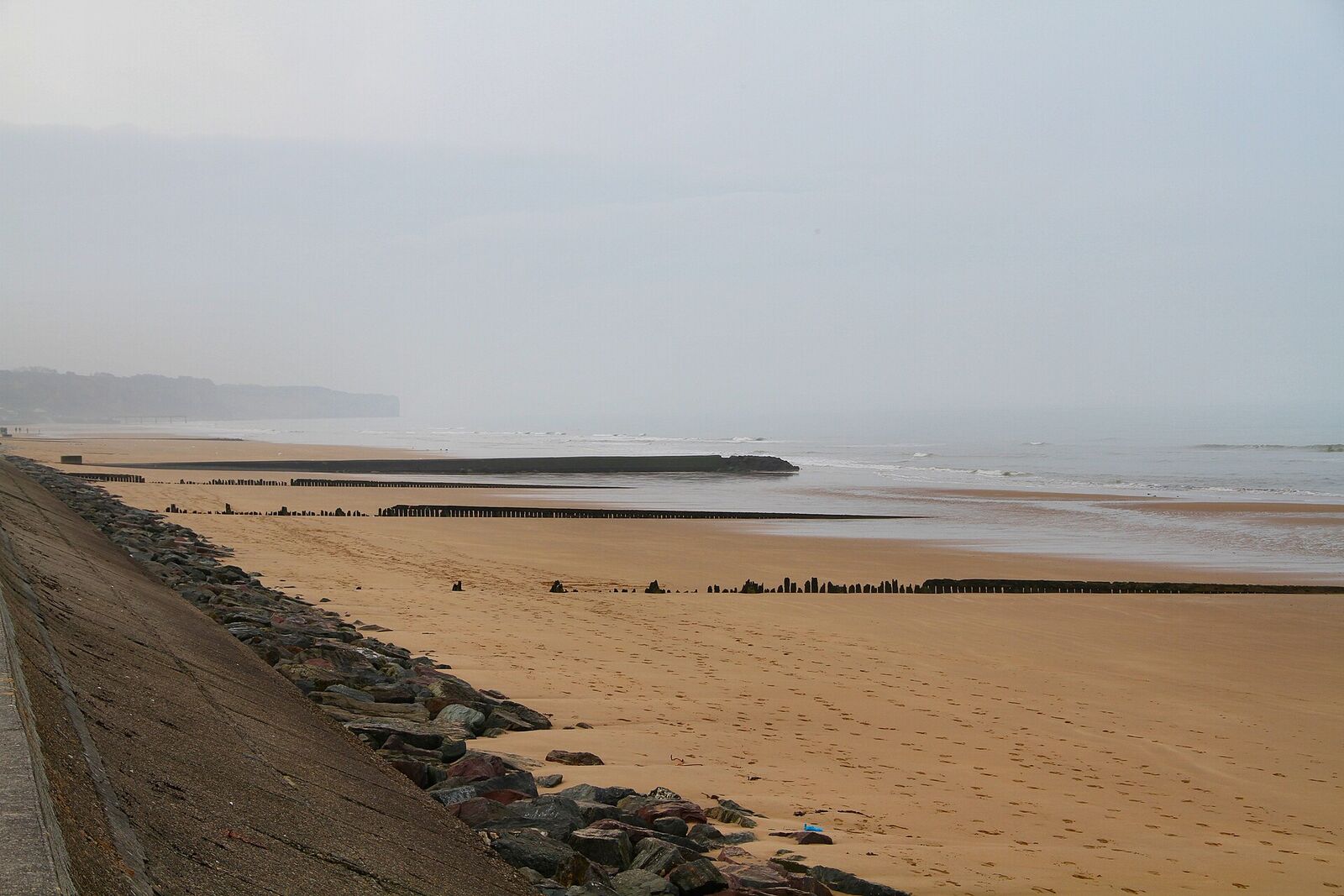
A village behind the centre of Omaha Beach, overlooking the D-3 draw and the site of the Mulberry "A" artificial harbour. The first temporary American cemetery in France was laid out here in June 1944 before the dead were reinterred at Colleville.
Most visitors reach Saint-Laurent-sur-Mer without realising they have arrived at the dead centre of Omaha Beach. The village lies just inland of the shingle, strung along the shallow valley the invasion planners labelled the D-3 draw, or Les Moulins - one of only a handful of natural exits where men and vehicles could climb off the sand and into Normandy. Everything that made this stretch of coast so lethal on 6 June 1944, and so important in the weeks that followed, is concentrated within a short walk of the seafront here.
The D-3 draw and the fight for Les Moulins
The Germans understood that the beach could be sealed simply by holding the draws, and they fortified Les Moulins with unusual care. The valley mouth was blocked by an anti-tank wall and a long V-shaped ditch, covered by strongpoints on the bluffs to either side. When the first waves of the 116th Infantry Regiment - the "Stonewallers" of the 29th Division - came ashore against the Dog Red and Easy Green sectors, they were cut down in the open before they reached the shingle bank.
For hours the draw stayed shut. Progress came not through the valley but up the bluffs on foot, in small groups. One party, led by Major Sidney Bingham, pushed into the ruined seaside houses at the foot of Les Moulins and clung on under heavy fire while others worked inland along the high ground. A detail often overlooked: grass and brush fires on the bluffs threw up drifting smoke that, for a while, screened part of the beach from German gunners - an accident of the bombardment that quietly saved lives. By the following day the village itself had been cleared, and Les Moulins became one of the main arteries feeding the beachhead.
A supply port and the first war graves
Because it sat behind the centre of the beach, Saint-Laurent quickly turned into a logistics hub. Offshore, engineers began sinking blockships to form a breakwater, part of the American "Mulberry A" - the prefabricated artificial harbour towed across the Channel to land supplies until a real port could be captured. The great storm of mid-June wrecked Mulberry A beyond repair; its scattered remains lie under the water off this coast. Inland, an emergency airstrip was scraped out within days to fly wounded men back to England.
It was here, too, that the U.S. Army laid out the first temporary American cemetery in France, on the high ground overlooking the beach where so many had fallen. In the weeks after D-Day nearly 3,800 Americans were buried in its rows. After the war the dead were reinterred - many just to the east, at the permanent Normandy American Cemetery above Colleville-sur-Mer, others repatriated home at their families' request.
What to see today
Walk down to the beach at Saint-Laurent and you stand in front of the D-3 draw itself; a memorial on the seafront marks the exit the assault troops fought so hard to open. Rising straight out of the sand is Anilore Banon's stainless-steel sculpture "Les Braves," its tall curved blades catching the light at every tide - the most striking modern monument on Omaha Beach, and easy to reach at low water.
A few steps back, at Les Moulins on the Avenue de la Libération, the Omaha Beach Memorial Museum gathers vehicles, weapons and personal effects from the sector. Turn your back to the sea and look up at the bluffs: the ground rising on either side of the valley is the slope the infantry had to climb under fire. Knowing that the graves of nearly four thousand men once covered the fields above lends the quiet, holidaymaking calm of the village a weight that is easy to miss.
Practical notes
The seafront is reached by turning off the D514 and dropping down the Avenue de la Libération to a car park at the bottom by the sand. That descent is the D-3 draw itself, so the drive in is already part of the visit. The beach is open access and free at any hour; the museum at the top of the avenue is ticketed.
An hour is enough to walk out to Les Braves, read the memorials and get your bearings, with another hour for the museum. Time the visit against the tide if you can, because the sculpture stands out on the sand and is best approached at low water, when the beach is broad and firm.
The promenade and the seafront are flat and paved, which makes this one of the easier Omaha stops with a wheelchair or a pushchair; the soft sand above the tideline and the bluff paths climbing either side of the valley are another matter, being steep and unsurfaced. Next door, the Overlord Museum and the strongpoint at Widerstandsnest 62 are each a few minutes by car and complete the picture of the sector.