Bény-sur-Mer Canadian War Cemetery
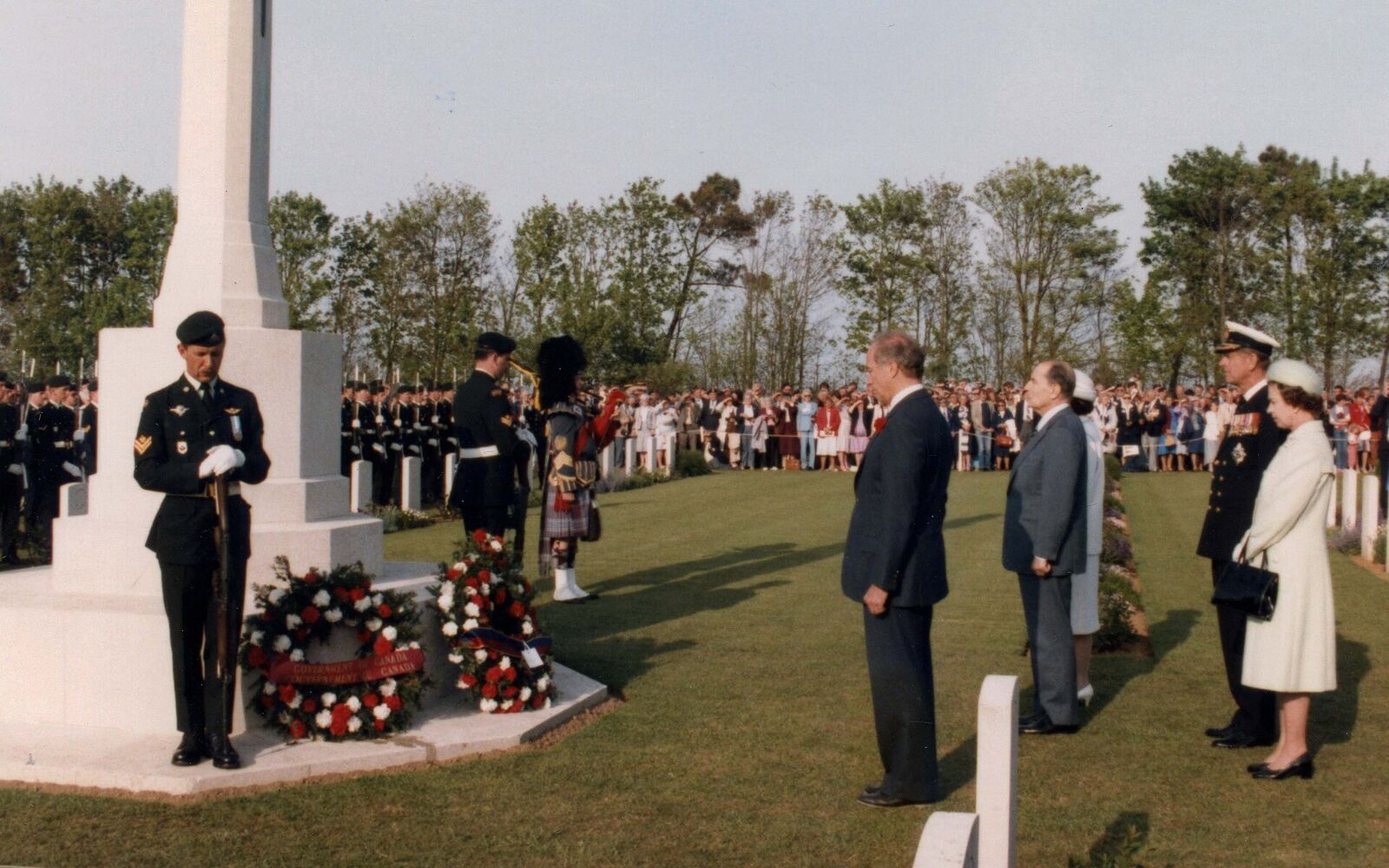
The resting place of 2,049 Canadians, most of whom fell on Juno Beach and in the advance towards Caen. Twin sandstone shelters, neat headstones and Norway maples give the cemetery a distinctly Canadian character a few kilometres inland from the landing beach.
A few kilometres inland from the noise and crowds of Juno Beach, the land rises gently through wheat fields towards the village of Reviers. Here, on the north side of a quiet country road, lies the largest Canadian cemetery of the Normandy campaign. Most visitors reach Juno first and only later climb the slope to Bény-sur-Mer, which is exactly the journey the men buried here made in reverse: they came ashore on the beach and pushed inland, and this is roughly as far as many of them got.
Why the cemetery is here
The great majority of the men at Bény-sur-Mer served in the 3rd Canadian Infantry Division and its supporting armour, the formation that assaulted Juno on 6 June 1944 and then fought its way toward Caen. The division drew its battalions from across the country - Ontario, Quebec, the Prairies and the Maritimes - so the headstones read like a roll-call of Canada itself. The cemetery sits inland rather than on the beach because it grew up behind the advancing front, close to where the fiercest fighting of the first weeks took place. Alongside the infantry lie a small number of airmen, three British soldiers and a member of the French Resistance. Nineteen of the graves are unidentified.
Some of the men here did not fall in open battle. In the days after D-Day, Canadian prisoners were murdered by soldiers of the 12th SS Panzer Division "Hitlerjugend" near the Abbaye d'Ardenne, on the approaches to Caen. A number of those victims rest at Bény-sur-Mer, and their presence is a reminder that the story of Juno did not end at the water's edge.
The Westlake brothers
Walk the rows and you will find, again and again, the same surname on adjacent stones. Bény-sur-Mer holds nine sets of brothers - an extraordinary concentration of family loss. The best known are the three Westlake brothers from Toronto. George, serving with the North Nova Scotia Highlanders, was killed on 7 June, the day after the landings. Four days later his brothers Albert and Thomas, both riflemen with the Queen's Own Rifles of Canada, were killed together; found side by side, they were buried side by side. George lies only a few rows away. The brothers had lost their father as boys and were known to be unusually close; a park in Toronto now carries their name. Their three headstones, so near one another, tell in a single glance what the casualty figures cannot.
What to see today
The cemetery was designed by Philip Hepworth, one of the Commonwealth War Graves Commission's principal post-war architects, and it has a character quite unlike the beach memorials. From the road you pass between two low sandstone shelter buildings framing the entrance. Do not simply walk through them: each has a narrow stair to an elevated viewing platform, and from the top the whole cemetery opens out below you - the long central axis, the ranked headstones and the Cross of Sacrifice at the far end. It is the best vantage point on the site and one most visitors miss.
The planting is deliberately Canadian. Maples stand among the graves, turning the plots into something that would not look out of place at home, a quiet act of belonging on foreign soil. Take time to read the personal inscriptions chosen by families at the foot of the stones; the ages recur in the late teens and early twenties. Look, too, for the single headstone set slightly apart from its neighbours - it marks a soldier whose exact resting place within the cemetery could not be fixed, an honest admission carved in stone.
Bény-sur-Mer is open every day and free to enter. It rewards a slow, unhurried visit - and it pairs naturally with the beach at Courseulles-sur-Mer and the Juno Beach Centre a short drive to the north.
Practical notes
The cemetery stands beside a country road between Reviers and Bény-sur-Mer, a few minutes inland from the coast road, and is signed from the villages either side. There is space for a handful of cars at the entrance; the lane is narrow, so pull well in. Entry is free and there is no ticket office.
Allow forty-five minutes to an hour, and longer if you intend to read inscriptions rather than walk the axis and leave. The ground is level and the mown grass paths between the plots are firm in dry weather, so the main walk from the entrance to the Cross of Sacrifice is manageable with a wheelchair or a pushchair, though the turf softens after rain. The one part that is not accessible is the stair inside each shelter building up to the viewing platform: a narrow, steep flight with no alternative way up.
Most people fold the cemetery into a Juno morning. Graye-sur-Mer, with its buried Churchill AVRE and the Cross of Lorraine on the dunes, is a few minutes north, and inland the underground radar bunkers at Douvres-la-Délivrande make a very different companion piece if you have half a day rather than an hour.