Juno Beach Centre
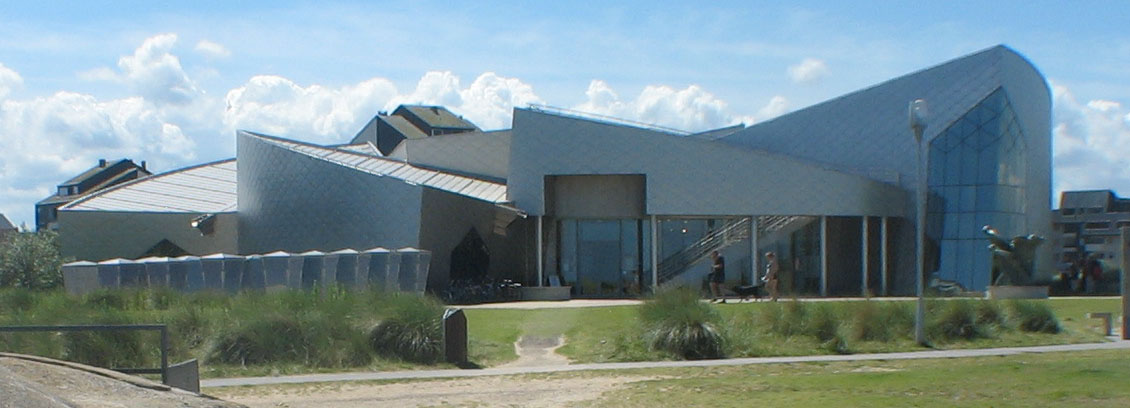
Canada's museum on the Normandy coast, opened in 2003 to tell the story of the Canadian war effort and the men who landed on Juno. Its striking pentagonal design, exhibitions and guided bunker tours make it the focus of remembrance along this stretch of beach.
The Juno Beach Centre stands roughly a hundred metres back from the sand at Courseulles-sur-Mer, on the very ground a German strongpoint held on the morning of 6 June 1944. It is Canada's only museum on the invasion coast, and it exists because a group of veterans refused to let their war fade into a footnote of a mostly American and British story. What they built is less a war museum than a portrait of a country, framed by the beach where thousands of young Canadians came ashore.
What happened on this shore
Juno was the responsibility of the 3rd Canadian Infantry Division. Its stretch of coast, about ten kilometres wide, straddled the small fishing harbour of Courseulles and the villages of Bernières and Saint-Aubin. Courseulles itself was one of the most heavily fortified points assaulted on D-Day: a German strongpoint knitted together from anti-tank guns, machine-gun casemates and a warren of tunnels, held here by a company of the 736th Infantry Regiment.
The 7th Canadian Infantry Brigade landed in front of Courseulles, the Regina Rifle Regiment and its neighbours fighting through the town's defences house by house, while the 8th Brigade came ashore to the east at Bernières and Saint-Aubin. Many landing craft struck beach obstacles on the run-in, and the infantry often arrived without the shelter of their supporting tanks. The first minutes were murderous. Yet by the end of the day the Canadians had pushed further inland than any other Allied force, a feat that cost them dearly in the crossing.
A building shaped like a country
The centre opened on 6 June 2003, the culmination of a grassroots campaign led by the veteran Garth Webb and his partner Lise Cooper, eventually backed by Canadian and French governments and private donors. The Canadian architect Brian K. Chamberlain gave it a striking form: a low, five-pointed structure clad in scales of titanium, its geometry evoking a maple leaf and the five invasion beaches. Inside, the exhibitions deliberately reach beyond the single morning of the landings. They trace Canada before the war, the vast civilian and military effort a young nation poured into the fight, and the country it became afterward, so that a visitor leaves understanding who these soldiers were and what they returned to.
What to see today
Between the building and the dunes stands the sculpture Remembrance and Renewal, and in a gap in the dune line a symbolic landing-craft form honours the French Resistance, with an intact German observation bunker beside it. But the most rewarding part of a visit lies in Juno Park, the strip of preserved fortifications behind the centre. This was German strongpoint Stützpunkt 31, once bristling with some thirty bunkers and gun positions. Canadian university students, spending a season on the coast, lead guided tours through the surviving works: a large observation bunker that once carried a steel-domed machine-gun post, and an underground command post rediscovered only in 2010 and opened to visitors in 2014, linked by tunnel to the post above. The bunkers can be entered only on these tours, which is reason enough to time your visit around one.
Give yourself time for the surrounding villages, which the centre helps make legible. At Bernières, a short drive east, the seafront house known as the Maison des Canadiens is remembered as one of the first buildings liberated, taken by the Queen's Own Rifles within minutes of their costly landing; nearby stands an Inukshuk raised in memory of Indigenous Canadians who fought and fell here. West of Courseulles, at the edge of Graye-sur-Mer, rises the tall Cross of Lorraine marking where General de Gaulle stepped back onto French soil on 14 June 1944, after four years of exile. Seen together, they turn an afternoon at the museum into a walk across the whole Canadian day.
Practical notes
The centre stands at the seaward end of the Voie des Français Libres, the road that runs out past the harbour at Courseulles-sur-Mer to the dunes; follow signs for the museum rather than the town centre and you arrive at its own car park, with space for coaches. Admission to the museum is ticketed, and the guided tours of the bunkers in Juno Park are booked at the desk when you arrive, so it is worth asking about the next departure before you start on the exhibitions.
Allow two hours for the building alone and closer to three if you take a bunker tour and walk the dune path. Inside, the museum is modern, level and lift-served, and the approach from the car park is paved, so it suits a wheelchair or a pushchair without difficulty. Juno Park is another matter: the paths between the fortifications are sand and compacted gravel, the dunes rise and fall, and the underground command post is entered by a steep steel stair into a low tunnel. Sea wind here is constant, so bring a layer even in summer.
Almost everyone follows the museum with the villages either side, which take an hour or two more, and with Bény-sur-Mer Canadian War Cemetery a short drive inland, where many of the men whose stories you have just read are buried.