Graye-sur-Mer
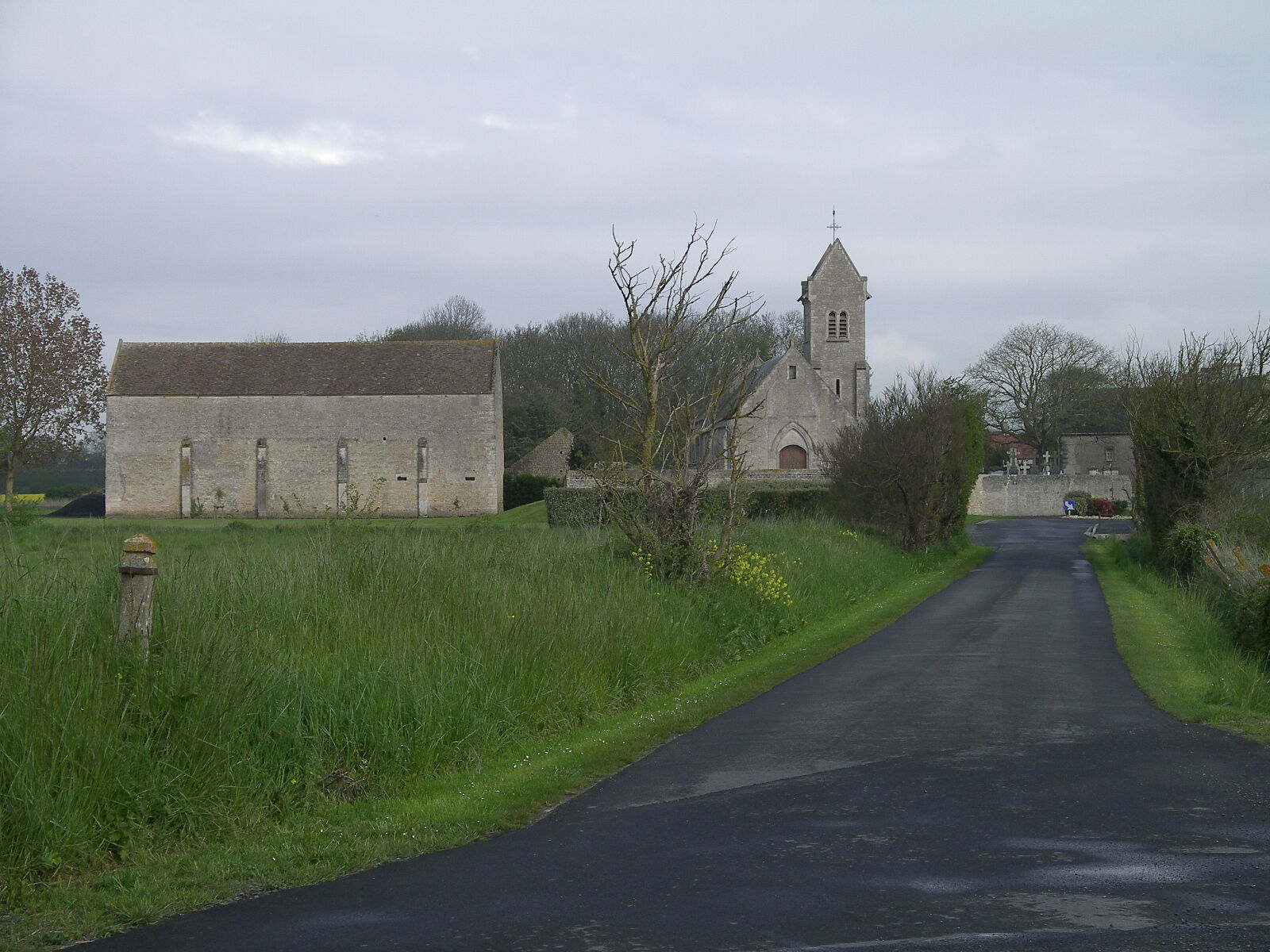
A village behind the western end of Juno Beach where a Churchill AVRE tank bogged down on D-Day; recovered from the marshes decades later, it now stands as a memorial. Nearby a Cross of Lorraine marks the spot where General de Gaulle returned to French soil on 14 June 1944.
On the morning of 6 June 1944, Graye-sur-Mer sat directly behind the western exits of Juno Beach, in the sector the Canadians codenamed Mike. It was not a heavily fortified village, and the fighting here was decided less by concrete strongpoints than by water, mud, and the narrow lanes leading off the sand. Two of Normandy's most evocative monuments now stand within sight of each other on the dunes, and the story of each rewards a visitor who slows down to look.
The tank that became a bridge
The armoured relic beside the road is a Churchill AVRE - an Armoured Vehicle Royal Engineers, a Churchill tank rebuilt to carry engineers who cleared obstacles under fire. This one, known to its crew as "One Charlie," came ashore at H-Hour with the 26th Assault Squadron, Royal Engineers, supporting the 7th Canadian Infantry Brigade.
Just inland, the low ground behind the dunes was crossed by a culvert and flooded by the Germans as an anti-tank obstacle. As One Charlie tried to work its way past this waterlogged gap, it foundered and sank into a crater. What happened next is the detail casual visitors miss: rather than being simply lost, the stranded tank was deliberately used. Engineers packed the crater and built their crossing over and around it, so that the vehicles following off the beach could pass. One Charlie spent D-Day not as a wreck but as the buried foundation of a roadway - a bridge made of a tank.
The cost was borne by its crew, most of whom were killed or badly wounded in the action. The tank then vanished into the marshy ground for three decades. It was located and dug out in the mid-1970s, restored, and raised here as a memorial in 1977, standing only a short distance from where it went down. The bond it created lasted lifetimes: in later years the ashes of one of its drivers were scattered beside it, at his own wish, so that he could return to the machine and the ground he had survived.
The Cross of Lorraine
A short walk away, on the boundary between Graye-sur-Mer and Courseulles-sur-Mer, an immense steel Cross of Lorraine rises from the dunes - the emblem of the Free French. It marks the spot where, on 14 June 1944, eight days after the landings, General de Gaulle stepped back onto French soil for the first time since 1940. He had crossed from England aboard the Free French destroyer La Combattante, and from this beach he went inland to Bayeux, the first liberated town of any size on the continent, to assert the authority of Free France before the Allies could impose their own administration.
The cross you see today is a monument of the modern era, raised in 1990 for the centenary of de Gaulle's birth and inaugurated in the presence of his son. At eighteen metres it is visible from far along the shore, a deliberate counterweight to the very British and Canadian character of the beaches around it.
Practical notes
Read the plaque on the tank before you circle it: it names the unit, the H-Hour landing, and the crew, and it is worth standing where the ground falls away toward the dunes to picture the flooded gap that trapped the vehicle. From the Cross of Lorraine the view opens across the sand toward Courseulles and the Juno Beach Centre, a few minutes to the east. Come at a low, quiet hour if you can; the site is at its most eloquent when the beach is nearly empty and the scale of both the machine and the cross has room to register.
Both monuments stand at the seaward end of the village, reached from the D514 coast road and then down the Voie des Français Libres to the dunes. Parking is free and a short walk from each, and the whole site is open access at any hour with nothing to pay.
Allow thirty to forty-five minutes for the tank and the cross together, and a little longer if you want to walk the beach between them.
The approach roads and the hard standing around the AVRE are level, and both monuments can be reached and seen properly with a wheelchair or a pushchair without going onto the sand. Beyond that the ground changes quickly: the dunes are soft, loose and uneven, and the boardwalks and sandy paths through them are hard work on wheels and slippery after weather. Firm sand appears only at low tide. The natural continuation is east along the shore to Courseulles and the museum on the beach there, or a few minutes inland to the Canadian graves at Bény-sur-Mer, where many of the men who came off this stretch of sand are buried.