Saint-Aubin-sur-Mer
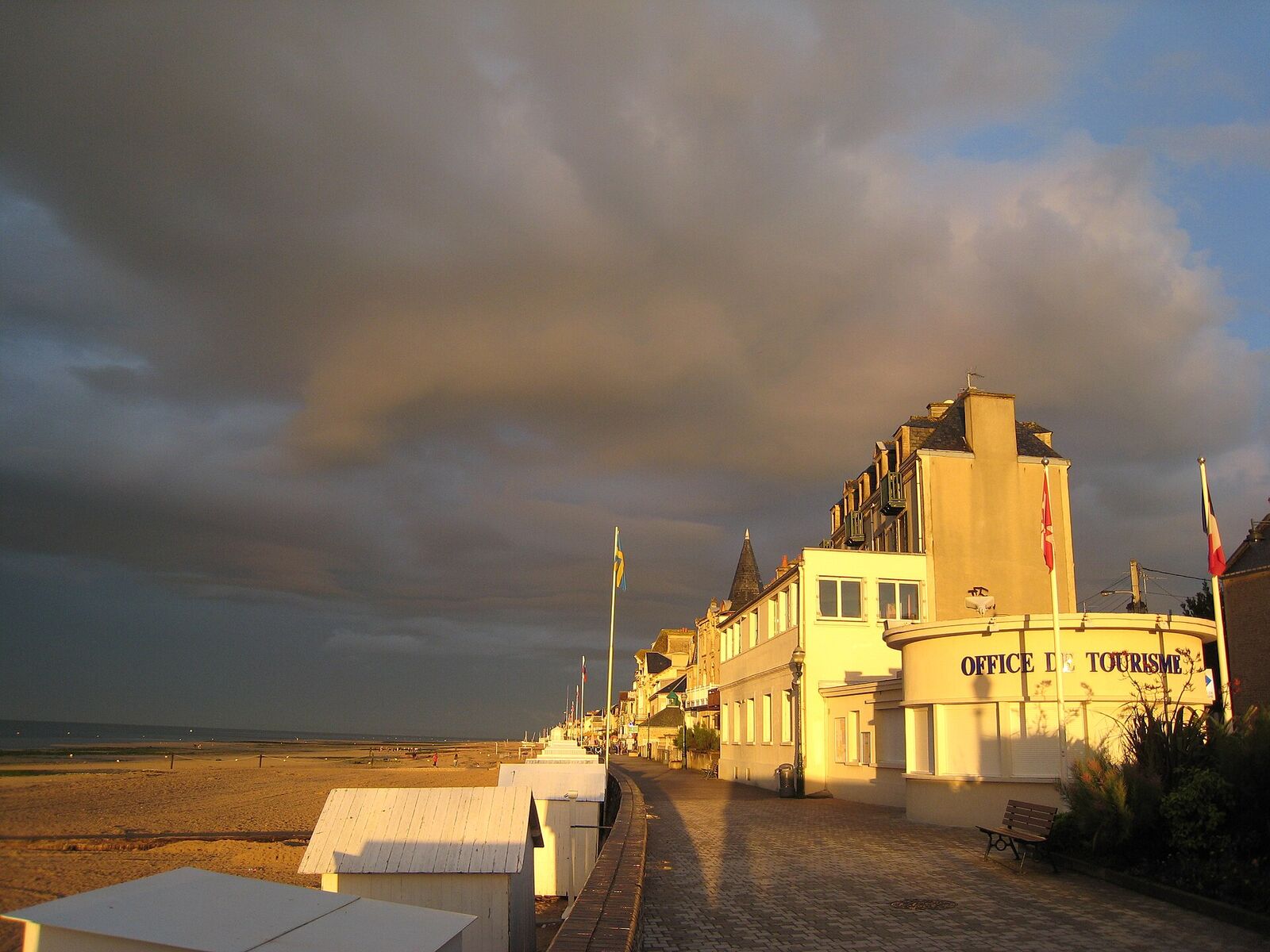
A seaside resort at the eastern edge of Juno Beach (Nan Red sector), assaulted by Canadian infantry and British commandos on D-Day. A preserved German 50 mm gun casemate, scarred by Allied fire, still stands on the seafront promenade.
Of all the villages strung along Juno Beach, Saint-Aubin-sur-Mer keeps its scars closest to the surface. The German gun casemate that held up the assault on the morning of 6 June 1944 still stands on the seafront, its 50 mm barrel pointing along the sand exactly where it once swept the beach. Few of the sunbathers who pass it on the promenade realise they are walking through the heart of a strongpoint that cost a Canadian regiment dearly.
The eastern edge of Juno
Saint-Aubin marked the boundary of the Nan Red sector, the far-left flank of the Canadian landings. The task of taking it fell to the North Shore (New Brunswick) Regiment, part of the 8th Canadian Infantry Brigade, supported by the amphibious Sherman "DD" tanks of the Fort Garry Horse. A poignant detail is easy to miss: many North Shore men were Acadians, French-speaking descendants of settlers who had once left this very corner of France for Canada. Two centuries on, their sons came back to liberate it.
The regiment landed a few minutes behind schedule into a heavy sea, opposite the strongpoint the Germans called Widerstandsnest 27. Preliminary bombardment had failed to silence it. Its reinforced casemate, machine guns and mortar caught the leading companies as they crossed the open sand, and its anti-tank gun knocked out several of the first tanks ashore. The defenders, drawn from Grenadier-Regiment 736 and stiffened by Eastern conscripts, fought hard. Spent shell cases counted around the emplacement afterward testified to how long the crew kept firing.
The deadlock was broken by armour. An Armoured Vehicle Royal Engineers, mounting a heavy demolition mortar, worked in close and cracked the casemate open after roughly three-quarters of an hour of fighting. Even then, German infantry fell back into the streets and villas, and the village was not fully cleared until evening, with isolated groups holding out into the next morning.
The commandos' crossing
Behind the infantry came 48 Royal Marine Commando, tasked with pushing east toward Langrune-sur-Mer to link Juno with Sword. Their landing was among the worst on the whole front. Fire from the still-active strongpoint raked their craft as they came in; men were hit before they reached the sand, and others, swimming from landing craft snagged on the beach obstacles, were dragged under by the surf. The commando came ashore at little more than half strength, many weapons and much of its ammunition lost, and still had to fight its way inland.
What to see today
The casemate is the centrepiece. It stands on the promenade at Place du Canada, low and squat, angled so the sea could never fire straight down its throat. Look for the pale gouges and cratering on the concrete, the marks left by the tank that finally reduced it, and note that the original 50 mm gun is still in place, a genuine rarity on these beaches. Stand behind it and you see the field of fire the way the crew did, straight along the open sand.
Around the bunker, a cluster of memorials repays a slow walk. Stones honour the North Shore Regiment, the Fort Garry Horse (whose plaque records their tanks landing "at H hour"), and 48 Royal Marine Commando. A separate memorial marks the Acadian connection, and each August the village holds "la Semaine acadienne," a week of remembrance and festival that binds Saint-Aubin to New Brunswick and to the men who came home to fight.
Walk east from the casemate along the seafront toward Langrune and you retrace the commandos' brutal advance through what was then a fortified suburb. It is a short stroll now, past cafés and beach huts, but it is worth pausing to measure how far, and at what price, that ground was won.
Practical notes
Saint-Aubin sits on the coast road that runs the length of Juno, and the seafront is signed from every approach into the village. There is parking along the front and around Place du Canada, within sight of the casemate. Everything here is open access and free: the bunker, the memorials and the beach are simply part of the promenade, which is why so many people walk past them without looking up.
Three quarters of an hour covers the casemate and the ring of memorials around it comfortably, and an hour and a half if you walk east along the front toward Langrune and back. It is a good place to combine with a meal, since the cafés are a few steps from the concrete.
The promenade is paved, level and easy the whole way, so a wheelchair or a pushchair has no difficulty with the bunker, the memorials or the walk east; the beach below is reached by ramps and steps, and the sand is soft at the top and firm only nearer the water. The casemate is viewed from outside. Along the coast, the Juno Beach Centre gives the Canadian story in full and needs a couple of hours, and Bernières-sur-Mer, a few minutes west, has the much-photographed seafront house that appears in so many landing photographs.