Hill 112
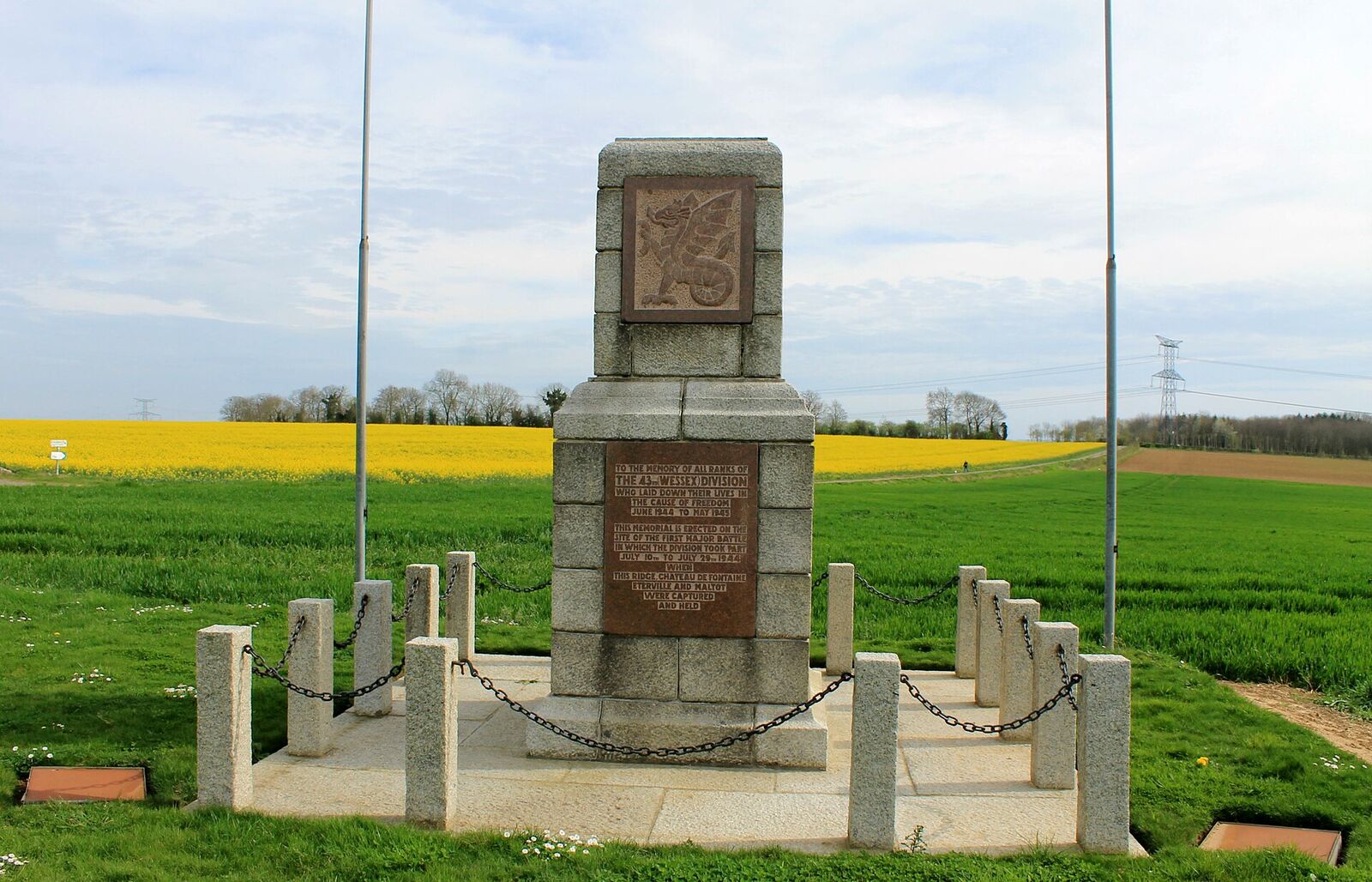
A low ridge west of Caen whose commanding view made it some of the most bitterly contested ground of the campaign through July 1944. Memorials and a surviving Churchill tank now mark the slopes where British and German armour fought at close quarters.
Drive the narrow lanes south-west of Caen and the ground barely seems to rise at all. Yet this shallow swell of farmland, 112 metres above sea level, was worth an appalling number of lives in the summer of 1944. From its long crest you can see for miles across the Odon valley in every direction, and in July that view made Hill 112 a place both sides believed they could not afford to lose. German commanders are said to have judged that whoever held it held the road to Caen; the British simply had to take it.
What happened here
Hill 112 was a central objective of Operation Jupiter, launched on 10 July 1944 as the British Second Army tried to prise open the German line west of Caen. The 43rd (Wessex) Infantry Division, supported by armour, attacked across open, gently rising fields with almost no cover, into the fire of dug-in SS panzer units holding the reverse slopes.
The fighting that followed was among the most concentrated of the whole campaign. Men described a landscape stripped of its crops and hedgerows, cratered like the Western Front, fought over yard by yard through choking dust and the smell of burning. On the evening of the attack, a battalion of the Duke of Cornwall's Light Infantry - territorial volunteers, not career soldiers - reached the summit and dug in around a small copse that became known as Cornwall Wood. Through the night German tanks counter-attacked again and again, at times driving directly over the slit trenches. The Cornishmen held, but at a terrible cost: of roughly 380 who went up the hill, some 250 were killed or wounded. Among the dead was their commanding officer, a lieutenant-colonel of twenty-six, shot while observing the enemy from an apple tree.
Neither side truly won Hill 112 that summer. The crest remained a contested no-man's-land, swept by fire, until the wider German front around Caen finally gave way weeks later. So many men from the West Country fell here that local people came to call it the "Hill of Cornwall".
The memorial garden today
The summit is now a quiet garden of remembrance, and its existence owes much to one man. Albert Figg, a Royal Artillery sergeant who fought here in 1944, spent his later years determined that the crews and infantrymen who died on the hill would not be forgotten; he was still working on the site into his nineties, and died in 2017 aged 97.
The most striking feature is a restored Churchill tank, the type that fought and burned on these slopes, set up on the hill in 2000 in memory of the tank crews - many of whom died trapped inside their machines. Nearby stands a bronze infantryman, moved to the centre of the site and unveiled in 2017, and a 25-pounder field gun added more recently. Look, too, at the trees: 112 of them, planted in the shape of a Maltese Cross to form four Avenues of Remembrance, where visitors leave small wooden poppy crosses for named relatives and comrades.
A short distance away, beside the road, is the older stone memorial to the 43rd (Wessex) Division, carved in the years after the war and now cared for by the Commonwealth War Graves Commission. It is one of a family of near-identical monuments the division raised on hilltops back home in Wessex and Cornwall.
Practical notes
Hill 112 sits in open country between the villages of Éterville, Maltot and Esquay-Notre-Dame, with no town at the site itself - satellite navigation struggles here, so aim for the Route de Maltot out of Éterville and watch for the tank. It is exposed and windswept, which is part of the point: stand by the Churchill, look out over the fields the men had to cross, and the ground explains itself.
There is no visitor centre, no ticket and no facilities of any kind at Hill 112, which is worth knowing before you set out. The memorial garden lies beside the road with a gravel pull-in for a handful of cars, so it is best treated as a stop on a wider drive rather than a destination in itself. Fuel, food and toilets are back in the villages or in Caen. The site is open at all hours.
Half an hour to forty-five minutes is about right: long enough to walk the Avenues of Remembrance, read the divisional memorial down the road, and give the view the attention it deserves.
The garden is flat and the going is mostly mown grass with some gravel paths, so a wheelchair or a sturdy pushchair can manage it in dry weather, though the grass turns soft and heavy after rain and there is no hard path to every feature. The tank and the main memorial can be seen from the roadside if the ground is too wet. Nothing here offers shelter from the wind. Combine it with Saint-Manvieu War Cemetery a short drive north, where many of the men who fought on these slopes are buried, or with the Mémorial de Caen for the wider story of the battle for the city.