Saint-Manvieu War Cemetery
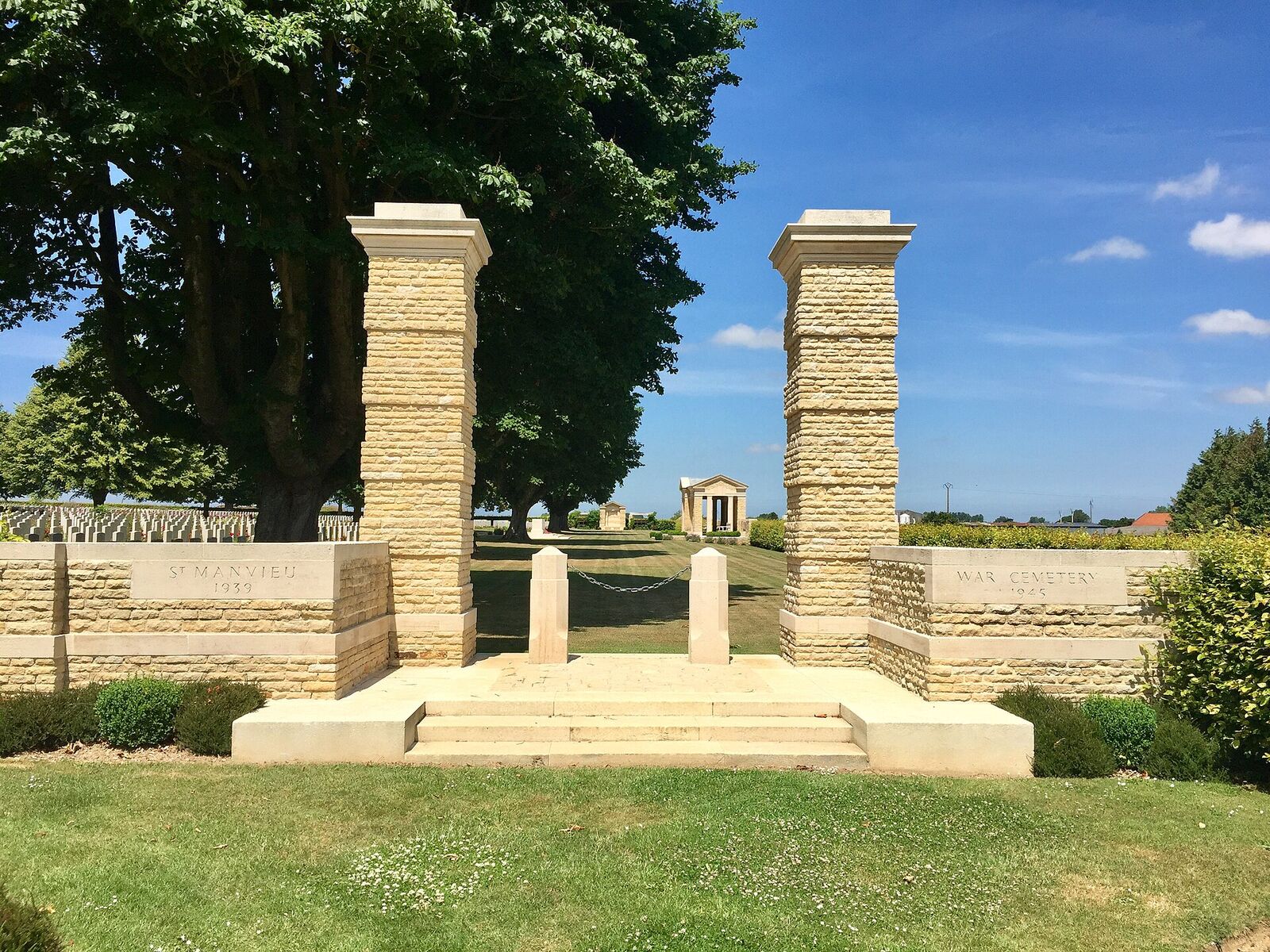
A Commonwealth cemetery at Cheux, west of Caen, holding over 2,000 graves. Many are men of the British divisions who fell in Operation Epsom and the bloody fighting along the Odon valley in late June 1944; German war dead lie here too.
The cemetery sits in open farmland on the D9 west of Caen, between the villages of Cheux and Saint-Manvieu-Norrey. It is quiet, level ground now, hedged and planted, but the flat fields around it are the point: this gently rolling farmland gave attackers almost no cover in the summer of 1944, and the men buried here died crossing it. More than 2,000 lie in the plots, and unusually for a Commonwealth cemetery, hundreds of them wore field-grey.
The fighting west of Caen
Most of the dead fell in the battles fought between Tilly-sur-Seulles and Caen from the middle of June to the end of July 1944, above all during Operation Epsom in the last week of June. Epsom was a British attempt to swing round Caen from the west, cross the little River Odon, and seize the high ground beyond. The assault was led by the 15th (Scottish) Division, whose first task on 26 June was to take Cheux and Saint-Manvieu, the very villages beside this cemetery.
It went slowly and it cost dearly. The Scots advanced behind a rolling artillery barrage into standing corn, fog and drizzle, and into German positions that had not been suppressed. Once across the Odon they held a narrow salient that soldiers came to call the "Scottish Corridor", raked from both flanks and battered by determined counter-attacks. Fighting swirled around Hill 112, the dominating height south of the river, which the Germans clung to for weeks. Epsom did not take Caen, but it drew in and wore down German armour that might otherwise have been used elsewhere. The cost is legible in these headstones, and in how many of them record men in their early twenties or younger.
A cemetery of former enemies
The cemetery was opened while the battle was still going on, receiving its first burials in mid-June 1944, and graves were later concentrated here from the surrounding battlefields. What makes it stand apart is that it holds both sides. Alongside more than sixteen hundred Commonwealth burials lie some 555 German war dead, many of them never identified. They were buried by the same hands, in the same ground, within sight of one another. Standing among the two sets of headstones, the neat Portland stone of the Commonwealth graves and the darker German markers, is a plainer reminder than any monument that the Odon valley was lethal to everyone who fought over it.
What to see today
The cemetery was designed by the architect Philip Hepworth, one of the principal designers of the Commonwealth's Normandy cemeteries, and it has his restrained, almost domestic feel. You enter up a short flight of stone steps to a raised terrace; the shelter building stands near the entrance, with the Stone of Remembrance and its inscription "Their Name Liveth For Evermore" set before it. The Cross of Sacrifice rises on a raised platform at the western end, so that the long rows run away from it across the lawns.
Walk the rows and read the regimental badges: Scottish infantry above all, but also the West Country and Yorkshire divisions and the tank crews who fought alongside them. Pause over the personal inscriptions families chose for the foot of each stone, and look for how young the ages so often are. Seek out the German plot to grasp what a "mixed" cemetery really means on the ground.
Practical notes
The cemetery stands on the D9, the Rue de la Guinguette, roughly ten kilometres west of Caen and signposted in the usual green-and-white Commonwealth lettering. It is easy to drive past. There is a layby beside the road with room for a few cars, and a short grass path from it to the gate. Entry is free and the grounds are permanently open, with the visitors' register kept in the shelter by the entrance.
Half an hour is enough to walk the rows and find the German plot; allow an hour if you have a particular grave to look for, since the register and the plot layout take a little working out. It is a quiet stop rather than a long one, and it goes well at the end of an afternoon.
The ground inside is firm, mown and level, and the paths between the plots are easy walking. The one obstacle is the entrance itself, a short flight of stone steps up to the terrace, which will defeat a wheelchair and means lifting a pushchair. From here the natural continuation is a drive south over the Odon and up towards Hill 112, where the ground the men here died for still rolls away under the sky, or north to the airfield at Carpiquet that cost the Canadians so much in the same weeks.