Cagny
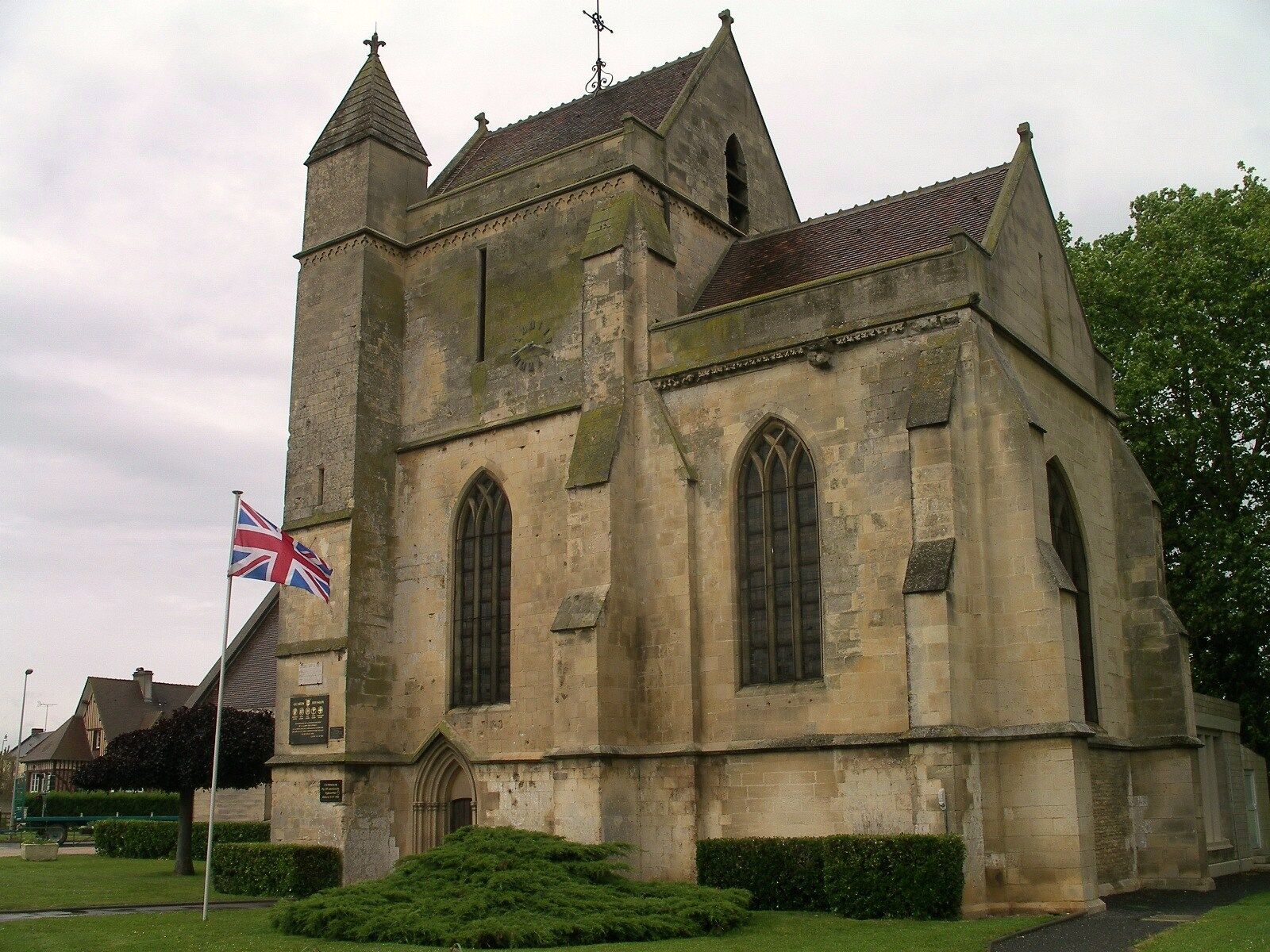
A village east of Caen that became a strongpoint during Operation Goodwood, where a handful of 88 mm guns pressed into an anti-tank role helped blunt the British armoured advance across the cornfields in July 1944.
On the morning of 18 July 1944, the fields east of Caen shook under one of the heaviest aerial bombardments of the Normandy campaign. Operation Goodwood, a massive British armoured thrust meant to break out of the beachhead, sent hundreds of tanks rolling south through the corn. Cagny, a farming village that had been all but flattened by the bombers, should by rights have fallen in the first hour. Instead it became one of the hard corks in the bottle - a place where a handful of guns and a stubborn German officer bought hours that the British could not spare.
What happened here
The village sat squarely in the path of the 11th Armoured Division, and directly across the axis of advance of regiments such as the Fife and Forfar Yeomanry and the 23rd Hussars. As their Shermans crested toward the Bourguébus ridge, they were caught in flanking fire from Cagny. The guns responsible were a battery of 88 mm anti-aircraft weapons - designed to shoot down aircraft, but murderously effective against tanks, where a single hit was usually enough to leave a Sherman burning.
The story owes much of its fame to Major Hans von Luck, a battle-group commander of the 21st Panzer Division, who told it in his post-war memoir. Returning to the front, he found the flak battery intact amid the ruins and its Luftwaffe captain unwilling to fire on ground targets - anti-aircraft guns answered to a different chain of command. Von Luck, by his own account, drew his pistol and offered the officer a choice between a decoration and being shot. The guns were repositioned in an orchard on the village edge, and within minutes several British tanks were wrecked.
It is a vivid anecdote, and largely true, but modern study of wartime reconnaissance photographs shows the defence was never just four guns. Tanks, self-propelled assault guns and further anti-tank pieces were dug in around Cagny, laying overlapping fields of fire across the open wheat. Two Tiger tanks pushing toward the village from the east were themselves knocked out - whether by the British or by "friendly" 88s remains debated. The British commander, unwilling to storm the village head-on, passed the problem to the Guards Armoured Division; the Irish Guards took Cagny the following day. But the delay had already blunted the offensive's momentum, and Goodwood never achieved the clean breakthrough its planners hoped for.
What to see today
Cagny is a quiet, rebuilt commune, and the visitor who arrives expecting a battlefield park will find instead an ordinary Norman village - which is rather the point. The best way to understand what happened is to stand at its edge and look north and west across the flat, open farmland. This is the ground the British tanks crossed, fully exposed; the gentle rise toward Bourguébus, a few kilometres to the south, was the objective they never firmly reached.
The church of Saint-Germain, parts of which are medieval, sits at the heart of the village. It was near the church that von Luck first spotted a gun barrel pointing skyward, and the surrounding lanes and orchards mark the general area where the battery made its stand - though the exact emplacements have long since returned to farmland. There is no large formal memorial here on the scale of the beach sites; Cagny's significance is read in the landscape rather than in monuments.
If you are touring the Goodwood battlefield, Cagny pairs naturally with a wider loop east of Caen taking in the ridge villages and the surrounding countryside. Note, too, the village's post-war twinning with Pirbright in Surrey - a long-standing tie between a Norman farming community and an English one, of the kind that quietly threads the region's memory of 1944 into the present.
Practical notes
Cagny lies just off the main roads running south-east out of Caen and is signposted from the D613; it takes about a quarter of an hour from the city. There is nothing to pay and nothing to book. Park in the village near the church of Saint-Germain, where there is room on the street, and walk out to the edge of the built-up area from there.
Twenty minutes to half an hour covers what there is to see, unless you are making a wider circuit of the Goodwood ground, in which case Cagny is one stop among several and worth timing for good visibility. There is little shade and few facilities in the village.
The village streets are level and paved and present no problem with a wheelchair or a pushchair. Beyond them the ground is working farmland: the tracks are earth, rutted by tractors and often muddy, and the fields themselves are private, so keep to the lanes and field edges and take the view from there. That is no real loss, because the flat openness is the whole point. From here the Mémorial de Caen sets the battle in context, and Bretteville-sur-Laize Canadian War Cemetery lies a short drive south-west among the same summer battlefields.