Bretteville-sur-Laize Canadian War Cemetery
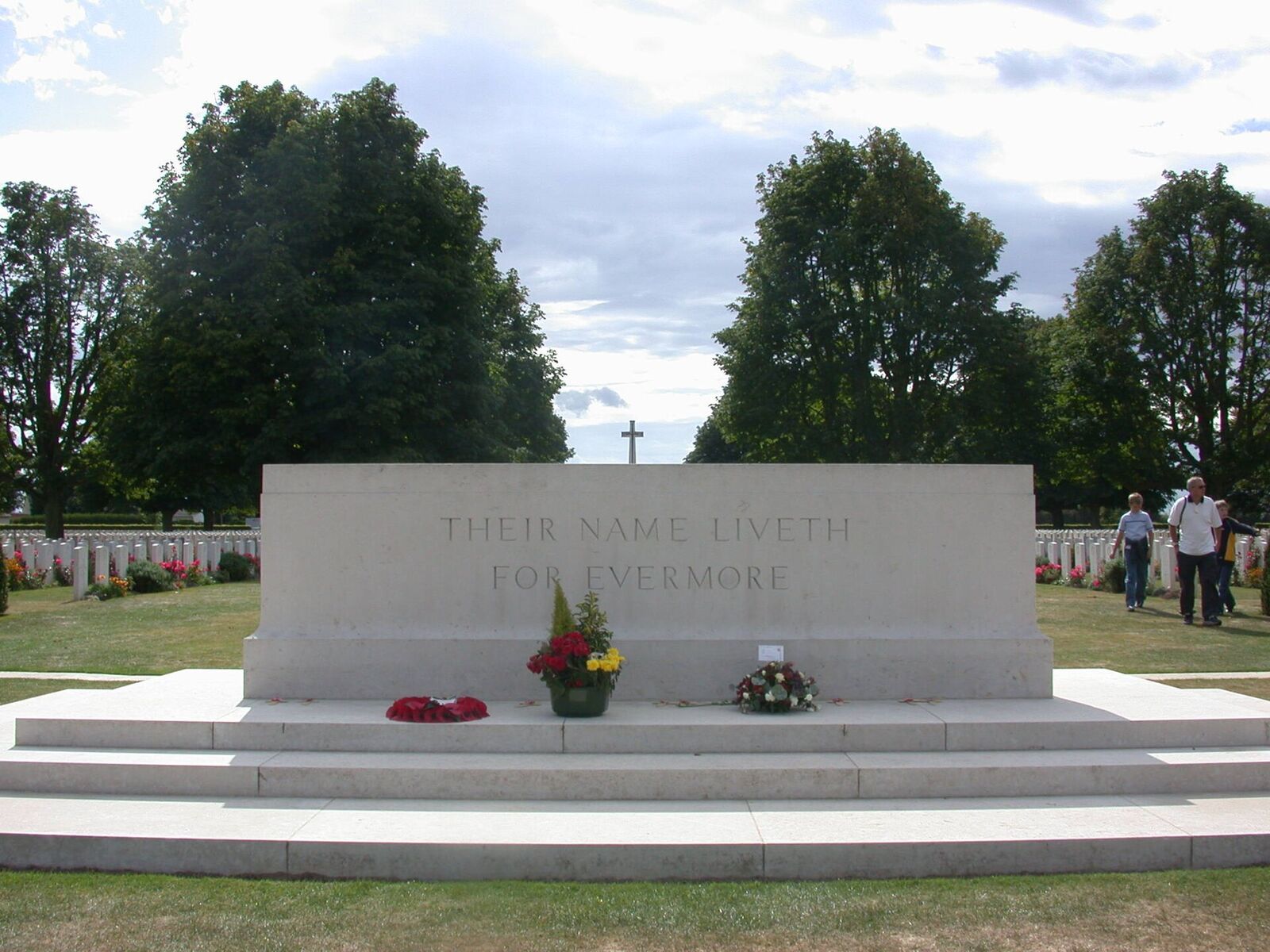
A Commonwealth cemetery at Cintheaux, south of Caen, holding 2,958 graves. Most are Canadians killed in the August 1944 offensives, Operations Totalize and Tractable, that drove south toward Falaise to close the pocket.
Of the two great Canadian burial grounds in Normandy, this is the quieter and the harder one to reach. It sits on a low plateau of open farmland beside the arrow-straight N158 between Caen and Falaise, yet there is no gate onto the main road; you turn off through the village of Cintheaux and approach it from behind, along a country lane. That indirectness feels fitting. Bény-sur-Mer, near Juno Beach, holds the men who died taking the coast in June. Bretteville-sur-Laize holds those who died in the grinding weeks that came after, pushing south into ground the Germans had turned into a killing floor.
What happened here
Most of the nearly 3,000 men buried here fell in the second phase of the Normandy campaign, from the ridges south of Caen in late July to the closing of the Falaise Pocket in August 1944. This was the country of Verrières Ridge, of the villages along the Orne, and of Operations Totalize and Tractable, the two set-piece armoured drives meant to break through toward Falaise and trap the retreating German armies. The fighting was among the costliest the First Canadian Army knew. Almost every unit of II Canadian Corps is represented in the rows here, which is why the headstones read like a roll-call of an entire army in one place.
The plateau itself saw hard combat. Cintheaux and the neighbouring hamlets were strongpoints on the Totalize axis, and the open, gently rising fields to the south gave German gunners long, clear fields of fire. Somewhere out in that landscape, during Totalize, a mixed Canadian armoured battlegroup lost its way in the smoke and half-light, ended up far ahead of the advance in the wrong valley, and was destroyed almost to a man. Many who died in these fields lie under this grass.
A boy among the soldiers
If you look for one grave, look for Private Gérard Doré of Les Fusiliers Mont-Royal. He had run away from home in Quebec and lied about his age to enlist, and he was killed in the fighting on Verrières Ridge on 23 July 1944, a month before what would have been his seventeenth birthday. He is generally recorded as the youngest Allied soldier to die in the Normandy campaign. His headstone stands among men two and three times his age, in a cemetery where a great many of the dead were still in their early twenties. It is worth finding, and worth standing at for a moment.
What to see today
The cemetery follows the classic Commonwealth War Graves Commission plan. Enter through the stone gateway and the ground opens along a central axis: the Stone of Remembrance with its inscription "Their Name Liveth For Evermore" near the entrance, and at the far end the Cross of Sacrifice, its bronze sword facing back down the lawns. The Portland-stone headstones stand in long, rank-blind lines, grouped by unit, each carved with a regimental badge, a name and date where known, and often a short inscription chosen by the family. The graves of the unidentified - there are dozens - carry Kipling's words, "A Soldier of the Second World War, Known Unto God."
Take the register and visitors' book from the shelter by the entrance and read a few entries before you walk the rows; the abstraction of nearly 3,000 dead resolves into individual regiments and ages. Then note the setting itself. From this slight rise you can see the farmland the advance had to cross, flat and exposed, with almost no cover. Understanding why so many lie here begins with simply looking south across those fields. In the adjacent village of Cintheaux, small memorials mark the Totalize fighting for anyone who wants to extend the visit on foot.
Practical notes
Leave the N158 at Cintheaux and follow the narrow lane signposted for the cemetery; it is easy to overshoot at speed, and there is no access from the dual carriageway itself. A short gravel drive ends at a parking area beside the gateway, big enough for a few cars but not for a coach. The cemetery is open access and free, as all Commonwealth war cemeteries are, with no attendant on site.
Three quarters of an hour is enough for most visitors, and rather more if you are searching for a name; the register in the entrance shelter gives the plot and row. Underfoot it is easy: the drive and forecourt are firm, the lawns are close-mown and level, and the wide grass paths between the plots take a wheelchair or a pushchair well in dry weather, though the turf softens after rain and the borders at the foot of the headstones are planted rather than paved.
It sits naturally in a day spent south of Caen rather than on the coast. Bourguébus and the ridge villages on the Totalize axis are a few minutes north, and the Mémorial de Caen is the obvious place to set the whole campaign in context either before or after.