Hillman Fortress
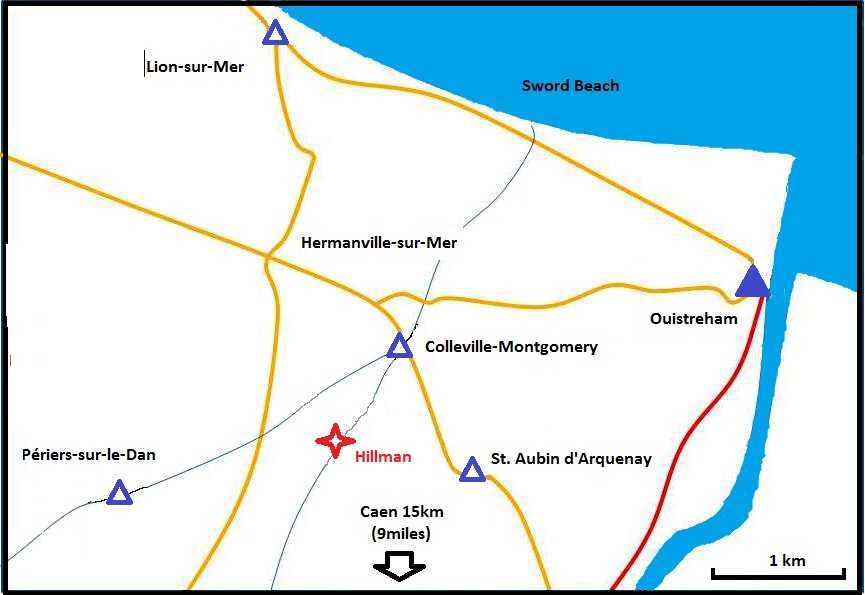
A large German command bunker complex behind Sword Beach, codenamed Hillman, whose stubborn defence delayed the British advance on Caen on D-Day. The cleared site, with its restored bunkers, is maintained by a local association and open to visitors.
From the coast road, Hillman gives almost nothing away. What you see is a wide field of grass on the Périers Ridge, a scatter of low concrete shapes half-sunk into the ground, and the long horizon behind Sword Beach. That flatness is the point. The Germans built the position to disappear into the farmland, and even now it takes a moment to grasp that you are standing on one of the most stubborn strongpoints the British met on 6 June 1944.
The strongpoint the Suffolks had to take
Known to the Germans as Widerstandsnest 17 and codenamed "Hillman" by the British, the complex spread across roughly 24 hectares of high ground more than two miles inland from the beach. It was the headquarters of the 736th Grenadier Regiment, ringed with barbed wire, minefields and small Tobruk machine-gun pits, and anchored by two large command bunkers linked underground to armoured observation cupolas. From here German gunners and observers could see the whole sweep of the landing beaches below them.
Clearing it fell to the 1st Battalion, the Suffolk Regiment, part of the British 3rd Infantry Division. They had come ashore on Sword in the morning and pushed inland, only to be halted by wire and mines that the pre-landing bombardment had barely touched. Royal Engineers worked forward to blow gaps in the wire with Bangalore torpedoes while flail tanks beat paths through the mines. Even then the supporting Sherman tanks found that their shells simply bounced off the thick steel cupolas. The position had to be taken the hard way, bunker by bunker, through the afternoon and into the evening. Most of it fell around dusk; the final bunker held out until the following morning, when its garrison of roughly seventy men, and the regimental commander, Colonel Krug, surrendered. The Suffolks lost seven men killed and around two dozen wounded.
Why a single fort mattered
Hillman's resistance had consequences far larger than one hilltop. The 3rd Division's ambitious objective for D-Day was the city of Caen. The hours consumed in reducing this fort helped ensure that Caen was not taken that evening as planned, and the city would not fully fall to the Allies for another two months of hard fighting. Standing on the ridge, it is easy to understand why the Germans chose this ground and why it cost so much to clear.
What to see today
The site is open, free and largely self-guided, reached from the Rue du Suffolk Régiment, with a small display Churchill tank near the car park. Take time to walk the whole perimeter rather than heading straight for the big bunkers, because the scale is the story: the fighting positions are spread far apart, and crossing the open ground between them on foot gives a sense of what the infantry faced under fire.
Look closely at the armoured cupola on one of the command bunkers, where you can still make out the marks left by direct hits that failed to penetrate. Notice how the two main bunkers are set low and mounded over, all but invisible until you are almost on top of them. Underground you can see the cramped network of rooms, and features that are easy to overlook: the water tank and pump that let the garrison seal itself in and keep fighting.
The memorial here exists because of a gesture of reconciliation. In 1989 a local landowner, Madame Lénaud, gave the ground of one of the bunkers to the Suffolk Regiment, and a memorial was created inside and inaugurated in the presence of veterans. The site is cared for by the association Les Amis du Suffolk Regiment, whose volunteers open the command bunker for guided visits in summer. Marker boards with audio guide you around; the quiet field does the rest.
Practical notes
Turn inland off the D514 coast road at Colleville-Montgomery and follow the signs up through the village to the ridge; the lane ends at the site, and the car park is small, so a coach or a busy summer afternoon can make it tight. There is nothing here in the way of facilities, so bring what you need with you.
Give it an hour. That sounds generous for a field until you start walking it, and the perimeter circuit is the whole reason to come rather than a detail of it. If the volunteers are on site and the command bunker is open, add another half hour for the interior and the memorial.
Underfoot it is mown grass and beaten farm track over open, gently sloping ground. It is walkable in ordinary shoes in dry weather but it turns heavy and muddy after rain, the concrete aprons and earthworks are uneven, and the bunker interiors are reached by steps into cramped, dark spaces. That combination rules out a wheelchair and makes a pushchair hard work, though the car park end and the Churchill tank are reachable on the level. There is no shade and the ridge is exposed to the wind.
Half an hour away, Pegasus Bridge makes the obvious next stop, and Hermanville War Cemetery is closer still if you want to see where the Suffolks' dead were laid.