Hermanville War Cemetery
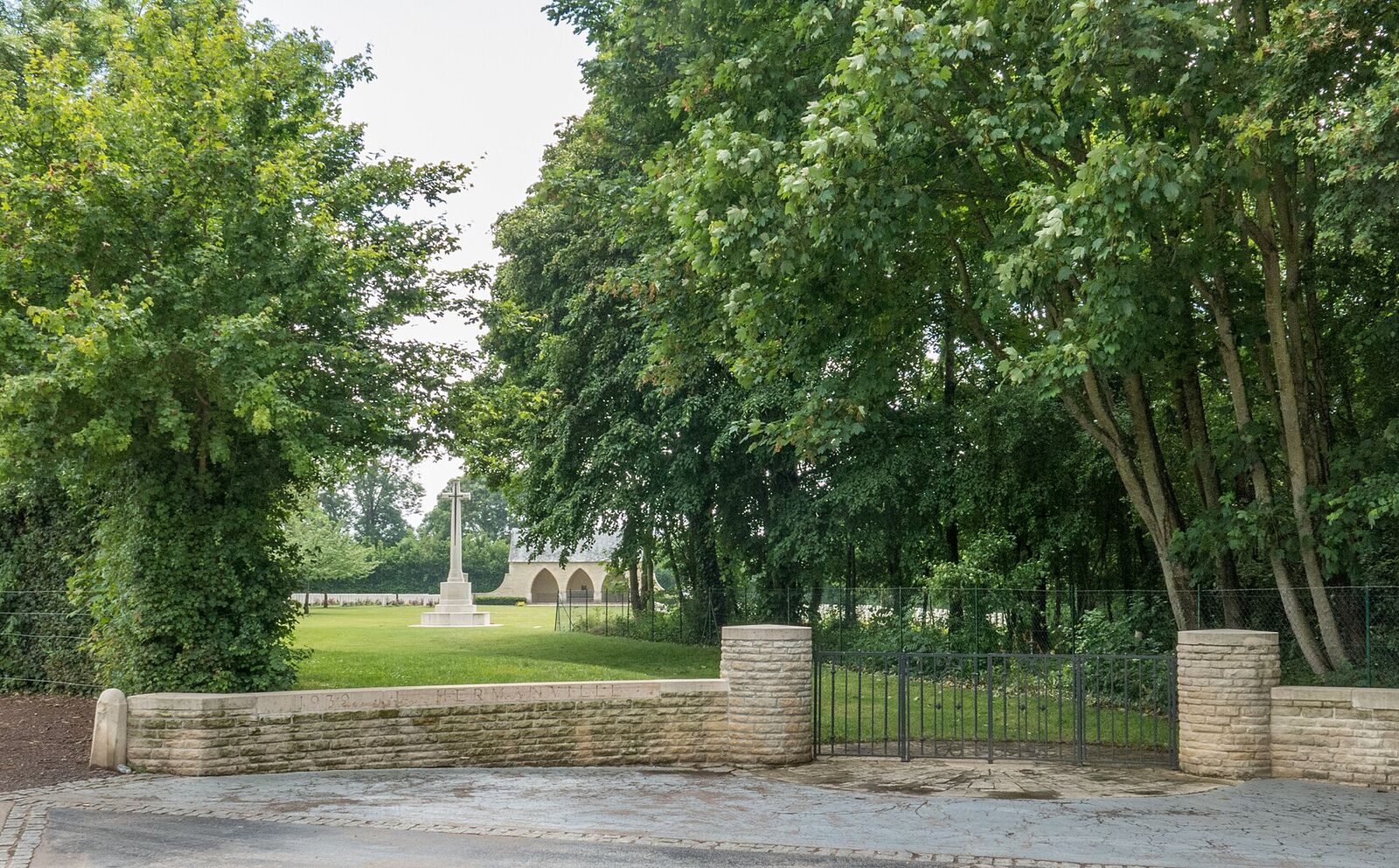
A Commonwealth cemetery just behind Sword Beach holding around a thousand graves, mostly British soldiers killed in the D-Day landings and the first push inland toward Caen. Its proximity to the shore reflects how close the fighting came to the sea.
Of all the Commonwealth cemeteries in Normandy, few sit as close to the sea as this one. Barely a kilometre inland from Sword Beach, Hermanville War Cemetery began not as a planned memorial but as a working burial ground opened while the battle was still raging on the sand. Men were brought here within hours of falling, and for a time it was known simply as Sword Beach Cemetery. That bluntness of name says a great deal about how it came to be.
What happened here
Hermanville-sur-Mer lay directly behind Sword, the easternmost of the five invasion beaches. On the morning of 6 June 1944 the village was among the first places liberated, cleared early in the day by infantry advancing off the beach. The soldiers who came ashore here belonged largely to the British 3rd Infantry Division, tasked with pushing hard and fast toward Caen, the objective that would remain out of reach for weeks.
The cemetery holds just over a thousand Commonwealth graves. The great majority are British, with small numbers of Canadian, Australian and French servicemen among them. More than a hundred are unidentified. A striking feature of the register is how many of the dead were not infantry at all but sailors and Royal Marine commandos, a reminder that the assault on Sword was as much a naval undertaking as a land one, and that the men who crewed the landing craft and cleared the beaches died alongside those they carried. While many here fell on D-Day itself or in the first grinding days of the drive inland, the cemetery also received casualties brought in later from the summer battles, including Operation Goodwood in July and the closing of the Falaise pocket in August.
A detail worth knowing
There is a quieter story bound up with Hermanville that most visitors never hear. In the village stands an old well, the Mare Saint-Pierre. In the weeks after the landings it became a vital source of fresh water for the armies pouring across the beaches, and British records credit it with supplying something in the order of a million and a half gallons between the landings and the start of July. It is a small, human reminder that an invasion is not only guns and tanks but also the endless practical business of keeping living men supplied, carried on within sight of the graves of those who did not survive the first day.
What to see today
The cemetery was designed by the British architect Philip Dalton Hepworth, and it rewards an unhurried visit. The entrance is framed by a low limestone wall with rounded stone piers, and the ground opens into a broadly triangular plot flanked by trees. The Cross of Sacrifice stands a short way in along the central path; at the far end a stone shelter holds the visitors' register and a bench, worth using simply to sit and take in the scale of the place.
Walk the rows slowly and read the personal inscriptions that families were permitted to add to the headstones. Some are almost unbearable in their plainness. Others carry a stubborn tenderness. Look, too, at the ages carved into the stone: many of the men buried here were still in their late teens or early twenties. Because the cemetery drew in the fallen from several different phases of fighting, the graves are not uniform in date, and a careful reader will find June, July and August deaths lying side by side.
The cemetery is permanently open and there is parking nearby. Standing among the headstones, it is worth remembering how short the walk is back to the water. The men buried here scarcely made it off the beach, and the sea that carried them ashore is never far behind you.
Practical notes
The cemetery is on the southern edge of Hermanville-sur-Mer, signed from the village centre on the road running inland toward Colleville-Montgomery. The lane is quiet and there is space to pull in at the gate. Like all Commonwealth burial grounds it is free to enter.
Half an hour will do if you simply walk the rows, three quarters if you sit in the shelter with the register and read the inscriptions properly. Most visitors underestimate how long the second of those takes.
The ground is level from the gate onward, with a firm central path and mown grass between the plots, so it is straightforward with a wheelchair or a pushchair, and there are no steps or slopes to negotiate. There is little shade, which matters on a bright afternoon. If you want to understand what the men buried here were sent to do, the German headquarters position at Hillman Fortress is a few minutes inland and shows exactly what stood between the beach and Caen; it is rougher going, over grass and down into concrete, and worth an hour on its own.