US Navy Monument
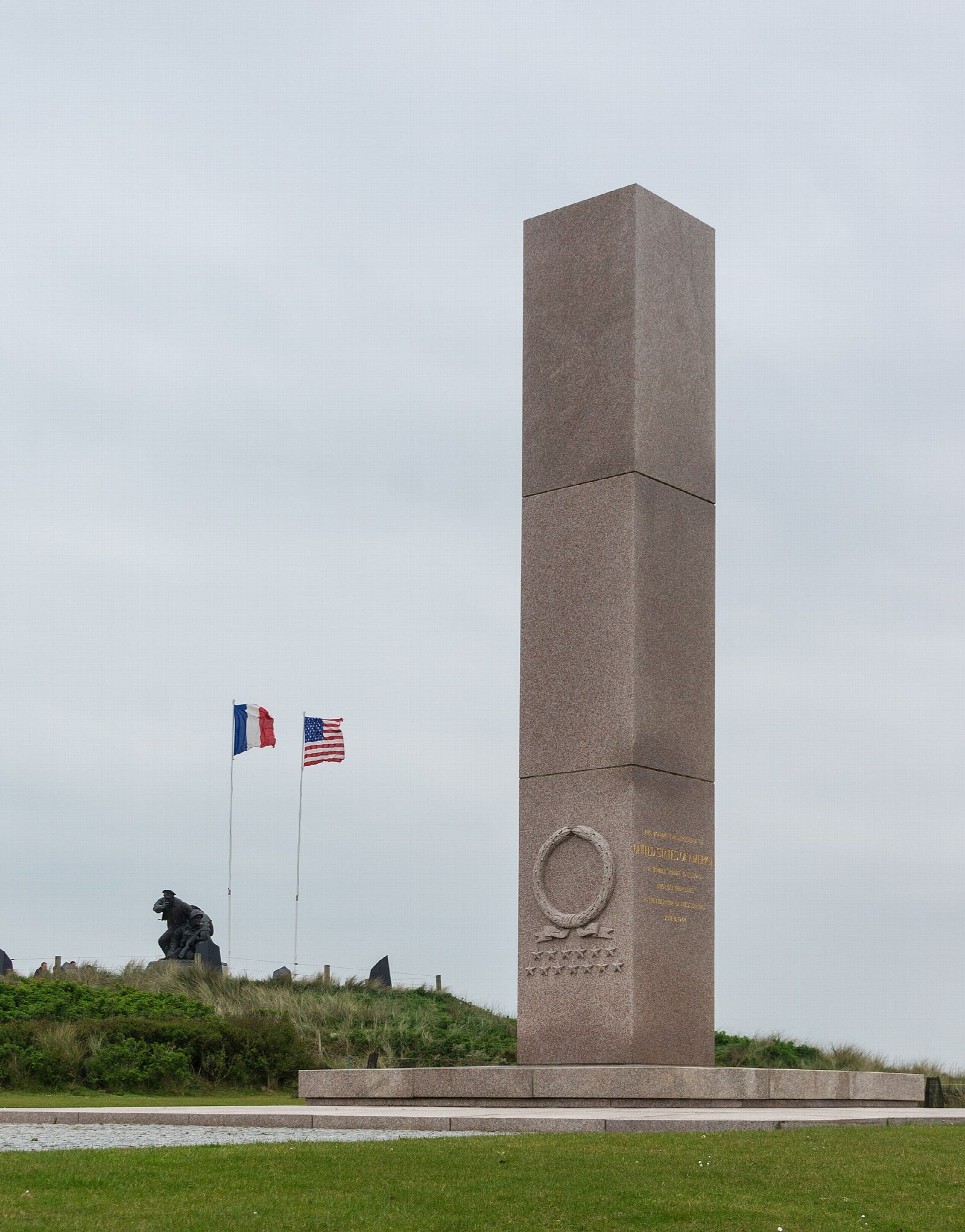
Dedicated in 2008 on the dunes behind Utah Beach, this granite monument honours the United States Navy's part in the landings: the bombardment that preceded them, the landing craft crews, and the demolition teams who cleared the obstacles ahead of the infantry. The Lone Sailor statue stands a short walk away, and the beach itself is a few steps north.
The story told on Utah Beach is usually an army story: the 4th Infantry Division coming ashore, the airborne drop inland, the causeways through the flooded ground behind the dunes. This monument, set on the dunes a short walk from the beach, is there to make the point that none of it happened without the fleet.
What it commemorates
The granite monument was dedicated in 2008 and honours the United States Navy's part in the landing here. That part began well before the first infantryman touched the sand. Warships offshore bombarded the coastal batteries at first light. Minesweepers cleared the approach channels. Landing craft crews ran the assault waves in, took the ramps down under fire, backed off and went again.
It also records the work of the demolition teams. The obstacles seeded across the foreshore, the stakes and ramps and hedgehogs designed to gut a landing craft on a rising tide, had to be blown before the tide covered them. That work was done in the open by naval combat demolition units and army engineers together, and it was among the most dangerous jobs of the morning.
Utah is the beach where the plan went wrong in a way that turned out well. The assault waves were pushed south of their intended sector by the current, landing on a stretch that was less strongly defended than the one they had trained for. Getting the follow-up waves, the vehicles and the supplies onto that unplanned frontage, and keeping them coming across the beach for weeks afterwards, was a naval problem as much as a military one.
What to see
The monument stands among a cluster of markers on the dunes, and it is worth reading them as a group rather than singly. The Lone Sailor, a bronze figure familiar from the United States Navy Memorial in Washington, stands nearby looking out to sea. A short walk away is the marker for kilometre zero of the Voie de la Liberté, the road that runs from this beach across France to Bastogne.
From the monument the ground falls away to the sand. Look north along the beach and then turn and look inland, at the low wet ground behind the dune line: that flooded belt is why the causeways mattered so much, and why the airborne divisions were dropped behind it during the night to hold the far ends of the crossings.
Practical notes
The monument is on the dune ridge at Utah Beach in the commune of Sainte-Marie-du-Mont, reached on the D913 which ends at the beach. There is a large car park at the end of the road serving the whole cluster of memorials and the museum. Access to the monument is free and unrestricted at all hours.
Allow twenty minutes for the monument and the markers around it, or an hour if you are taking in the beach and the dune walk as well. The site is level and hard surfaced from the car park, which makes it one of the easier memorials on this coast for a wheelchair or a pushchair. There is no shelter on the dunes.
It is the natural first or last stop on a Utah day. Inland lie Sainte-Marie-du-Mont itself, the guns at Brecourt Manor, and the church at Angoville-au-Plain where two American medics treated the wounded of both sides. North along the coast road are the casemates of Crisbecq Battery and Azeville Battery, the guns the fleet was firing at.