Les Braves
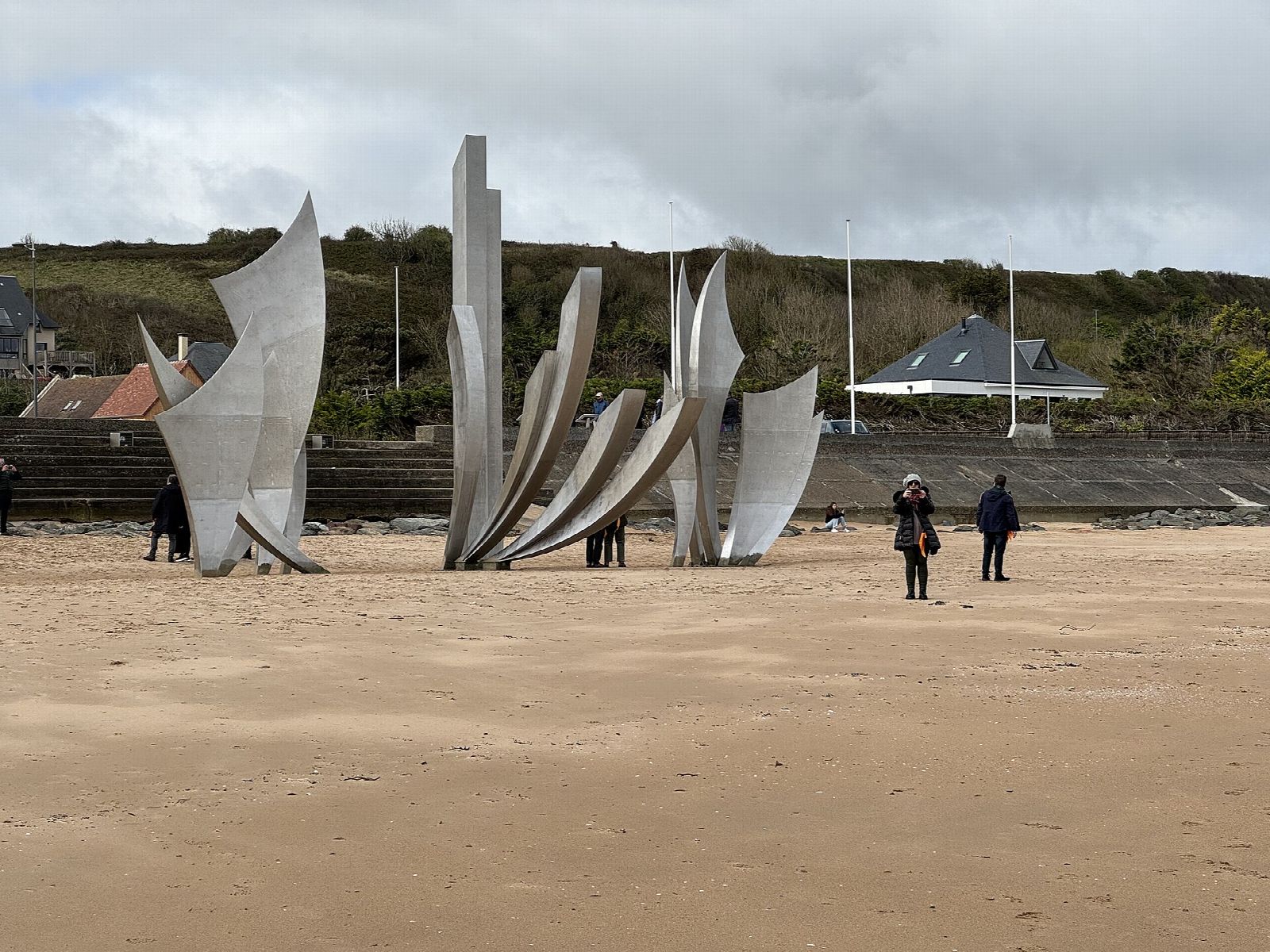
Anilore Banon's stainless steel sculpture stands on the sand at Saint-Laurent, the only memorial on Omaha Beach that the tide reaches twice a day. Installed for the sixtieth anniversary in 2004, its three elements are titled the Wings of Hope, Rise Freedom and the Wings of Fraternity. At low water you can walk all the way around it; at high water it stands in the sea.
Most memorials are built on dry ground, above the event they commemorate. This one is not. Anilore Banon's sculpture stands out on the sand of Omaha Beach in front of Saint-Laurent-sur-Mer, below the high water mark, so the Channel closes over its feet twice a day and drains away again. Whatever else it is, it is the only memorial on this coast that keeps the same appointment with the tide that the landing craft did.
The sculpture
Banon, a French sculptor, made the piece for the sixtieth anniversary of the landings in 2004. It is worked in stainless steel, chosen because it can survive permanent immersion in salt water, and it is not one object but three, set close together and meant to be read as a group.
The central element is titled Rise, Freedom. Flanking it are the Wings of Hope and the Wings of Fraternity. The forms are deliberately not figurative. There are no soldiers here, no rifles, no landing ramps; instead a set of tall blades that lean and open like something coming up out of the sand. Visitors tend to read them as wings, or as flames, or as figures standing. The sculptor has said the intention was to make the dead of the beach present without illustrating how they died.
Seen from the shore the piece is a silhouette against the water. Seen from the water's edge, with the bluffs behind it, the scale reverses and the sculpture is small against a very large beach. Both readings are worth having, which is an argument for walking out to it rather than photographing it from the promenade.
Where it stands
The position is not arbitrary. The sculpture sits roughly at the draw known as Les Moulins, one of the handful of gaps in the bluff line that the assault had to open in order to get off the sand at all. The wide flat foreshore in front of it is the ground the first waves crossed under fire from the heights, including the strongpoint at Widerstandsnest 62 further east above the Colleville draw.
A few paces away stands the Signal Monument, one of the series of stone markers placed along the invasion coast in the years after the war, with its inscription recording that the Allied forces landed on this shore and liberated Europe. The two make an instructive pair: the formal state monument of the 1950s, and the far less literal sculpture of 2004 that was put on the beach itself.
What the tide does to it
Check the tide before you come, because it changes the visit completely. At low water the sea withdraws several hundred metres and you can walk right around the sculpture on firm sand, which is also the only way to understand the distance the assault had to cross in the open. At high water it stands in the sea and can only be seen from the shore.
Neither state is the wrong one. Many people find the flooded version the more affecting, and it is the reason the sculpture was placed where it was. But if you want to stand underneath it, you need the ebb.
Practical notes
The sculpture is reached from the seafront at Saint-Laurent-sur-Mer, where the D517 comes down to the beach at Les Moulins. There is parking at the bottom of the road and the beach access is a few steps from it. There is no ticket and no gate; the beach is open ground at all hours.
Allow half an hour, more if the tide is out and you want to walk the foreshore. Firm wet sand takes a wheelchair better than the soft dry sand higher up the beach, but there is no made path out to the sculpture and the approach is sand throughout. The seafront promenade gives a clear view for anyone who would rather not cross it.
It sits naturally in a morning on this stretch of coast. The Normandy American Cemetery is on the bluff a short drive east, the Overlord Museum beside it at Colleville-sur-Mer, and Vierville-sur-Mer closes the western end of the beach. Bring a coat: the foreshore is entirely exposed and the wind comes straight off the Channel.