Ver-sur-Mer
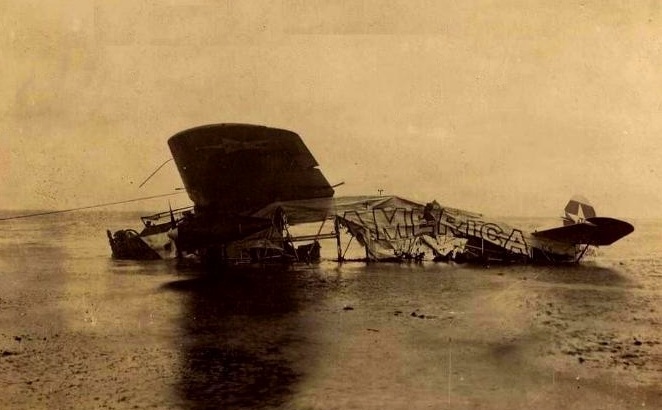
A seaside village on Gold Beach where British troops landed and the America Gold Beach Museum recalls both the assault and the first transatlantic airmail flight that ended nearby in 1927. It now sits beneath the British Normandy Memorial.
Ver-sur-Mer is an unassuming place to carry so much history. A small farming and seaside commune behind the low dunes of Gold Beach, it sits at the eastern end of the sector the British code-named King, close to the boundary with the Canadian beaches to the east. On any clear day you can stand on the rising ground behind the village and take in the whole sweep of coast that changed hands on a single June morning. Two very different stories converge here: a lost aeroplane from the 1920s, and the largest amphibious landing in history.
What happened here
On the morning of 6 June 1944 the men of the British 50th (Northumbrian) Infantry Division came ashore along this stretch of Gold Beach. Behind Ver-sur-Mer, on high ground, the Germans had begun building the Mont Fleury battery, a set of gun positions still unfinished on D-Day, several of its heavy guns standing in the open because their concrete casemates were incomplete. It was in the fighting to clear these defences that Company Sergeant Major Stanley Hollis of the Green Howards carried out the actions that made him the only man awarded the Victoria Cross for deeds done on D-Day itself. Advancing on a pillbox near the battery, he stormed it alone with grenade and Sten gun, then dealt with a second position, taking prisoners and very likely saving the lives of the men behind him. His day was not over; he would act again with the same reckless courage further inland.
The village itself was cleared as the assault pushed off the beach and up onto the plateau. The German strongpoints here fell quickly compared with the slaughter unfolding that same hour at Omaha, a few miles to the west, but the fighting was real and men died in the fields and lanes around Ver-sur-Mer.
The flight of the America
Long before the war, the village had already earned a footnote in aviation history. In the summer of 1927, only weeks after Lindbergh's solo crossing, the American explorer Richard Byrd and his crew flew the Fokker trimotor America across the Atlantic carrying the first official transatlantic airmail. Fog denied them a landing at Paris, and after hours circling they turned back to the coast and ditched in the shallows just off Ver-sur-Mer in the small hours of the morning. The crew waded ashore, bruised but alive. It is this coincidence of dates and place that gives the village museum its double name.
What to see today
The America Gold Beach Museum, in the heart of the village, tells both stories under one roof: one hall devoted to Byrd's flight and the ditched America, the other to the Gold Beach landings and the 50th Division. It is a modest, well-kept museum rather than a grand one, and the better for it.
A short walk or drive away, on the higher ground west of the village, stands the British Normandy Memorial, opened on the 77th anniversary in 2021. This is the emotional centre of any visit. Its stone columns carry the names of more than twenty-two thousand men and women who died under British command between D-Day and the end of August 1944, drawn from more than thirty nations. Laid out to read as a Union Flag from the air, it looks out over the very beaches below, with the ruins of the Mulberry harbour at Arromanches visible along the coast. Walk the colonnades slowly and read the names; a striking bronze group of three charging figures anchors the site.
Down by the shore, look for the memorials to the Royal Artillery of the 50th Division and the small hut commemorating Stan Hollis near where he came ashore. Together they make Ver-sur-Mer a place to pause rather than pass through.
Practical notes
The village sits directly on the D514 coast road, a few minutes east of Asnelles and west of Courseulles, and is small enough to drive through without noticing. Park in the centre near the museum, or use the car park at the memorial on the higher ground if you are starting there. Down at the shore there is roadside parking by the slipway. The museum is ticketed; the beach, the memorials and the seafront are free and open at any hour.
Two hours does the village properly, split between the museum and the walk down to the sea, and you should add another hour if you are taking in the memorial on the hill above.
The village streets and the seafront road are level and easy going with a wheelchair or a pushchair, and the museum is a modern building on flat ground. Getting onto the beach itself means crossing soft sand and, in places, a bank of shingle, which is hard work on wheels; the memorials near the shore are reachable without leaving firm ground. The rising land behind the village is a gentle slope rather than a climb. Most visitors carry on east to Courseulles-sur-Mer and the Juno Beach Centre, which picks the story up where the British sector ends.