Maison des Canadiens
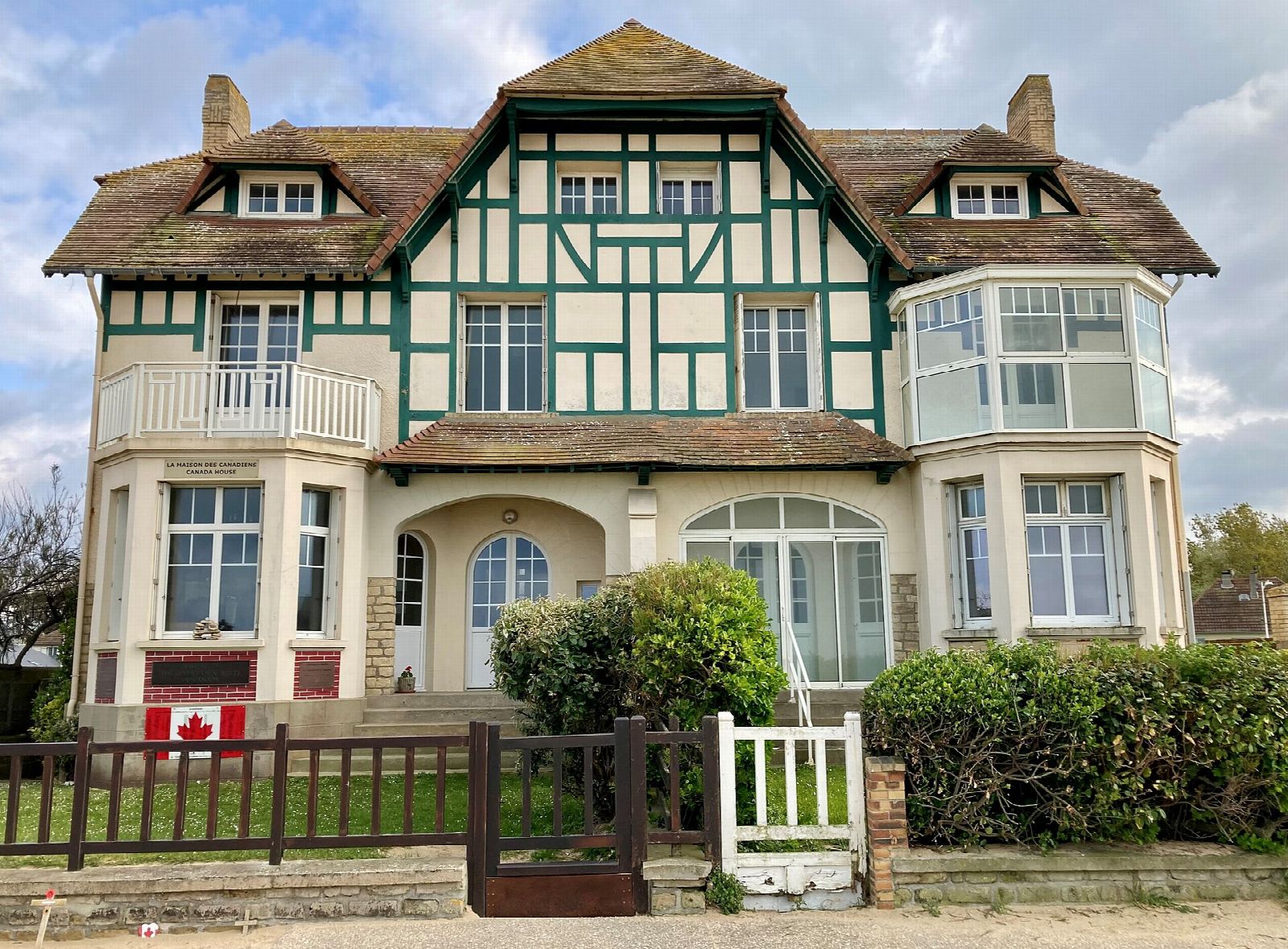
The tall seafront house at Bernières appears in some of the most reproduced photographs of 6 June 1944, because the Queen's Own Rifles of Canada came ashore directly in front of it. Often called the first house liberated on Juno Beach, it is still a private family home, opened to visitors in season by the family who have kept it as a memorial for decades.
There is a photograph almost everyone with an interest in D-Day has seen: Canadian infantry moving up a seawall on Juno Beach, with a tall, steep roofed seaside house behind them. The house is still there, on the promenade at Bernières-sur-Mer, and it looks very much as it did. It is one of the few places on this coast where you can stand in a famous frame rather than beside a monument to one.
The morning of 6 June
The stretch of sand in front of the house was the Nan White sector, and the unit that came ashore here was the Queen's Own Rifles of Canada. They landed into trouble. The tide was running higher than planned, which put the assault waves close in against the seawall with the beach obstacles still submerged behind them, and the supporting armour was late. The company crossing this frontage took heavy casualties in the first minutes, from a strongpoint sited to fire along the wall.
The house is often described as the first house liberated in France. That is a claim several places on this coast make, and it is not really settleable. What is not in dispute is that Canadian troops were past it and into the village street very early on 6 June, and that press photographers and film cameramen came ashore with the follow-up waves and used the building as the backdrop it has been ever since. That is why this particular house, out of all the houses on the Norman coast, became the image of the Canadian landing.
The house today
It is not a museum and not a public monument. It is a private family home, and it has stayed in the same family, who have looked after it as a place of memory for decades and who open it to visitors during the season rather than as a business. Canadian veterans and their descendants have been received here for many years, and the interior is hung with photographs, regimental plaques and things left behind by people who came back.
That domestic scale is the point of the visit. The rooms are small, the ceilings low, and the sea is directly outside the window. It gives you something the larger sites nearby cannot: the sense that the landing happened in front of somebody's house, in a working seaside village, and that people lived here before it and after it.
Outside, on the promenade, stands one of the Signal Monuments that mark the invasion coast, and the seawall itself runs east and west from the house.
Practical notes
The house stands on the seafront promenade at Bernières-sur-Mer, a short walk from the village centre and the church. Coming by car, park in the village and walk down; the promenade itself is not a through road for parking. Opening is seasonal and depends on the family, so treat it as something to look at from the promenade with the chance of getting inside, rather than a fixed appointment.
Allow twenty minutes outside, or the best part of an hour if the house is open. The promenade is flat and easy going, but the house is an old building with narrow stairs and is not suited to a wheelchair inside.
Pair it with the Juno Beach Centre at Courseulles-sur-Mer a few minutes west, which gives the Canadian campaign in full, and with Saint-Aubin-sur-Mer just east along the same seafront. The Bény-sur-Mer Canadian War Cemetery inland is where many of the men who landed on this frontage are buried, and it is the right place to finish rather than to start.