Valognes
Once known as the "Versailles of Normandy" for its elegant aristocratic townhouses, Valognes was devastated by bombing and shellfire in June 1944 during the American drive on Cherbourg. Much of its historic centre was lost in the battle.
Most visitors reach Valognes on the road up from Sainte-Mère-Église to Cherbourg, and it is easy to pass through without registering what stood here. This was one of the wealthiest small towns in pre-Revolutionary France, a place of paved courtyards and cut-stone facades built by families who wanted a quieter Versailles of their own. In June 1944 much of that inheritance was flattened in a matter of days. Knowing what to look for turns an ordinary market town into one of the more poignant stops on the Cotentin.
The last noble town in France
By the eighteenth century Valognes housed well over a hundred aristocratic families, who lined its narrow streets with elegant hôtels particuliers - private mansions with formal courts, gardens and stables. The town kept its cachet long after the Revolution, remaining fashionable with English visitors into the 1920s. It was, in effect, a museum of French domestic architecture that people still lived in. That density of stone and history is exactly what made its destruction so total.
A stronghold in the road to Cherbourg
After the landings, the American VII Corps swung north up the Cotentin peninsula with the deep-water port of Cherbourg as its prize. Valognes, roughly ten miles short of the port, sat squarely across that axis, behind Montebourg on the same road, and was treated as an enemy strongpoint to be reduced. A series of heavy air and artillery bombardments in June 1944 gutted the historic centre; survivors recalled the sky filling with aircraft and a roar like a sudden hurricane. Hundreds of townspeople were killed. When American infantry entered on 20 June, the streets were so choked with rubble that vehicles could barely pass, and the advance on Cherbourg had to be forced through the wreckage. Of some fifty grand townhouses, only around fifteen came through. Among the outright losses was the medieval church of Notre-Dame, whose early-seventeenth-century Gothic dome was reputed to be the only one of its kind in France.
What to see today
The town rebuilt rather than restored, and the interest lies in reading that seam between what survived and what was replaced. Begin at the Hôtel de Beaumont (1767-1771), the finest of the surviving mansions and the clearest picture of what Valognes once was. Damaged but not destroyed, it was patiently restored after the war; look for the theatrical double-flight staircase that climbs in two arms before merging into a single suspended flight, and the formal rose garden behind. Rooms are open to visitors in season.
Walk to the Église Saint-Malo for the sharpest lesson of all. Its soaring fifteenth-century flamboyant choir survived the bombing; the nave did not, and was rebuilt in a deliberately modern idiom by the architect Yves-Marie Froidevaux, using slender pale concrete pillars that open into a bright, uncluttered vault. Standing at the crossing, you can see medieval stone and 1950s concrete meeting head-on - the whole story of the town in one building.
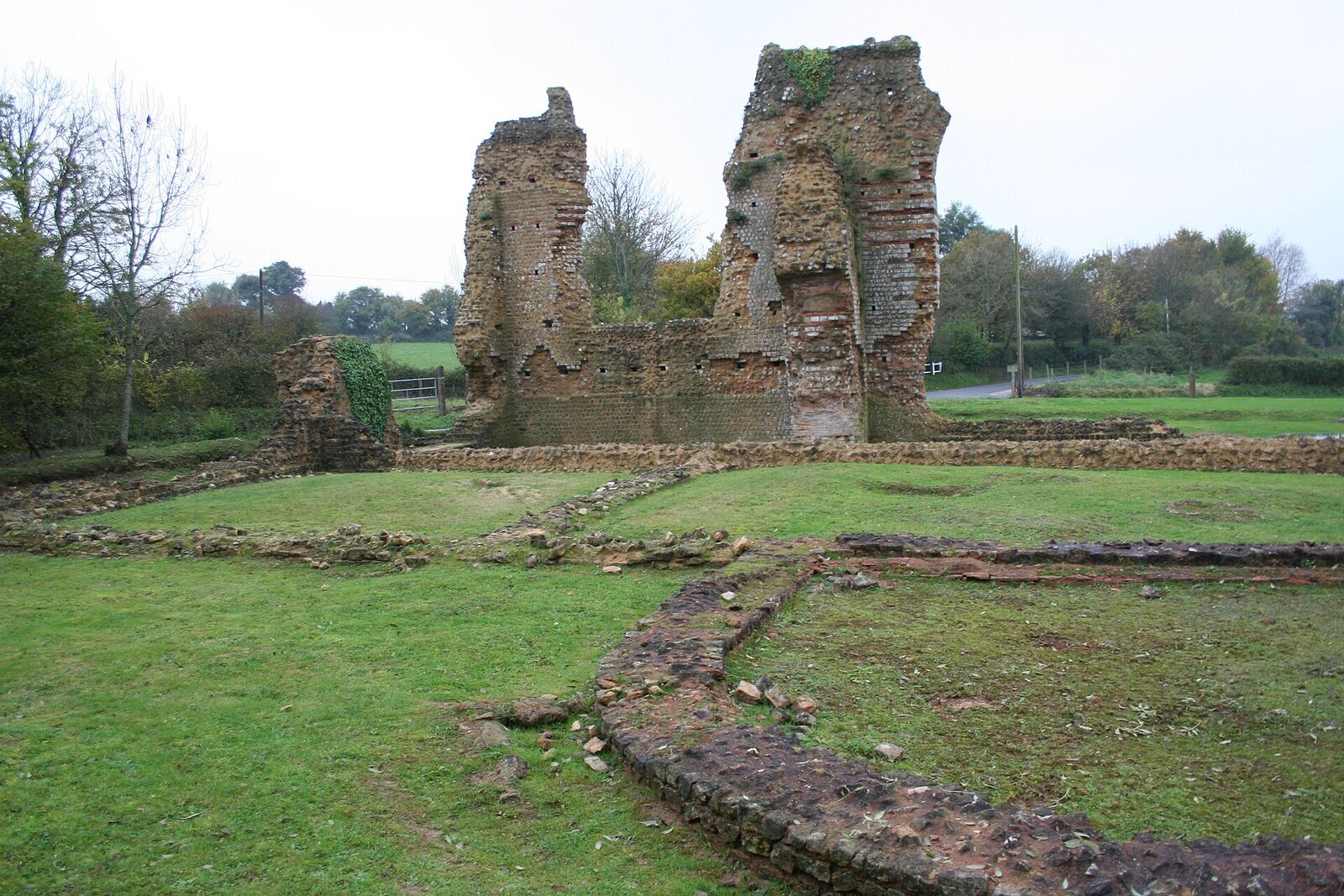
From there the old quarter rewards slow wandering. The Hôtel de Grandval-Caligny is where the writer Barbey d'Aurevilly lodged in the 1870s and 1880s and wrote much of Les Diaboliques. The riverside Rue du Grand-Moulin preserves timber artisans' houses and traces of the town's old leather and parchment trades. On the edge of town, the ruined Gallo-Roman baths of Alauna - brick-and-stone walls still standing several metres high - are a reminder that Valognes was a place of consequence eighteen centuries before D-Day. For a lighter note, the regional cider museum occupies a Renaissance mansion with a spiral stair tower, a survivor from an older prosperity. Together they make Valognes less a battlefield than a study in loss, endurance and what a town chooses to build back.
Practical notes
Valognes lies just off the N13 between Sainte-Mère-Église and Cherbourg, and the historic quarter is compact enough to see entirely on foot. Park near the centre or by the river and walk; the Hôtel de Beaumont, the Église Saint-Malo and the old streets are all within a few minutes of one another. Alauna, on the edge of town, needs the car and is open ground you can walk into without a ticket, while the Hôtel de Beaumont and the cider museum are ticketed and open seasonally.
Allow two hours for the town, or half a day if you go inside the mansions.
The centre is flat and the streets are paved, so a wheelchair or a pushchair is fine on the walking route, though some of the older lanes are cobbled and jolting, and the pavements narrow to almost nothing in places. Inside the Hôtel de Beaumont the great staircase is the point of the building and there is no lift. At Alauna the footing is rough grass and uneven around the ruins.
Valognes fits naturally into the drive north. The gun positions at Crisbecq lie between here and the coast, and Fort du Roule, cut into the rock above Cherbourg, is the end of the road the Americans were fighting up when this town was destroyed.