Lion-sur-Mer
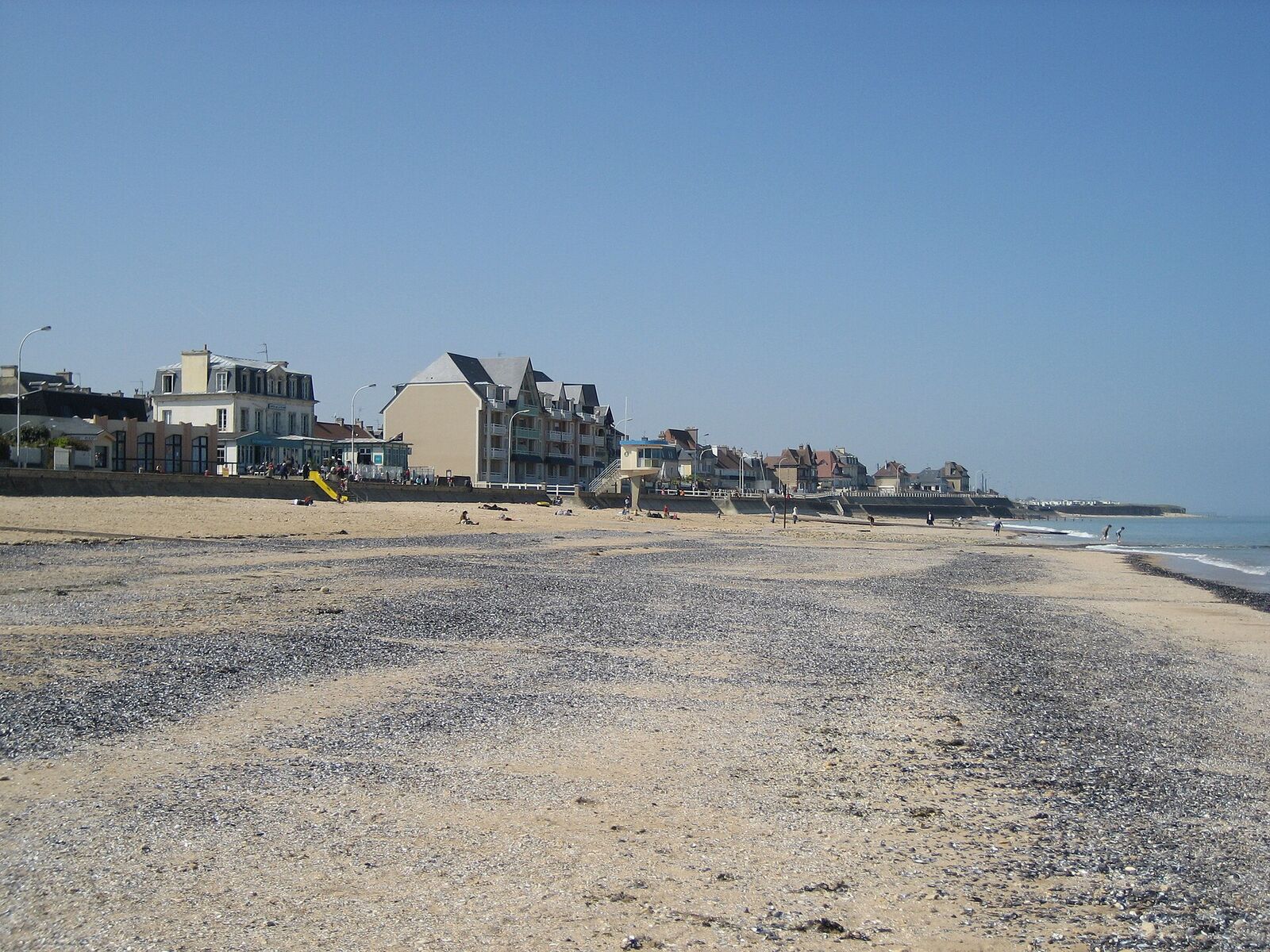
A resort at the western end of Sword Beach where No. 41 (Royal Marine) Commando met stubborn resistance from a fortified strongpoint on D-Day. A memorial and a Churchill tank now stand on the seafront recalling the action.
Lion-sur-Mer sits at the far western edge of Sword Beach, where the long British landing sector runs out and the coast bends toward Juno. On the morning of 6 June 1944 that geography mattered enormously: this quiet seaside resort marked the hinge between two invasion beaches, and closing the gap between them was one of the day's unfinished tasks. What looks today like an unremarkable stretch of villas and promenade was, for a few hours, one of the most stubborn pockets of resistance on the whole Anglo-Canadian front.
What happened here
The task of taking Lion-sur-Mer fell to No. 41 (Royal Marine) Commando, who came ashore near Hermanville at the western end of Sword in the middle of the morning. Their orders were demanding: seize the German strongpoint in the town, take the château at Haut-Lion where an enemy headquarters was thought to be hiding, and push west to link hands with No. 48 (Royal Marine) Commando coming off Juno, sealing the seam between the two beaches.
The strongpoint, which the Allies had codenamed "Trout," was a compact but well-sited defensive position built around field and anti-tank guns, with shelters and observation posts. The assault went wrong quickly. Supporting armour was knocked out within minutes by a concealed German anti-tank gun, and with radio sets lost in the landing the commandos could not call down the naval gunfire that might have broken the position. Attacks through the afternoon stalled against determined defenders, and a Luftwaffe bombing raid added to the toll, wounding the commanding officer among others. By nightfall No. 41 had suffered casualties approaching half its strength, and the town was still not taken.
Lion-sur-Mer only fell the next day, 7 June, once the defenders could be worked over by destroyers offshore and reinforced infantry from several British battalions joined the fight. The château at Haut-Lion was cleared, the link with the Juno forces was finally made, and scattered resistance in the area was mopped up over the days that followed. It was a small action by the scale of the wider battle, but a costly and revealing one, a reminder that even a lightly held resort could hold up elite troops for the better part of two days.
What to see today
The best place to begin is the seafront on the western side of town, near the Boulevard Maritime, where the memorials cluster. The unmistakable landmark is a Churchill AVRE tank, the squat, blunt-nosed engineer variant with its stubby Petard mortar mounted in the turret. It was installed here for the 65th anniversary in 2009, and it is a pointed choice of monument: tanks of exactly this type were among the armour knocked out in the failed assault. A nearby stone records that the vehicle was offered by a senior British veteran who had commanded an infantry battalion on D-Day.
Close by stand a memorial plaque to No. 41 (Royal Marine) Commando and a stele remembering both the Allied soldiers and the civilians who died here. Take a moment to read them together: Lion-sur-Mer's war did not end with liberation. In the town centre, near the church, the Place des Victimes du 2 Juillet 1944 is named for townspeople killed weeks after D-Day, when a mine dropped by parachute exploded in the community. It is the kind of detail a visitor hurrying along the coast road will miss entirely, and it says much about how the fighting reached beyond the beaches into ordinary civilian life.
From the promenade, orient yourself westward toward Luc-sur-Mer and Juno beyond: that stretch of coast is the ground the commandos were trying to close. Walking it, even briefly, gives a far better sense of the day's problem than any map, and turns an easily overlooked resort into one of the more human corners of the Sword Beach story.
Practical notes
The coast road passes straight through the town, and the memorials are grouped at the western end of the seafront on the Boulevard Maritime, where there is parking along the front outside the busiest summer weeks. The tank is the landmark to steer for; the plaques and the stele stand within sight of it. Half an hour covers the seafront group, an hour if you walk into the centre for the square named after the victims of July 1944 and take in the church on the way. Everything here is outdoors, open access and free.
The promenade and the town streets are flat and paved, so a wheelchair or a pushchair has no trouble with any of it, and the memorials can all be reached without leaving hard ground. Access to the sand is by steps in most places; the beach shelves gently but is soft and stony in patches above the tideline. There is little shelter on the front when the wind is up, which is worth knowing before you plan a slow walk along it.
Ouistreham is ten minutes east along the same road and makes the natural continuation of the Sword story, while Hermanville War Cemetery just inland holds many of the men who fell in these first days. To follow No. 41 Commando further, their next fight in Normandy was the reduction of the Douvres-la-Délivrande Radar Station in the fields behind the coast.