Cambes-en-Plaine
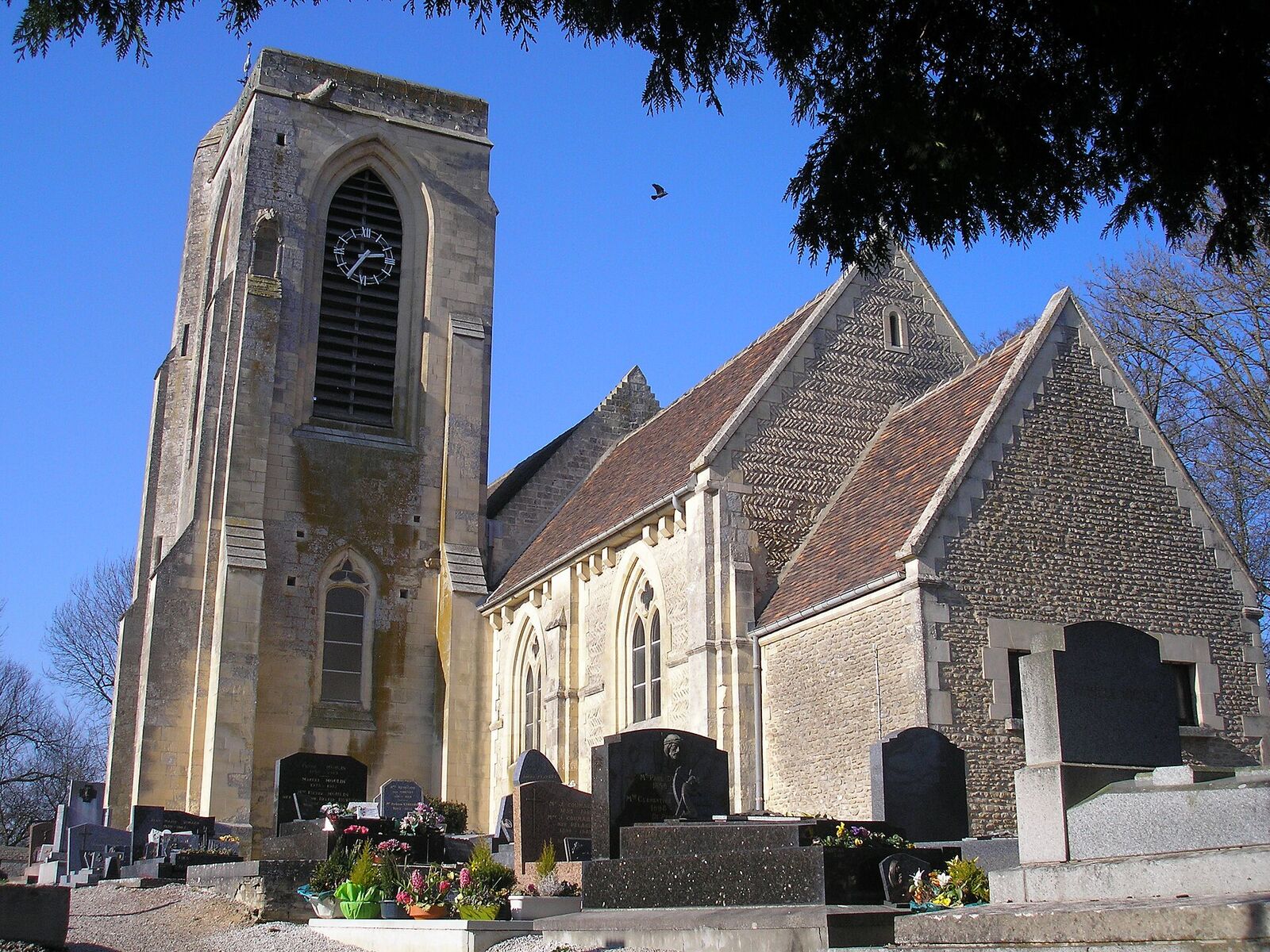
A village and walled wood north of Caen where British infantry of the 3rd Division fought a hard battle in mid-June 1944 to push the front toward the city. A Commonwealth war cemetery lies just outside the village.
Most visitors reach Cambes-en-Plaine on the quiet D-roads north of Caen, and the approach itself is the story. The land here is almost flat and open, broken only by a dark line of trees on the horizon: Cambes Wood. In June 1944 that wood was a walled enclosure held by German infantry, and the fields you drive across were the killing ground that men of the British 3rd Division had to cross on foot to take it.
The battle for the wood
Cambes was meant to fall quickly. It sat on the direct line from Sword Beach toward Caen, and the 3rd (United Kingdom) Infantry Division wanted it in the first days ashore. Instead the German counter-attack - armour of the 21st Panzer Division and, close behind, the young fanatics of the 12th SS - stiffened the whole front. A first British push into the village on 7 June had to be given up.
The serious attack came on 9 June, delivered by the 2nd Battalion, Royal Ulster Rifles. The wood was the enclosed park of a château, ringed by high stone walls that made it a natural fortress. To reach it the Rifles had to advance roughly a mile in the open from the direction of Anisy, across a gentle slope of waist-high summer corn that offered no cover at all. After a short bombardment - including the six-inch guns of the cruiser HMS Danae firing offshore - and with tanks of the East Riding Yeomanry in support, the companies walked forward into heavy shell and machine-gun fire. An armoured officer watching expected the attack to break; instead the infantry kept advancing in open order, holding their spacing, through what looked like an impassable barrage. They took the wood, but at a hard price: more than forty men of the battalion killed and well over a hundred wounded in a single afternoon, with one assault company losing all three of its platoon commanders.
Holding the wood proved almost worse than taking it. For close to a month Cambes was the front line, a shell-torn no-man's-land where the Rifles and their relieving battalions endured near-constant German artillery until the village was finally cleared during Operation Charnwood, the set-piece assault on Caen, on 8 July.
The war cemetery
On the edge of the village lies Cambes-en-Plaine War Cemetery, one of the smaller and less-visited Commonwealth burial grounds in Normandy - which is part of its quiet power. It holds 224 Second World War graves, almost all identified. The first burials were made as Operation Charnwood was actually in progress in early July, and more than half of the men here belonged to the 59th (Staffordshire) Division, chiefly the South and North Staffordshire regiments who fought toward Caen. The cemetery was designed by P. D. Hepworth, with the usual Cross of Sacrifice set back from a tree-lined approach.
What to see today
The wood still stands north of the village, and it repays a slow look: picture the flat, exposed fields around it as the ground the Rifles crossed upright, in daylight, into fire. In front of the cemetery, on the Rue du Mesnil Ricard, stands a memorial to the 2nd Royal Ulster Rifles who took the village on 9 June, and elsewhere in Cambes you will find monuments to the 59th (Staffordshire) and 3rd British Infantry Divisions who liberated it. Read the cemetery register in the entrance shelter before you walk the rows; the ages and the county regiments tell you plainly who paid for this unremarkable-looking patch of Normandy. Access is easy and the cemetery is always open, with parking close by - but come without a crowd, and the place speaks for itself.
Practical notes
The village lies in the lanes north of Caen, signed off the main road running up toward Douvres-la-Délivrande, and it is small enough to leave the car once and cover everything on foot. The cemetery entrance is on the Rue du Mesnil Ricard, beside the Royal Ulster Rifles memorial, and the other monuments are a few streets away in the village.
Half an hour is enough for the cemetery itself, and an hour if you also walk out toward the wood and stand in the fields the Rifles crossed. Go early or late if you can; the light across that flat ground does more for the story than any panel.
Inside the cemetery the going is easy: a firm path in from the gate and mown grass between the rows, level throughout, so a wheelchair or a pushchair manages it without trouble. Beyond the village the field edges and the track toward the wood are unsurfaced and can be muddy, and the wood itself is private ground best looked at from the roadside. For context, the Mémorial de Caen is fifteen minutes south and sets this small action inside the whole battle for the city, while Ardenne Abbey, where Canadian prisoners were murdered in the same days, is a similar distance west.