Asnelles
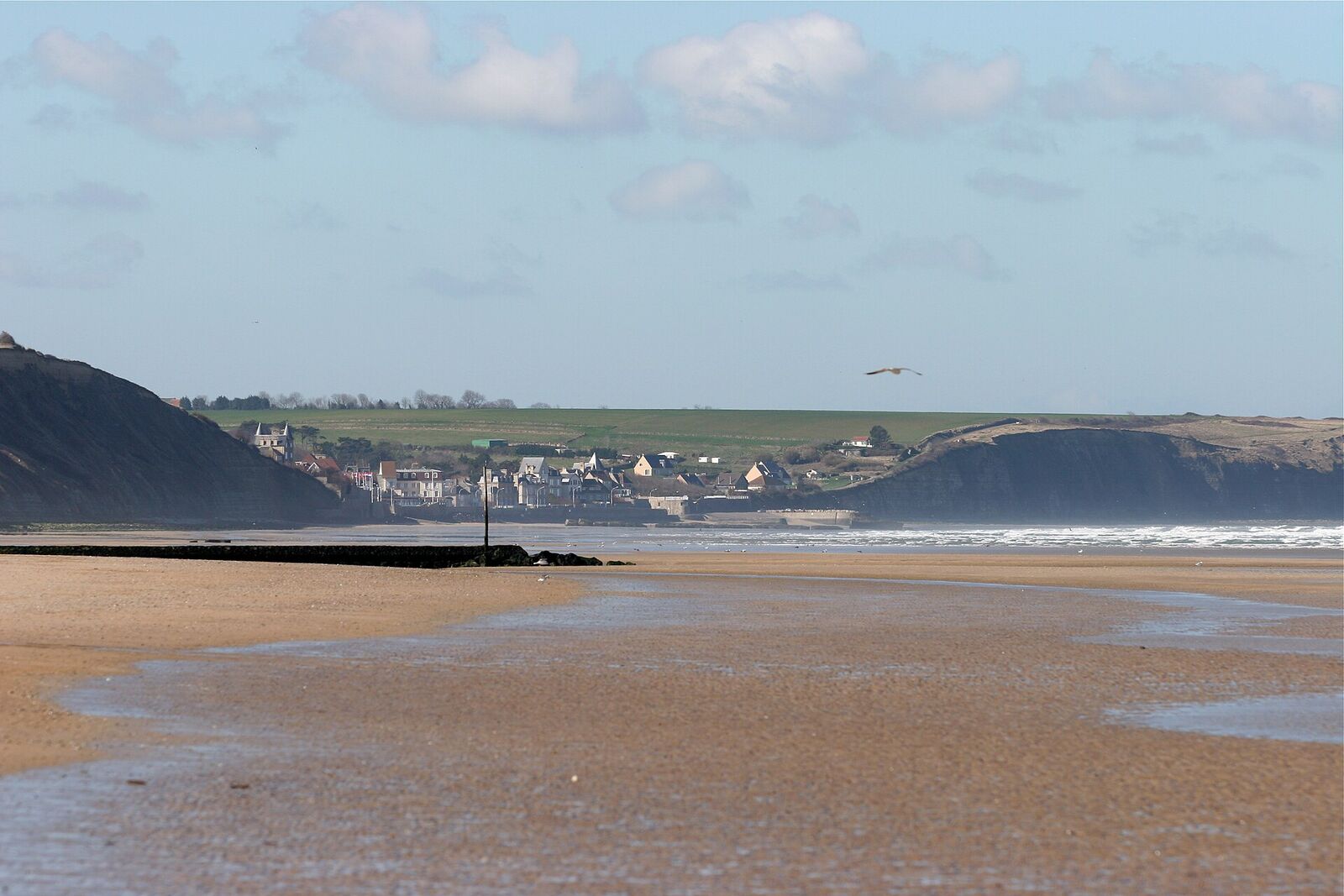
A seaside village at the eastern end of Gold Beach (Jig sector), liberated by the British 50th (Northumbrian) Division on D-Day. Remains of German bunkers still line the front, alongside memorials to the units that landed here and at neighbouring Le Hamel.
Asnelles sits at the point where Gold Beach turns from open sand toward the cliffs of Arromanches, and that geography decided its morning on 6 June 1944. This was the Jig sector, the western end of the British assault, and the ground here was overlooked by a German strongpoint that the pre-landing bombardment had failed to touch. What looks today like an unremarkable resort seafront was, for several hours, one of the harder-fought stretches of the whole invasion coast.
The morning of 6 June
The assault at Asnelles and neighbouring Le Hamel fell to the 231st Infantry Brigade, part of the 50th (Northumbrian) Division under Major-General Douglas Graham. The brigade - the 1st Hampshires, the 1st Dorsets and the 2nd Devons, led by Brigadier Sir Alexander Stanier - came ashore from around 07:30, the leading battalions wading in against a rough sea and a rising tide that squeezed the beach and crowded the assault together.
The trouble was Le Hamel. A fortified position built into and around a former children's tuberculosis sanatorium, known to the Germans as Widerstandsnest 37, had survived the naval and air bombardment largely intact. Its heaviest weapon, a gun set in a thick concrete casemate at the eastern end of the sanatorium, was sited to fire not out to sea but straight along the length of the sand. It raked the incoming waves of infantry and knocked out a string of armoured vehicles as they came ashore. The 1st Hampshires, pushing directly against it, took some of the heaviest casualties of any British battalion that day.
Because the casemate could not be beaten from the front, the position was eventually taken from behind. Infantry worked inland and looped back toward the coast, and a Churchill AVRE - one of the specialised armoured vehicles designed for exactly this kind of work - closed in on the strongpoint from the rear and fired its short Petard mortar, the "Flying Dustbin," through the casemate's back opening at point-blank range, wrecking the gun. Only in the mid-afternoon did Le Hamel finally fall. The delay cost lives, but by evening the brigade had its foothold and was pushing inland toward Arromanches, where the Mulberry harbour would soon be built.
What to see today
Asnelles rewards visitors who slow down and look. The great grey casemate of Widerstandsnest 37 still stands on the seafront at Le Hamel, its walls scarred, its embrasure angled down the beach exactly as it was in 1944 - stand behind it and the reason for the carnage on the sand is immediately, uncomfortably clear. Other concrete emplacements and fragments of the German line survive along the front, easy to walk straight past if you do not know to look.
Along the sea wall are the memorials the story deserves. One marks the 231st Brigade as the first troops to land here, listing the Devon, Hampshire and Dorset regiments and their onward march through France, Belgium and Holland. A separate memorial nearby honours the South Wales Borderers. Take a moment, too, at low tide to look out to sea toward Arromanches, where the rusting concrete Phoenix caissons of the artificial harbour still break the water.
Beyond the beach
Asnelles carries a quieter piece of Free French history as well. Maurice Schumann - the broadcaster whose voice carried de Gaulle's appeals to occupied France over the BBC, and who came ashore in this sector - chose to be buried in the village. His grave is a reminder that the men who landed here were fighting to hand France back to the French. Behind the front, the twelfth-century church of Saint-Martin and the old seaside villas hint at the resort Asnelles was before the war, and has quietly become again.
Practical notes
Asnelles is on the D514 coast road, and the part you want is Le Hamel, the western end of the seafront where the road runs closest to the sand. There is free parking along the front and a larger area near the beach access, and the great casemate is a couple of minutes' walk from either. Coming from Arromanches the road drops down off the cliff into the village, which is the approach that makes the geography clearest.
An hour is plenty: half of it at the casemate and the memorials on the sea wall, half on the beach itself. The promenade and the sea wall are level and paved, so the memorials and the view along the sand are easy with a wheelchair or a pushchair, and there are benches. The bunker itself sits on sand and rough ground with an uneven approach, and the beach is soft above the tideline, so anyone on wheels will do better staying on the front. As with all of this coast, low tide is when the ground reads properly.
The obvious continuation is west along the shore to Arromanches for the harbour caissons the men here were fighting to make possible, or east along Gold Beach to the British Normandy Memorial above Ver-sur-Mer, where the names of the dead of this brigade are recorded.